On August 6, 2026, Japan’s FSA and National Police Agency asked the JVCEA to roll out 11 fraud-prevention measures, including withdrawal delays after deposits and mandatory waiting periods fo
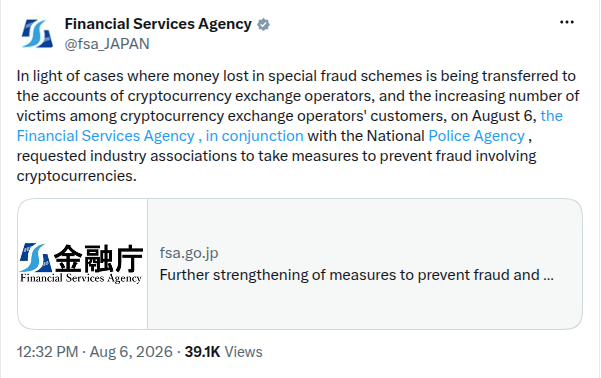
On August 6, 2026, Japan’s FSA and National Police Agency asked the JVCEA to roll out 11 fraud-prevention measures, including withdrawal delays after deposits and mandatory waiting periods for new withdrawal addresses, aimed at stopping scam proceeds from moving through crypto exchanges. It’s a request, not binding law, and no penalty for non-compliance has been disclosed. A similar informal request in 2021 over Japan’s crypto Travel Rule was later folded into binding industry self-regulatory rules within thirteen months. Nothing guarantees this request follows the same path on the same timeline.
 Japn Financial Service Agency
The 11-item list covers the account lifecycle end to end: tighter checks when an account is opened, a waiting period before customers can withdraw crypto after depositing fiat or buying an asset, and a mandatory delay before newly registered withdrawal addresses can be used. The trigger, according to the agency’s own notice, is a rise in cases where proceeds from Japan’s “special fraud” schemes, investment scams and romance scams run through social media, end up routed through crypto exchange accounts.
What the FSA Actually Asked For
Beyond withdrawal restrictions and address registration, exchanges are also asked to set withdrawal limits based on customer risk profile, strengthen transaction and access monitoring, and move faster to freeze accounts once a suspicious pattern is detected. The list also asks exchanges to verify that a bank transfer’s sender name matches the crypto account holder’s name, and to share fraud-detection information both across exchanges and with police. The request applies to every registered exchange regardless of size. Smaller operators that lack the systems for immediate implementation get a phased rollout, not a pass.
A Request, Not a Rule
The notice doesn’t say what happens to an exchange that reads all 11 items and does nothing. Japan’s Payment Services Act sets binding registration, custody, and AML requirements for crypto exchanges, but this notice isn’t an amendment to that law. It’s addressed to JVCEA, the exchanges’ self-regulatory body, not to individual exchanges directly, using the same soft-request language FSA has deployed for years when it wants industry movement without going through the Diet.
That gap matters more than it looks. A separate amendment to the Financial Instruments and Exchange Act (FIEA) raised criminal penalties for unregistered crypto operators, pushing the maximum prison term from three to ten years, and took effect one to two days before this notice, around August 4-5. That puts this request in a different legal category entirely from the criminal statute now facing unregistered platforms like Bitget, which announced its Japan exit days earlier. The August 6 request targets already-registered, compliant exchanges, and carries no comparable enforcement language.
Unregistered Operators (Bitget, etc.)Registered Exchanges (this request)Legal formFIEA criminal statuteInformal request to JVCEAPenaltyUp to 10 years imprisonmentNone disclosedEffective~Aug 4-5, 2026Aug 6, 2026 (request issued)
The Same Mechanism, Run Before
FSA has used a request to JVCEA to move an industry standard without new legislation before. FSA sent JVCEA a similarly informal request in March 2021, the same instrument used here, asking it to introduce self-regulatory rules for Japan’s crypto Travel Rule, the AML standard requiring exchanges to share sender and receiver information on transfers. JVCEA folded that into binding self-regulatory rules by around April 2022, roughly thirteen months later.
JVCEA membership is a practical requirement for operating a registered exchange in Japan; a self-regulatory rule JVCEA adopts becomes something its members have to comply with to keep that standing. Read against the Travel Rule case, this August 6 request is the opening move in a sequence FSA has run before: request now, JVCEA rule later, no Diet vote required in between. FSA ran this exact playbook successfully in 2021. There’s no legal guarantee JVCEA moves as fast this time, and the request could just as easily stall if the political pressure driving it, this month’s fraud headlines, fades before JVCEA acts.
A Pattern of Asking
This request isn’t isolated within FSA’s own recent behavior. Earlier this year, the agency separately asked financial institutions, banks, not exchanges, to strengthen monitoring of transfers into crypto accounts and halt transfers where the sender’s name doesn’t match the account holder’s. That’s the same sender/holder-name check that now appears as item 9 on this August 6 list, extended to the exchange side of the same transaction. In November 2025, FSA separately signaled plans to require exchanges to hold liability reserves for hack and fraud losses, with legislation expected in the 2026 ordinary Diet session. That’s a different, capital-focused fix aimed at a different problem: compensating victims after losses occur, not restricting withdrawals before they can.
Timeline
- March 2021: FSA sends JVCEA an informal request on Travel Rule self-regulation.
- April 2022: JVCEA adopts binding self-regulatory rules implementing that request.
- Earlier in 2026: FSA asks banks to strengthen monitoring of transfers into crypto accounts.
- August 6, 2026: FSA and NPA jointly request 11 fraud-prevention measures from JVCEA.
Whether JVCEA Turns This Into a Rule
The next test of this request is whether JVCEA converts it into binding self-regulatory rules, as it did with the Travel Rule. A formal rule amendment within the next twelve to eighteen months would confirm FSA is running the same playbook. If that window passes with only exchange-level policy adjustments, the request stays an unenforced ask. JVCEA has not issued a public response detailing its implementation timeline. Separately, the liability-reserve bill FSA has signaled for this Diet session takes a different regulatory path: unlike this request, it would create a binding legal requirement if enacted.
FAQ
Is this request legally binding? No. It’s a formal request to JVCEA, Japan’s crypto industry self-regulatory body, not an amendment to the Payment Services Act or any other binding statute.
Which exchanges does it apply to? The request covers the full JVCEA membership, roughly 27 to 30 registered Crypto-Asset Exchange Service Providers in Japan, with no carve-out by exchange size.
What happens if an exchange doesn’t comply? FSA hasn’t spelled out any consequence for exchanges that skip these measures. The 2021 Travel Rule precedent shows requests like this one can become binding through JVCEA’s own self-regulatory rules. That outcome isn’t guaranteed on any fixed timeline here.
