Key Takeaways: JTO spiked 26% in seven days, driven by a Bitget staking event and anticipation around the JTX platform launching in July 2026 JTX will direct 80% of protocol revenue to open-m
Key Takeaways:
- JTO spiked 26% in seven days, driven by a Bitget staking event and anticipation around the JTX platform launching in July 2026
- JTX will direct 80% of protocol revenue to open-market JTO buybacks — the first direct value mechanism for token holders
- Annual token emissions of $96M–$128M still outpace projected buybacks of $19M–$30M
Jito (JTO), the governance token of one of Solana’s most deeply embedded infrastructure protocols, recorded a sharp price surge between June 15 and 16, 2026 — moving from around $0.55 to an intraday high of $0.79 before settling near $0.71 at publication time. The 24-hour trading volume exceeded $248 million, a multiple of its recent average. The seven-day gain of 18.7% placed JTO among the more notable moves for assets with a market capitalization above $300 million in that period. Three distinct factors are behind the move: a short-term liquidity event on Bitget, a structural change to the token’s economic design, and the announced launch of a consumer-facing product that would represent a significant directional shift for the project.
The Bitget Event: How Staking Lockups Move Prices
The immediate trigger for the sharpest part of the spike was a PoolX event on Bitget, which offered a 35,000 JTO reward pool to users who staked BGSOL during a fixed window. The mechanism is straightforward: when a meaningful portion of circulating supply gets locked into a staking contract for a short period, the available float on the secondary market contracts. Any incoming buy pressure — even at relatively modest volumes — then meets thinner order books, which amplifies upward price movement. These events rarely produce durable price levels on their own, but they can accelerate moves that are already being driven by broader fundamental changes. In this case, the staking event coincided with a period of rising market discussion around Jito’s product roadmap, which likely contributed to the scale of the move.
What JTX Actually Is — and Why It Changes Jito’s Economic Position
Until now, Jito has operated primarily as invisible infrastructure. Its MEV-optimized validator client processes roughly 90% of Solana’s active stake, and its liquid staking product JitoSOL holds approximately $2.4 billion in assets under management — a figure that has held relatively stable even as JTO’s price fell from historical highs of $6.01 in late 2023 to its current sub-dollar levels.
The protocol captures a significant share of Solana’s Real Economic Value through MEV tips — according to Blockworks’ Solana Financial Income Statement, Jito tips accounted for $10.5 million of the $43.2 million in total REV recorded in the most recent quarter, or roughly 25-30% of the network’s economic output. That share is lower than the 41.6%–66% range cited in the Helius H1 2025 Ecosystem Report, a decline the Solana Foundation attributes to microstructural improvements that reduced the network’s dependence on out-of-protocol tips. Either way, that revenue has historically flowed to stakers and validators rather than to JTO token holders in a direct, measurable way.
JTX introduces a direct revenue mechanism that did not exist before. The platform is being developed as a self-custodial, non-custodial onchain trading application targeting experienced retail traders who currently use centralized exchanges. It will launch with spot trading and add perpetual futures and prediction markets in subsequent phases. The economic design directly connects platform activity to JTO: 80% of all trading fees generated by JTX will fund open-market buybacks of the token. The remaining 20% goes to the DAO treasury, which under governance proposal JIP-24 already receives 100% of Block Engine fees.
The Jito Foundation has also formally relocated its operations back to the United States, citing clearer regulatory frameworks for digital assets, and announced institutional partnerships in the Asia-Pacific region aimed at establishing JitoSOL as a default collateral layer for institutional liquid staking.
JITO PROTOCOL — KEY METRICS (JUNE 2026)MetricValueValidator Client Market Share~90% of active Solana stakeJitoSOL Assets Under Management~$2.4 BillionShare of Solana Real Economic Value (MEV Tips)25% –30%Projected Annual Protocol Buyback (JTX revenue)$19M – $30MAnnual Token Emissions$96M – $128MBlock Engine Fee Distribution (JIP-24)100% → DAO Treasury
The Supply Overhang That the Buybacks Don’t Fully Address
The projected $19M–$30M in annual buybacks from JTX revenue needs to be read alongside annual token emissions in the range of $96M–$128M. Jito issues tokens continuously to incentivize validators, stakers, and protocol participants — a standard design for infrastructure protocols, but one that creates persistent net inflation in the token supply. Even at the upper end of buyback projections, the net effect remains dilutive for existing holders. Additionally, vesting schedules for early investors and core contributors continue running through December 2026, generating regular multimillion-dollar unlock events that add secondary market supply.
JTX Against Hyperliquid: A Structural Comparison
Jito Labs has positioned JTX as a competitor to Hyperliquid, the dominant decentralized perpetuals platform:
JTX vs. HYPERLIQUID — ARCHITECTURAL COMPARISONFeatureJito JTXHyperliquidArchitectureApp-layer on Solana L1Sovereign L1 AppchainExecution EngineJito BAM / Block Engine (~200ms)Custom Tendermint consensusOrder BookOnchain / hybridNative decentralized onchainAsset UniverseSolana ecosystem focusBroad, cross-chainRevenue Model80% → JTO buybacksStays within HYPE ecosystemMaturityLaunching July 2026Established, billions in daily volume
Hyperliquid operates on a sovereign Layer-1 blockchain built specifically for high-frequency order book matching. Because it does not share block space with NFT minting, meme coin launches, or other Solana ecosystem activity, it can consistently process tens of thousands of trade messages per second with minimal latency variance. JTX runs on top of Solana’s shared L1, which gives it access to the full Solana liquidity ecosystem and native integration with JitoSOL, but also means execution quality is partially dependent on network conditions at any given moment.
Jito’s BAM (Block-Analytic-Matrix) client has expanded to 28% of native Solana stake and has brought block engine auction intervals down to approximately 200ms — competitive for most retail trading purposes, but a different category than a purpose-built trading chain.
“We’re targeting the pro retail, prosumer trading audience on Solana. We feel there’s a gap there. A lot of the tools people use today are made for an older era on Solana. The assets people are trading are different now than what they used to be.”
— Jito Labs CEO
He added that the platform is explicitly going after users on centralized exchanges and traders migrating from other chains.
The economic model difference is also significant: Hyperliquid’s revenue primarily compensates validators and stakers securing its own chain, while JTX’s design explicitly directs the majority of fees toward token buybacks.
Technical Picture: RSI Neutral, Price Above 50-Day SMA
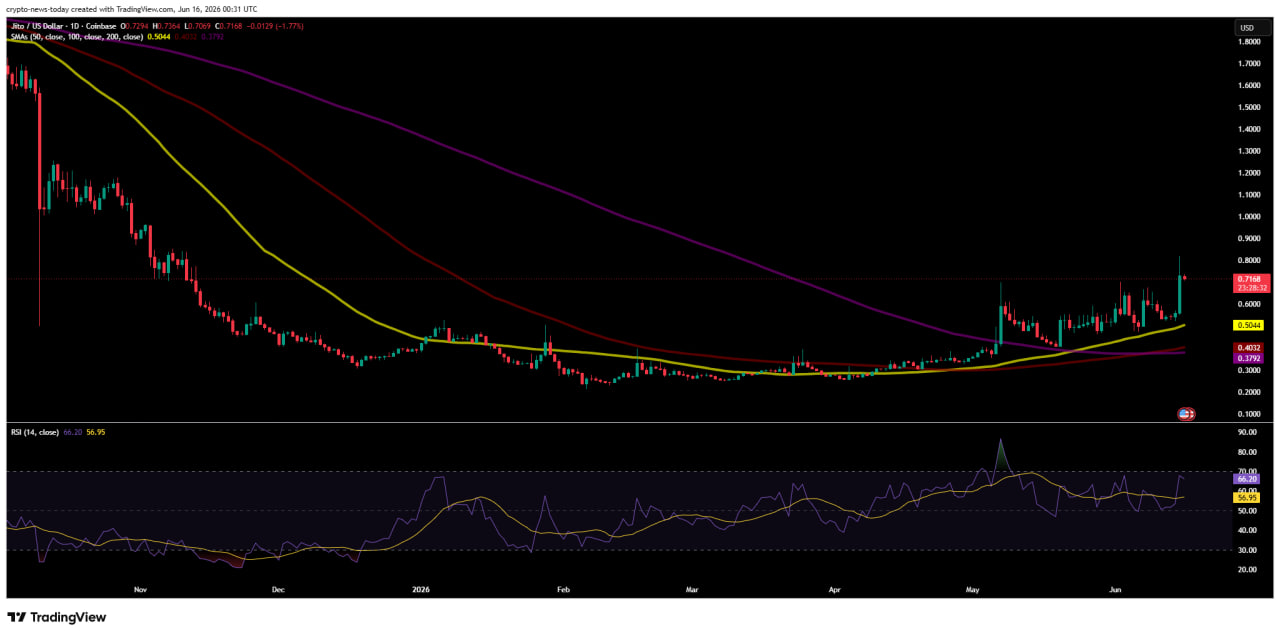
The daily chart on Coinbase (June 16, 2026) shows JTO at $0.7168, having crossed above the 50-day simple moving average of $0.5044 during the surge. The RSI (14) reading of 66.20 is approaching but not yet in overbought territory. The 100-day and 200-day SMAs remain at $0.4032 and $0.3792 respectively, meaning the current price sits above all three moving averages — an unusual configuration for an asset that spent most of the past six months in a slow decline.
 .
.
The post Jito JTX Explained: What’s Behind the JTO Token Surge appeared first on Coindoo.