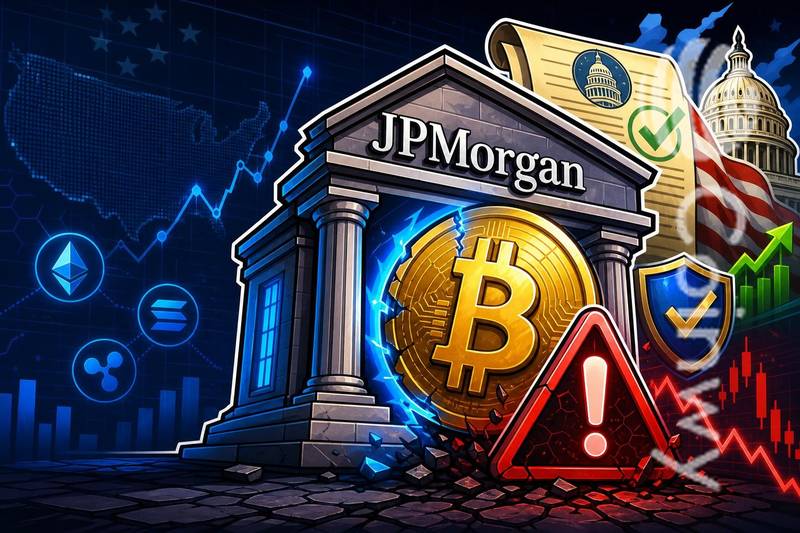
JPMorgan has voiced support for a U.S. crypto market structure bill while repeatedly warning that gaps in the broader digital asset framework could expose markets, financial institutions, and
JPMorgan has voiced support for a U.S. crypto market structure bill while repeatedly warning that gaps in the broader digital asset framework could expose markets, financial institutions, and regulators to significant risk.
The bank's position, reported by CoinDesk on June 29, marks a notable moment in the U.S. crypto policy debate. JPMorgan is the largest bank in the United States by assets, and its willingness to back crypto legislation signals that traditional finance sees a regulated digital asset market as both viable and necessary. For related coverage, see Marathon Digital weighs AI/HPC shift amid BTC sales.
The endorsement is not unconditional. JPMorgan paired its support with pointed warnings about weaknesses in the current regulatory framework, suggesting that passing a bill without addressing structural flaws could create new vulnerabilities rather than resolve existing ones. For related coverage, see JPMorgan Files Second Tokenized Fund on Ethereum.
What Risks JPMorgan Sees in the Digital Asset Framework
JPMorgan's concerns center on the gap between supporting a single piece of legislation and building a coherent regulatory architecture around digital assets. The bank has consistently argued that crypto oversight needs to account for systemic risks, not just market access. For related coverage, see eToro Reaffirms Crypto Commitment Despite Lower Q1 Activity.
This is not the first time the bank has flagged specific dangers. In early 2026, JPMorgan's CFO compared the stablecoin yield debate to a parallel banking system, warning that interest-bearing stablecoins could undermine traditional deposit structures without equivalent regulatory safeguards.
CEO Jamie Dimon reinforced that stance in March, arguing that stablecoin issuers paying interest should face the same regulations as banks. The through line is clear: JPMorgan wants crypto regulation, but it wants that regulation to protect the competitive position of licensed financial institutions.
Earlier in June, the bank warned that time was running short for lawmakers to pass a crypto market structure bill, framing the legislative window as a narrowing opportunity that Congress could miss entirely.
What the Position Means for U.S. Crypto Policy
When a bank of JPMorgan's size backs a crypto bill, it gives lawmakers political cover to move forward. Regulatory skeptics in Congress can point to institutional support as evidence that the legislation is not a concession to an unregulated industry but a step toward bringing digital assets into existing financial guardrails.
At the same time, JPMorgan's warnings create pressure to amend or strengthen the bill before passage. The bank's dual message, support the structure but fix the gaps, could slow the legislative process as committees work to address the concerns of both crypto advocates and traditional finance.
JPMorgan's own activity in the digital asset space adds context to its policy stance. The bank has filed to launch tokenized funds on Ethereum, positioning itself to operate within whatever framework Congress creates. Its regulatory preferences are shaped in part by its own strategic interests in tokenized financial products.
The bank's crypto involvement has not been without controversy. JPMorgan has also faced a class action lawsuit over a $328 million crypto Ponzi scheme, underscoring the risks that exist even for established institutions operating near the digital asset ecosystem.
For crypto-native firms and traditional financial institutions alike, JPMorgan's conditional endorsement reinforces one takeaway: the U.S. is moving toward a regulated crypto market, but the final shape of that regulation remains contested. The bill's passage, if it happens, will likely reflect compromises driven as much by Wall Street's risk concerns as by the crypto industry's push for clarity.
Disclaimer: This article is for informational purposes only and does not constitute financial or investment advice. Cryptocurrency and digital asset markets carry significant risk. Always do your own research before making decisions.
Read original article on coinwy.comRead also :