JPMorgan analysts said a delayed U.S. crypto market structure bill could weaken public blockchain networks by allowing tokenization to migrate onto traditional financial infrastructure instea
JPMorgan analysts said a delayed U.S. crypto market structure bill could weaken public blockchain networks by allowing tokenization to migrate onto traditional financial infrastructure instead.
In a Wednesday research note led by Nikolaos Panigirtzoglou, the bank said the longer the Senate delays the Digital Asset Market Clarity Act, the greater the risk that "tokenization and blockchain-based applications eventually [are] absorbed by incumbent market infrastructure rather than accruing to public crypto networks."
The bank argues that regulatory uncertainty could encourage institutions to keep tokenization within existing financial infrastructure instead of building on open blockchain networks.
Related: Vanguard fund adds millions to Peter Thiel-backed company
Warning comes as Wall Street accelerates tokenization efforts
On July 15, the Depository Trust & Clearing Corporation (DTCC) announced a pilot with nearly 40 firms, including JPMorgan, BlackRock, Goldman Sachs, Vanguard and the New York Stock Exchange, to tokenize stocks and U.S. Treasurys held in DTCC custody.
Many Wall Street tokenization projects currently rely on private, permissioned blockchain networks.
JPMorgan believes clearer crypto rules could encourage institutions to use public blockchain infrastructure instead, bringing more trading activity and liquidity to public crypto networks rather than keeping it within traditional financial systems.
Citi estimates the global tokenized financial asset market, currently worth about $17 billion, could reach $5.5 trillion by 2030 in its base-case scenario, driven primarily by public equities and government debt rather than private markets.
The bank, however, said improving regulation and institutional infrastructure are key catalysts for adoption.
Source:
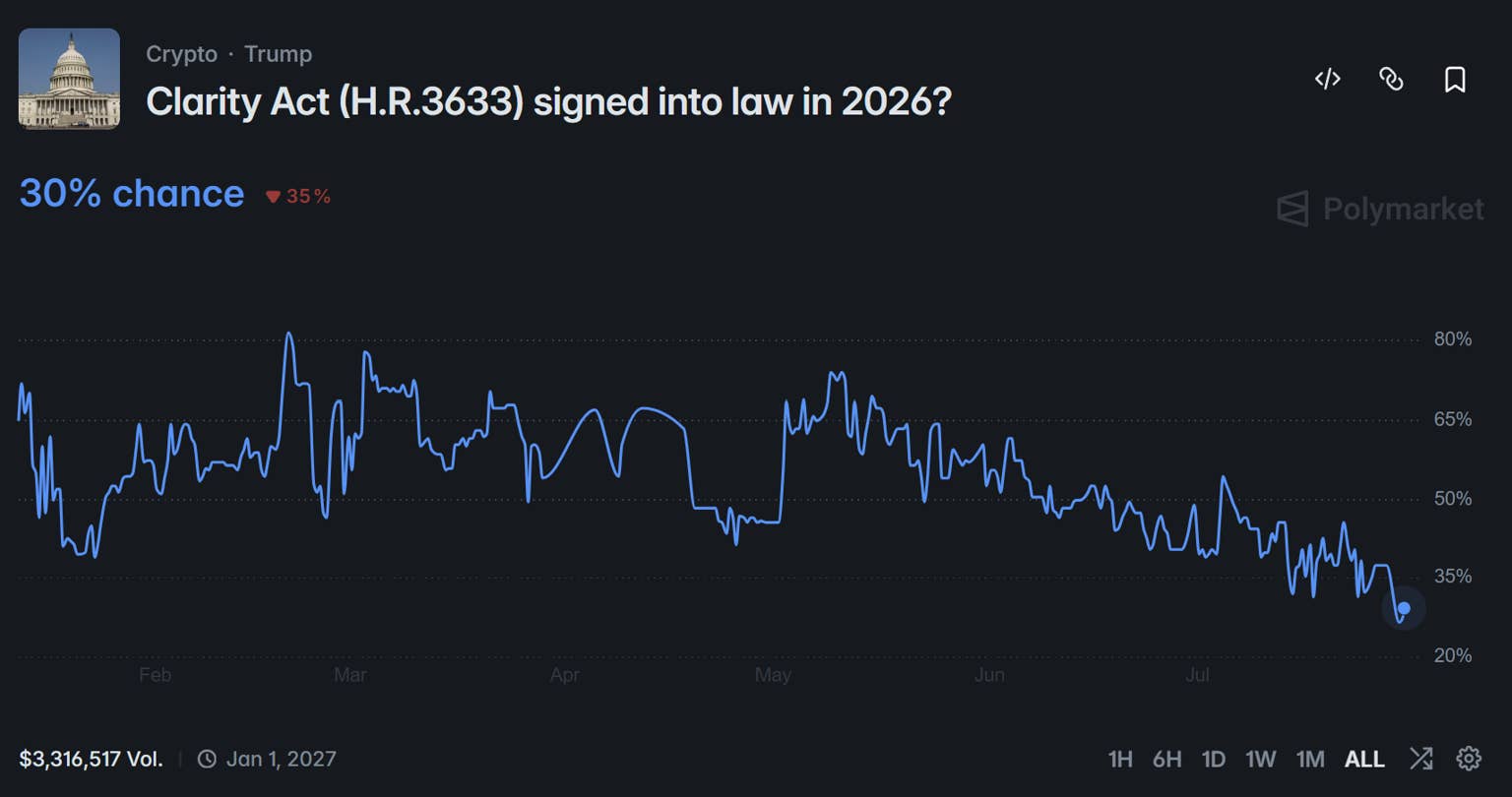
Polymarket Meanwhile, prediction market Polymarket currently assigns roughly a 30% chance that the Clarity Act will become law before the end of 2026.
Wall Street and crypto firms urge Senate to move forward
The Clarity Act would divide oversight of digital assets between the Securities and Exchange Commission and the Commodity Futures Trading Commission, creating a clearer regulatory framework for tokenized assets, crypto intermediaries and decentralized finance.
Support for the bill has broadened across both traditional finance and the crypto industry in recent weeks.
Trending on TheStreet Roundtable:
BlackRock, the world's largest asset manager, called the legislation "an important step toward establishing a regulatory framework for digital assets that puts investors first."
On July 24, Fidelity said the Senate should pass the bill because "clear rules of the road" are essential to strengthen investor confidence, provide certainty for market participants and reinforce U.S. leadership in digital asset markets.
Franklin Templeton also urged lawmakers to act, saying the legislation would clarify "how crypto is regulated" and ensure firms know "which regulators they answer to."
Goldman Sachs CEO David Solomon has also endorsed the proposal last week, saying that while the bill "is not perfect," he is "very supportive of moving the CLARITY Act forward, so we can get some market structure in place and start to move the innovation process along."
The Senate is scheduled to begin its summer recess on Aug. 8, leaving lawmakers with only a handful of legislative days to advance the bill before the break.
Related: Analyst cuts Circle stock price target ahead of earnings