JPMorgan Chase says investors are stepping back from one of this year's most popular trades, and both Bitcoin (BTC) and gold are feeling it. For most of 2026, the logic was pretty simple. Con
JPMorgan Chase says investors are stepping back from one of this year's most popular trades, and both Bitcoin (BTC) and gold are feeling it.
For most of 2026, the logic was pretty simple. Conflict in the Middle East pushed oil prices higher, which led to inflation fears creeping back in. Investors moved capital into assets that hold value when currencies don't.
Meaning, they bought gold and Bitcoin. They called it the debasement trade.
Related: Jamie Dimon issues stark warning on the job market as AI freezes hiring
However, that trade now seems to be losing steam.
In a research note published May 28, JPMorgan analysts led by managing director Nikolaos Panigirtzoglou flagged simultaneous outflows from both Bitcoin and gold ETFs, alongside weakening positions in CME futures tied to both assets.
Panigirtzoglou was clear this is not a rotation. Investors are not selling Bitcoin to buy gold, or the other way around. They are stepping away from both at the same time.
"Bitcoin had been the main manifestation of the debasement trade since the start of the Iran conflict," JPMorgan said, as reported by Coindesk.
Understanding the number play
To understand why this reversal matters, it helps to see how strong the trade had become.
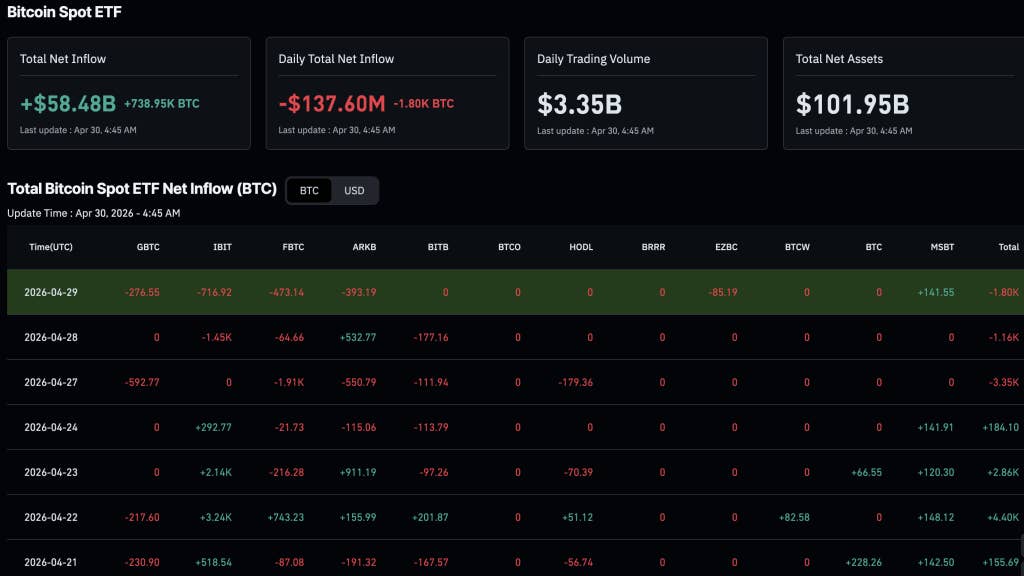
According to CoinGlass data, Bitcoin ETFs logged inflows for three consecutive months: $1.32 billion in March, $2.44 billion in April, the strongest monthly figure of the year.
Source: CoinGlass
Gold ETFs, meanwhile, told a different story. After heavy outflows in March, global gold ETFs staged a sharp recovery in April, pulling in $6.6 billion across all regions, according to the World Gold Council, lifting total holdings to 4,137 tonnes and assets under management to $615 billion.
Europe led the charge with $3.7 billion in inflows, while North America contributed $1 billion.
Most Popular on TheStreet Roundtable:
Both assets, in other words, were attracting capital through April. The debasement trade was significantly broadening.
But May changed the whole picture.
According to SoSoValue, U.S. spot Bitcoin ETFs have recorded $2.07 billion in net outflows in May alone, the largest monthly exit of 2026.
In fact, these Bitcoin ETFs recorded $733.43 million in net outflows on May 27 alone, with BlackRock's IBIT leading the exit at $527.84 million, followed by Grayscale's GBTC at $104.76 million and Fidelity's FBTC at $60.30 million.
Total net assets across all U.S. spot Bitcoin ETFs now stand at $96.45 billion, representing 6.40% of Bitcoin's total market cap.
Gold ETFs are moving in the same direction over the same period, which JPMorgan said is consistent with a broad macro unwind rather than any asset-specific concern.
The debasement trade, at its core, is a bet that government money is losing value. When investors fear inflation, rising debt, or geopolitical instability, they move into assets with limited supply, gold historically, and more recently Bitcoin.
Gold and Bitcoin tend to benefit when that fear is loud. They suffer when it goes quiet.
Why investors are pulling back
JPMorgan pointed to one likely cause: easing expectations around the conflict between the United States and Iran.
According to Panigirtzoglou's note, investors appear to be positioning ahead of a potential diplomatic agreement between the United States and Iran.
If tensions ease, the inflation and geopolitical anxieties that made both assets attractive hedges lose their grip, and so does the trade built around them.
For now, the fear trade is quiet. Whether it stays that way depends on what happens next between Washington and Tehran.
Related: Michael Burry drops bombshell on SpaceX, OpenAI IPOs