In its first long-term forecast for the cryptocurrency, J.P. Morgan Asset Management anticipated bitcoin will deliver a compounded annual return of 10% over the next decade. The figure, publi
In its first long-term forecast for the cryptocurrency, J.P. Morgan Asset Management anticipated bitcoin will deliver a compounded annual return of 10% over the next decade.
The figure, published in the bank’s 2027 Long-Term Capital Market Assumptions on Oct. 19, is above U.S. stocks, gold and REITs.
This year’s 31st edition is the first to put a range on bitcoin returns.
Bitcoin’s bear case sinks to -11.2% as the bull case hits 16.6%
Bitcoin’s 10% is the highest return in the separate table JPMorgan built to compare it with 12 common investments, from stocks and bonds to gold and cash.
JPMorgan put yearly return forecasts on four traditional investments over 10 to 15 years.
Big U.S. companies get 7.5% and smaller ones 7.7%. Real estate investment trusts get 8.2%, and gold 5.5%.
Bitcoin’s forecast beats big U.S. companies by 2.5 percentage points. Over gold, the lead is 4.5 points.
The 10% is a base case. JPMorgan’s analysis indicates the bear case for bitcoin is a 10-year annualized return of -11.2%, and the bull case is 16.6%, based on a spot price of $83,000 as of Sept. 30.
Bitcoin supply growth relative to money supply is weighted 65%, gold-complement case 30%, and network adoption 5%.
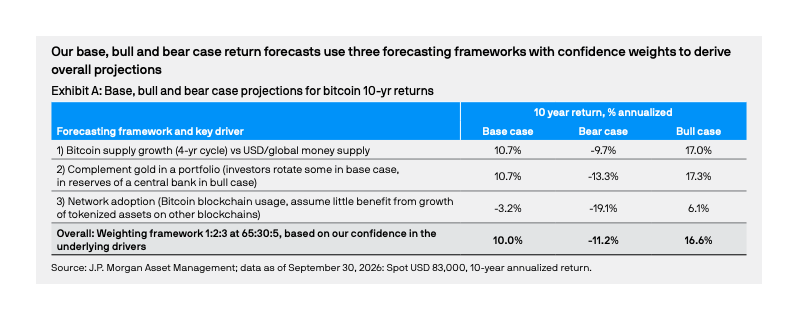
Base, bear and bull case projections for bitcoin’s 10-year returns, with data as of September 30, 2026, in J.P. Morgan Asset Management’s 2027 Long-Term Capital Market Assumptions
report.
A traditional 60/40 stock/bond portfolio has a 7% annualized return. The bank ascribed it to productivity gains from AI, corporate profitability and higher bond yields.
The report spans more than 200 asset classes. Authors Dr. Sheena Shah and Dennis Cristallo described bitcoin (BTC) as the anchor of the crypto ecosystem, citing liquidity, longevity and improving regulatory clarity.
A 55% volatility reading shuts BTC out of the main covariance matrices
JPMorgan has pegged bitcoin’s annualized volatility at 55%. The figure is about three times that of gold, at 17.2%, or U.S. large caps, at 18%.
The arithmetic average return of Bitcoin is 20.9% per year, well above the compounded figure of 10%.
Compounded returns incorporate losses that reduce subsequent gains. The compounded number is considerably lower than the simple average because of high volatility.
Volatility and unstable correlations kept bitcoin out of the bank’s main covariance matrices, the models that measure how asset prices move together. Instead, JPMorgan constructed a separate, smaller matrix that compared bitcoin with a subset of assets.
JPMorgan said it could add bitcoin to its main models later. That would take calmer prices, steadier links to other assets, clearer rules and deeper markets.
BlackRock’s IBIT saw $665.16 million in inflows on Monday, October 19, the highest single-day inflow since October 2025, reported Cryptopolitan. U.S. spot bitcoin ETFs combined netted $526.6 million as bitcoin hovered between $82,000 and $83,000.
Bitwise CIO Matt Hougan welcomed the inclusion but said the estimate of 55% volatility was too high given bitcoin’s narrowing price swings over the last 15 years. “First they ignore you, then they laugh at you, then they fight at you, then they add you to their Long-Term Capital Markets Assumptions paper and predict you’ll be the best-performing asset of the next decade,” he wrote on X.
In his weekly memo, Hougan has explained bitcoin wins on all economic outcomes. He wrote, “all of them lead to Bitcoin.”
“Wall Street is doing the math,” said Strategy Chairman Michael Saylor on X.
The bank said bitcoin exposures should be closely examined and any portfolio holding it should be stress tested against bull and bear scenarios.
If you're reading this, you’re already ahead. Stay there with our newsletter.