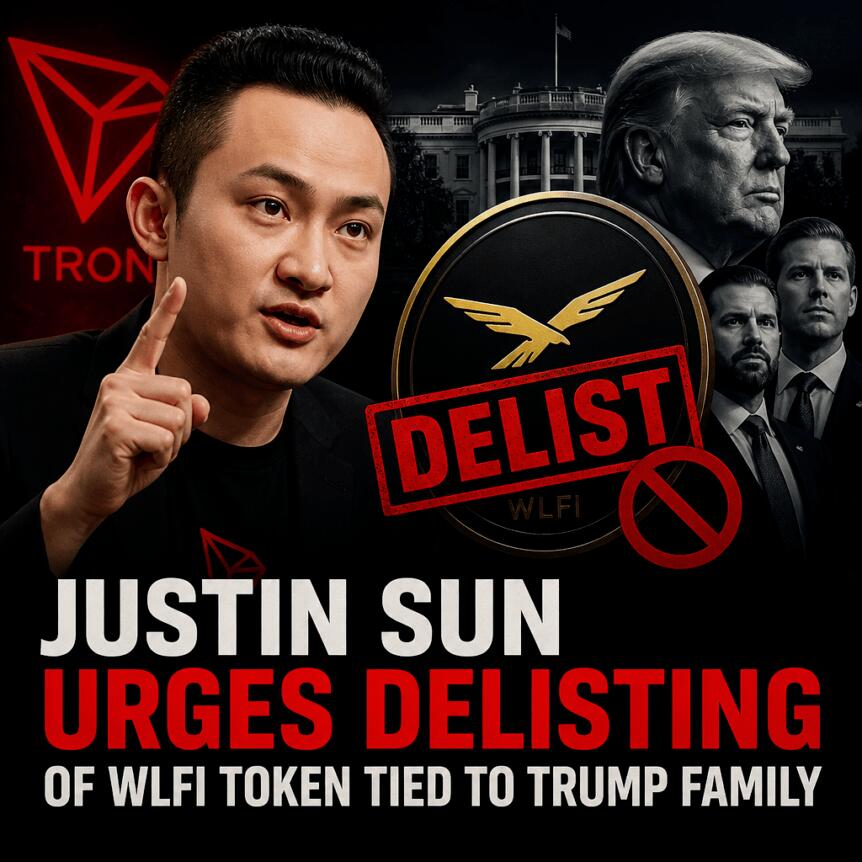
Tron founder Justin Sun has escalated his public dispute with World Liberty Financial by urging crypto exchanges to delist the platform’s WLFI token and impose tighter controls on any remaini
Tron founder Justin Sun has escalated his public dispute with World Liberty Financial by urging crypto exchanges to delist the platform’s WLFI token and impose tighter controls on any remaining activity.
In an X post dated Saturday, Sun said exchanges should remove WLFI from their listings and also consider issuing warnings to users, restricting deposits, and demanding clearer disclosures about what happened to funds tied to the token.
Key takeaways
- Justin Sun called for WLFI to be delisted and proposed additional exchange measures such as deposit restrictions and user warnings.
- WLFI reportedly dropped sharply over a 24-hour period, falling to about $0.01923 at the time of writing, according to CoinGecko.
- The market shock coincided with a reported sale of roughly $20 million in crypto from a World Liberty strategic reserve wallet, according to Lookonchain.
- The dispute sits within a broader legal conflict: Sun has sued World Liberty, and World Liberty has countersued for defamation.
Sun’s delisting push and proposed exchange safeguards
Sun’s message targeted the plumbing of token trading and custody. Rather than focusing only on the broader controversy, he asked exchanges to take concrete steps that could reduce liquidity and new inflows to WLFI.
Alongside the delisting call, Sun urged platforms to issue warnings, restrict deposits, and require disclosures about where funds had gone. Those suggestions—if adopted—would shift WLFI from an actively tradable asset toward a token that is harder to acquire and easier for exchanges to quarantine from user access.
Sun’s comments come during a period of heightened attention around WLFI, following rapid price deterioration reported on major data trackers.
WLFI’s sharp decline amid reported reserve wallet activity
At the time of writing, WLFI had fallen by more than half over 24 hours to $0.01923, according to CoinGecko.
Cointelegraph previously reported on the legal and political ties surrounding World Liberty, including Sun’s involvement and earlier backing. But the latest downturn appears to have been accompanied by a separate operational development: according to Lookonchain, a World Liberty strategic reserve wallet sold about $20 million in crypto at a steep loss.
The combination of a large reserve sale (as described by Lookonchain) and public pressure from a prominent industry figure is a recipe that often accelerates uncertainty. Traders typically respond quickly to anything that may suggest forced selling, liquidity strain, or governance and control issues—even when the underlying facts are still unfolding.
Cointelegraph asked World Liberty Financial for comment on the situation, but had not received a reply at press time.
A long-running legal feud between Sun and World Liberty
Sun’s call for delisting is not his first public escalation against World Liberty. Earlier coverage by Cointelegraph noted that Sun, who had supported and invested in World Liberty, sued the company in April. In that case, Sun alleged fraud and the unlawful freezing of his tokens.
World Liberty later responded with its own legal action. Cointelegraph reported that the platform filed a defamation lawsuit against Sun in May, alleging false statements and violations of token-sale terms. Sun denied those allegations.
For investors and users, the practical risk in such disputes is not only reputational. Legal conflict can affect token supply expectations, access to funds, custody arrangements, and the credibility of public claims—factors that frequently spill into trading behavior.
Sun’s latest comments—especially the request that exchanges cut access—signal that he believes the risk profile has become severe enough to justify immediate market-structure interventions.
Broader implications: what exchanges may do next
Whether exchanges act on Sun’s delisting request remains uncertain. Delisting decisions typically require platforms to independently assess token compliance, liquidity, custody and risk concerns—rather than responding directly to public advocacy from a third party.
Still, Sun’s proposal to also issue warnings and restrict deposits could be seen as an intermediate step some venues might consider even if full delisting is not immediate. If deposits are restricted, the token’s effective float can shrink, and new demand can be choked off—often reinforcing volatility.
Meanwhile, the reported reserve wallet sale highlighted by Lookonchain adds another variable investors will likely monitor closely. Large movements from reserve or treasury-like sources frequently become a focus of market scrutiny, because they can influence perceptions of runway, operating strategy, and whether sell pressure is ongoing.
With WLFI already showing steep intraday losses according to CoinGecko, attention may intensify on both the legal timetable between Sun and World Liberty and any subsequent disclosures—or lack thereof—surrounding token-related funds.
Readers should watch for two developments next: whether any exchanges announce delisting, warnings, or deposit restrictions for WLFI, and whether more details emerge regarding the strategic reserve wallet transactions cited by Lookonchain.
This article was originally published as Justin Sun urges delisting of WLFI token tied to Trump family on Crypto Breaking News – your trusted source for crypto news, Bitcoin news, and blockchain updates.