Why Is a Chat App Blockchain Getting So Much Attention? This Kaia (KAIA) Review looks at why a blockchain tied to two huge chat apps keeps showing up in Asian crypto news. Kaia is a Layer 1 n
Why Is a Chat App Blockchain Getting So Much Attention?
This Kaia (KAIA) Review looks at why a blockchain tied to two huge chat apps keeps showing up in Asian crypto news. Kaia is a Layer 1 network.
That just means it’s a blockchain with its own coin and its own set of computers, called validators, that check every transaction. It was formed by merging Klaytn, backed by Kakao, with Finschia, backed by LINE.
The mainnet went live on August 29, 2024, and the team now pushes stablecoins and small apps that run inside chat. Here’s a plain look at its roots, tech, token, supply, plans, and risks, with the project’s own claims marked as claims.
Who Created Kaia, and Why Did Two Chains Merge?
Klaytn started in 2019 under Ground X, the blockchain arm of Kakao. Finschia grew out of LINE Blockchain and began as its own mainnet in December 2022.
On January 16, 2024, the two foundations shared a plan to join forces, and governance members approved it on February 15, 2024.
The stated goal was to build the biggest Web3 ecosystem in Asia by pairing Kakao’s Korean users with LINE’s reach in Japan and nearby markets.
Each chain was strong in one region but small worldwide. One network meant shared money, shared developers, and a single token to follow.
What Is Kaia (KAIA)? Main Features at a Glance
Kaia (KAIA) review in everyday terms? The official Kaia documentation describes a fast chain made for daily apps, not just for traders.
It runs the Ethereum Virtual Machine, the software that executes smart contracts, which are small programs that run on their own once a blockchain accepts them. The main features are
EVM support, so developers can reuse Ethereum code and wallets.
Block times of about one second, according to the project.
Fees paid in KAIA, plus a priority fee that decides the transaction order.
Mini Dapps, which are small apps that open inside LINE chats.
Native USDT, the dollar stablecoin from Tether.
Staking and voting, where holders hand their tokens to validators.
Games, rewards, and friend-to-friend transfers drive most use today. LINE users can open a Mini Dapp without installing anything extra.
How Does Kaia Work? Technology and Consensus
Thetechnology section of the white paper explains a setup built on Istanbul BFT. It’s a method where a set group of validators agrees on each new block before it counts. A random-number tool then picks the next block creator, so nobody can easily guess who’s next.
Holders can delegate KAIA to a validator and split the rewards. A project interview before launch mentioned confirmations of about two seconds, so the one-second figure is better seen as a goal than a fact.
The chain launched on the Klaytn network, and FNSA holders swapped into KAIA through the Kaia Portal. Builders can start with the developer hub and the build tutorials, while questions go to the developer forum.
What Does the KAIA Token Do on the Network?
The token economy section says KAIA pays network fees, rewards validators, and gives voting power in governance. With every block, new rewards go to the block creator, to stakers, and to community funds that back growth.
Staking means locking tokens to help protect the network and earn a share of those rewards. Prices and listings are on the Kaia Portal token page.
Kaia Tokenomics: How Is the Supply Split?
The Kaia (KAIA) Review in numbers starts with the tokenomics documentation, and published allocation data show six groups that add up to about 8.77 billion KAIA.
Allocation
Share
Amount (KAIA)
Migrated from KLAY supply
43.2%
3,789,000,000
Validators and community
17.1%
1,500,000,000
Migrated from FNSA supply
13.4%
1,179,000,000
Kaia Ecosystem Fund
11.6%
1,020,000,000
Kaia Infrastructure Fund
10.8%
950,000,000
LINE NEXT delegation
3.8%
330,000,000
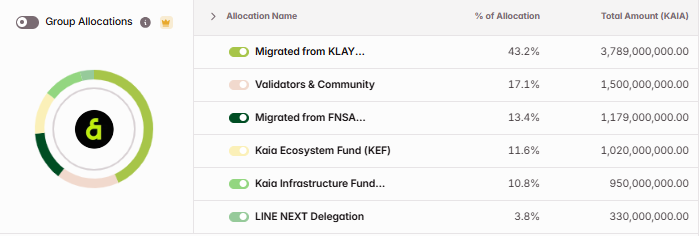
About 57% came from coins that old Klaytn and Finschia holders moved over, so most of the supply began in wallets that already existed. The two foundation funds hold roughly 22% for growth and infrastructure. Their release schedules matter, since big unlocks can push the price down. That’s why the published token data is worth checking now and then.
How Does Kaia Plan to Grow? Roadmap Highlights
As of November 5, 2026, theroadmap and the 2026 plan rest on three pillars:
Open governance: A more open governance and token setup.
KaiaBFT: A faster upgrade that aims for 10,000 transactions per second.
Institution tools: Stablecoin and compliance features for banks and firms.
Other points to note:
Tether put native USDT on Kaia in 2025 through LINE NEXT.
LINE NEXT offers USDT to LINE’s roughly 196 million monthly users.
Korean banks have reported stablecoin pilots on the chain this year.
The team posts news on itsofficial X account.
What Are the Main Risks and Concerns?
A fair Kaia (KAIA) review has to show where the chain could stumble. The stronger signal is reach, since LINE and Kakao already have millions of users. The main worry is that signups don’t equal real spending.
The project reported 35 million Mini Dapp users in the first month, yet available data suggests DeFi activity is still far smaller than on top chains.
Heavy reliance on LINE and Kakao for users, traffic, and growth.
Governance that still leans on a small group of council members.
Stablecoin rules in Korea and Japan that may change.
Upgrades like KaiaBFT that could miss their targets.
Price swings that hit staking returns and token value.
Expert Take: What Should Readers Watch Next?
The biggest unknown is whether chat users turn into steady customers of money apps. Stablecoin supply, real DeFi liquidity, and the arrival date of KaiaBFT are the numbers that matter most.
Fund releases and bank pilots becoming live products could shift the outlook too. Price alone says little, because market cap uses circulating supply, while fully diluted value counts every coin that could ever exist.
Readers should check each point on the official pages before forming a view.
Conclusion
In short, this Kaia (KAIA) review finds one EVM chain built from Kakao’s Klaytn and LINE’s Finschia, aimed at everyday chat users and stablecoin payments. Strong reach and a clear roadmap both stand out.
User conversion, governance concentration, and regulation remain open questions. Supply data and unlock schedules make a good next stop for anyone researching KAIA before making up their mind.
Disclaimer
This article is for information only and isn’t financial advice. Crypto assets are volatile and carry a high risk of loss, so readers should research on their own and talk to a licensed advisor before making any decision.