Kalshi News Today: Connecticut File Lawsuit Over Kalshi Sports Betting In the biggest Kalshi News Today headline this week, the State of Connecticut has escalated its fight with the predictio
Kalshi News Today: Connecticut File Lawsuit Over Kalshi Sports Betting
In the biggest Kalshi News Today headline this week, the State of Connecticut has escalated its fight with the prediction-market operator by filing a new lawsuit in state court.
The case adds to a growing pile of legal setbacks for Kalshi across multiple states and marks one of the most direct attempts yet to shut down its sports-related offerings within a single jurisdiction.
At a Glance
Connecticut has filed a lawsuit against Kalshi over alleged unlicensed sport wagering.
The state's Attorney General and Department of Consumer Protection are seeking an injunction, civil penalties, and disgorgement of gains.
A federal court already rejected Kalshi's argument that its sports contracts are federally regulated derivatives.
The enforcement is arbitrary and wants uniform federal oversight of prediction markets.
Connecticut Sues Kalshi Over Sports Event Contracts
On August 26, 2026, Connecticut Attorney General William Tong and Department of Consumer Protection Commissioner Bryan Cafferelli filed a verified complaint against KalshiEX LLC in Hartford Superior Court.
The filing asks the court to permanently bar KalshiEX from offering sport wagering in Connecticut without a license and to award civil penalties and disgorgement of revenue the state says was gained unlawfully.
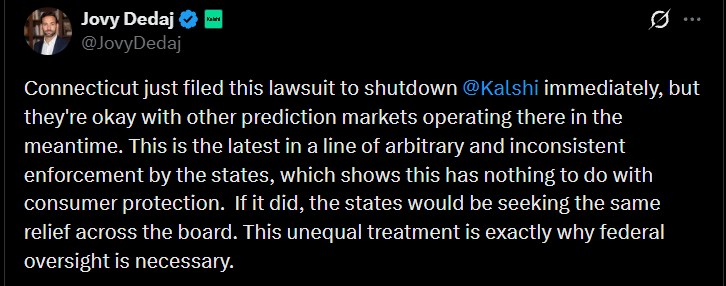
Source: Jovy Dedaj
Why Connecticut Says Kalshi Contracts Are Sports Betting
The complaint centers on Kalshi's "sports event contracts," which let users trade on outcomes such as which team or player wins, final point totals, point spreads, league standings, and individual player statistics.
It also points to kalshiEX parlay-style "combo" products, which bundle several sports outcomes into a single wager, arguing these products function exactly like the sports bets already regulated under state law rather than legitimate financial instruments.
Kalshi Faces Allegations of Unlicensed Betting and Deceptive Marketing
The law restricts sports wagering to a small number of licensed operators overseen by the Department of Consumer Protection, and the state has never held, or applied for, that license.
The complaint further alleges that marketed itself as a lawful, nationwide sports betting option and described its contracts using investment-style language, which the state characterizes as misleading given that the activity is not authorized under Connecticut's regulated wagering framework.
Connecticut Highlights Consumer Protection Concerns
A major thread running through the complaint involves protections that licensed Connecticut sportsbooks must follow but that Kalshi allegedly skips. The state notes that Kalshi permits users as young as 18 to trade sports contracts, while Connecticut's regulated sports wagering age floor is 21.
The filing also raises concerns about self-exclusion enforcement, deposit limits, contributions to problem-gambling funds, and third-party integrity monitoring meant to catch manipulation of sporting outcomes, protections the state says its licensees must meet but Kalshi does not.
State Enforcement Is Arbitrary and Calls for Federal Oversight
It has pushed back publicly, arguing that Connecticut's approach is uneven since other prediction-market platforms continue operating in the state while it alone faces this level of scrutiny.
The company frames this as evidence that state-by-state gambling enforcement is inconsistent, and it continues to argue that prediction markets built on event contracts should instead fall under a single federal regulatory framework rather than a patchwork of state gambling laws.
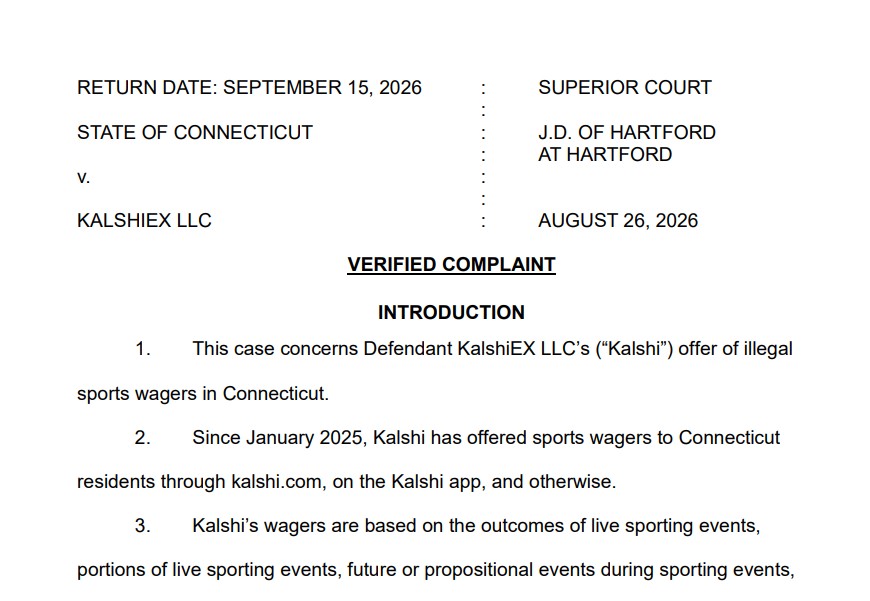
Source: Official Document
Earlier Court Ruling Strengthens Connecticut's Case Against Kalshi
Connecticut's new lawsuit follows directly from an earlier defeat for Kalshi in federal court. On August 7, 2026, U.S. District Judge Vernon Oliver denied Kalshi's request for a preliminary injunction, ruling that the company's sports-event contracts function as sports wagers rather than swaps regulated exclusively under federal commodities law, and that Connecticut's gambling statutes are not preempted.
The court formally denied the injunction motion on August 10, and on August 15 it also turned down Kalshi's emergency request for relief pending appeal. The state's complaint notes that courts and regulators in several other states, along with a federal appeals court, have reached similar conclusions about Kalshi's contracts.
What Happens Next?
With the lawsuit now filed, Connecticut is asking the court for a permanent injunction, restitution, civil penalties, and disgorgement of revenue tied to the alleged unlicensed activity.
It has signaled it plans to keep fighting the underlying legal theory, and the case is likely headed toward extended litigation given the company's parallel disputes in other states.
The outcome could carry weight well beyond Connecticut, since it touches on the broader unresolved question of whether sports-linked prediction market contracts belong under federal financial regulation or under states' gambling law.
Key Point
Details
Lawsuit
Connecticut sued Kalshi over alleged unlicensed sports wagering
Plaintiff
The Attorney General and Department of Consumer Protection
Main allegation
Kalshi's event contracts function as bets
Licensing issue
It does not hold the required wagering license
Consumer concerns
Age limits, self-exclusion, deposit limits, problem gambling protections, integrity monitoring
Kalshi's position
The enforcement is arbitrary; prediction markets need uniform federal oversight
Earlier ruling
Federal court rejected preliminary injunction request
What Connecticut wants
Injunction, civil penalties, and disgorgement of alleged gains
Conclusion
Connecticut's lawsuit marks a decisive escalation against the prediction market, reinforcing earlier federal rulings that its contracts are wagers, not derivatives. With penalties, disgorgement, and a permanent injunction on the table, the case could reshape how states nationwide handle prediction markets that blur the line between trading and betting.
YMYL Disclaimer: This article is for informational purposes only and does not constitute financial, legal, or investment advice. Prediction markets and wagering products carry financial risk, and their legal status varies by jurisdiction. Readers should consult a qualified professional and applicable state laws before participating in any wagering or trading activity.