The Kaspa cryptocurrency is equipped with most of the qualities that crypto investors seek for: Proof-of-work algorithm, scarcity and expanding Layer 1 network. But still, despite all these p
The Kaspa cryptocurrency is equipped with most of the qualities that crypto investors seek for: Proof-of-work algorithm, scarcity and expanding Layer 1 network. But still, despite all these positive characteristics, Solana’s value is much more preferable to the market.
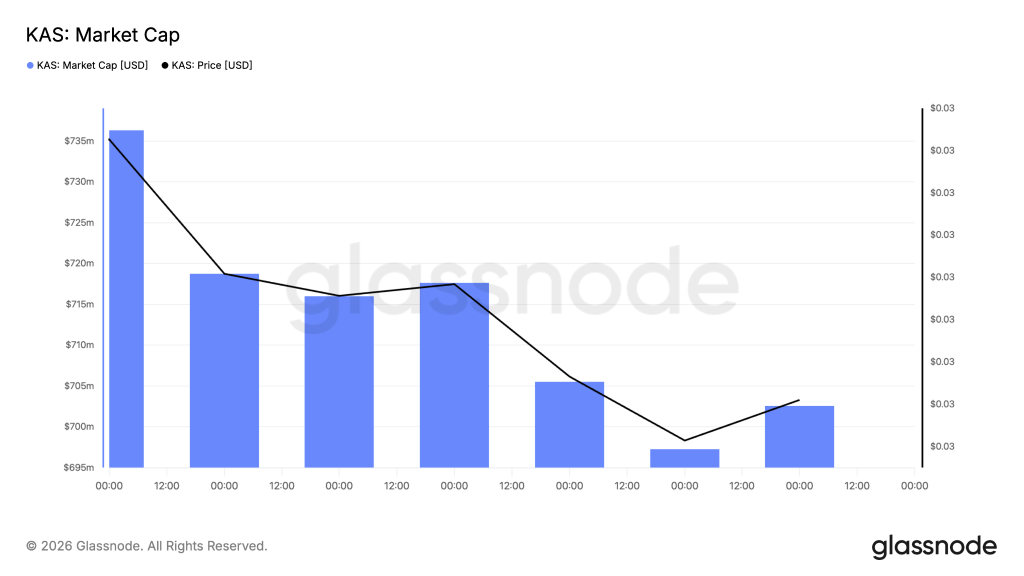
The numbers make the difference clear. Kaspa’s market cap is around $735 million, compared with roughly $44 billion for Solana. That is close to a 60-fold gap. Solana also has deeper liquidity, more applications, greater DeFi activity and a much larger user and developer base. So, what is Kaspa missing?
Kaspa Has Speed and Scarcity, But That Is Not Enough
Kaspa built its reputation around making proof-of-work much faster. Its emission model also gives KAS a strong scarcity argument. BSCN reported that roughly 96% of Kaspa’s 28.7 billion maximum supply has already been mined, with new emissions declining through a smooth monthly curve instead of traditional halvings.
The problem is demand. Scarcity matters much more when people actually need the asset. Kaspa’s market cap data puts the network at around $700 million-$735 million, meaning relatively modest capital flows can have a noticeable effect on the KAS price.
 Source: Glassnode
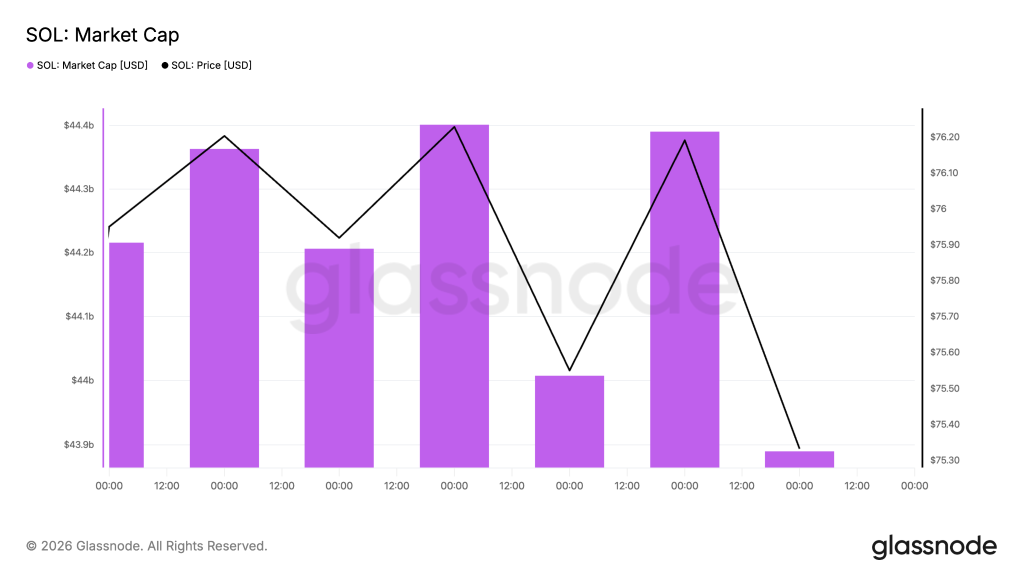
Solana operates from a completely different scale. Its market cap is around $43.5 billion-$44.4 billion, and the SOL price has been moving through a much tighter range than KAS. During the period reviewed, KAS showed roughly a 5% market-cap fluctuation, compared with about 1% for SOL.
 Source: Glassnode
Toccata Has Not Yet Delivered Everything Users Expected
Kaspa’s Toccata upgrade was an important step. Activated on June 30, 2026, it introduced smart-contract capabilities, native KRC-20 tokens and covenant support, effectively giving Kaspa a programmable Layer 1.
But technology needs users. The market reaction provided a good example. KAS dropped nearly 8% within hours of the upgrade, showing that investors did not immediately assign a higher valuation to the new functionality.
This is where Solana has a major advantage. Its ecosystem already contains DeFi platforms, stablecoins, meme coins, trading applications and other products that generate activity and liquidity. Kaspa is still trying to turn its technical capabilities into an ecosystem large enough to create the same network effects.
Kaspa’s Whale Data Is Another Problem
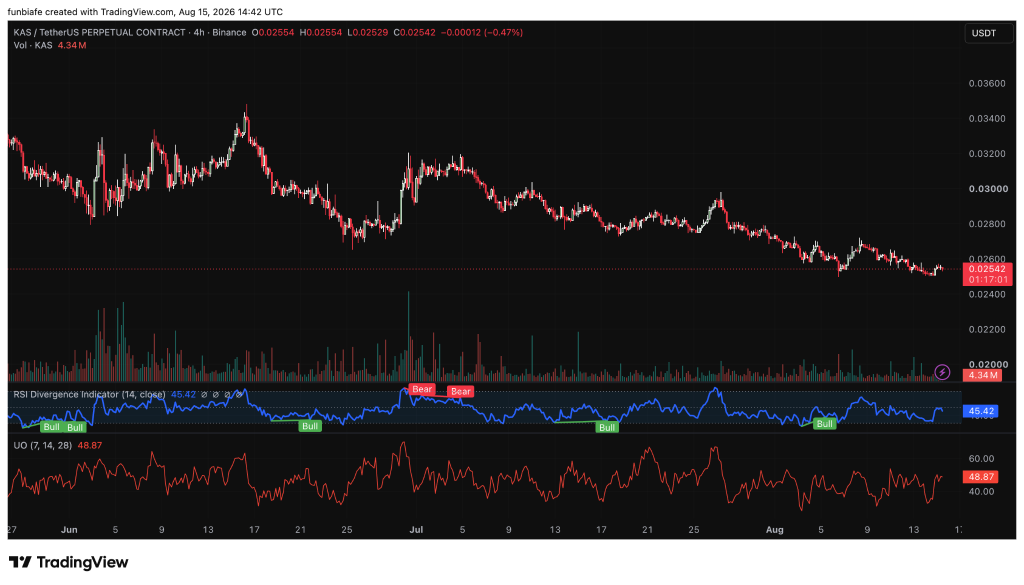
The KAS price chart does offer some encouraging signals. We had a look at the KAS/USDT setup, and the price had fallen from around $0.036 in early August to approximately $0.022 before recovering toward $0.02542.
 Source: TradingView
The RSI produced three bullish divergence signals, with the indicator forming higher lows as price made lower lows. That can point to weakening selling pressure. The Ultimate Oscillator, however, is at 48.87, meaning KAS still needs to reclaim the 50 level to confirm stronger momentum.
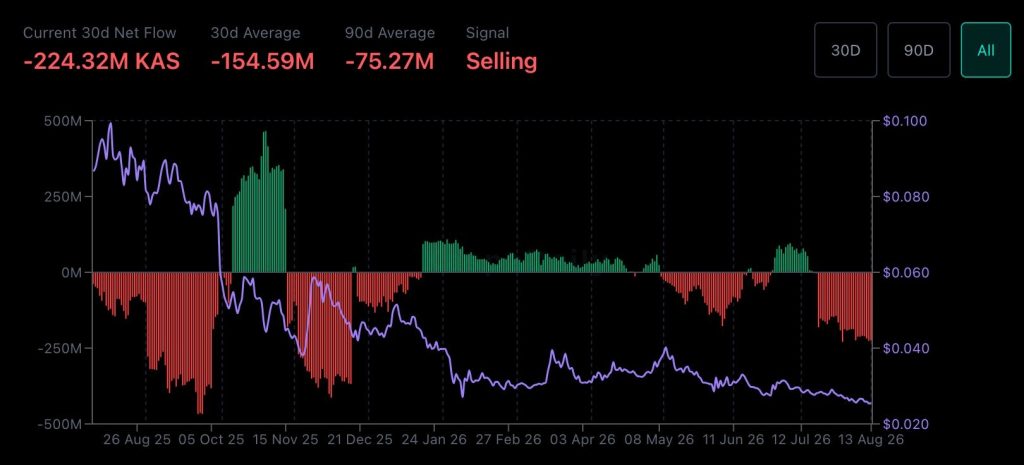
There is a major warning in the whale data chart shared by KaspaDaily. Kaspa’s 30-day whale net flow is -224.32 million KAS, compared with a 30-day average of -154.59 million and a 90-day average of -75.27 million.
 Source: X/@Dailykaspa
In simple terms, large holders are selling more aggressively than the longer-term averages indicate. That makes the KAS price setup much less convincing. A break above $0.026 could open the way toward $0.028-$0.030, but losing the $0.022 support could expose $0.020.
Read Also: If Ethereum Hits $10K, Here’s How High XRP and Solana Could Go
Solana Gives Users More Reasons to Stay
Solana’s advantage comes from the ecosystem surrounding SOL, not simply the underlying technology.
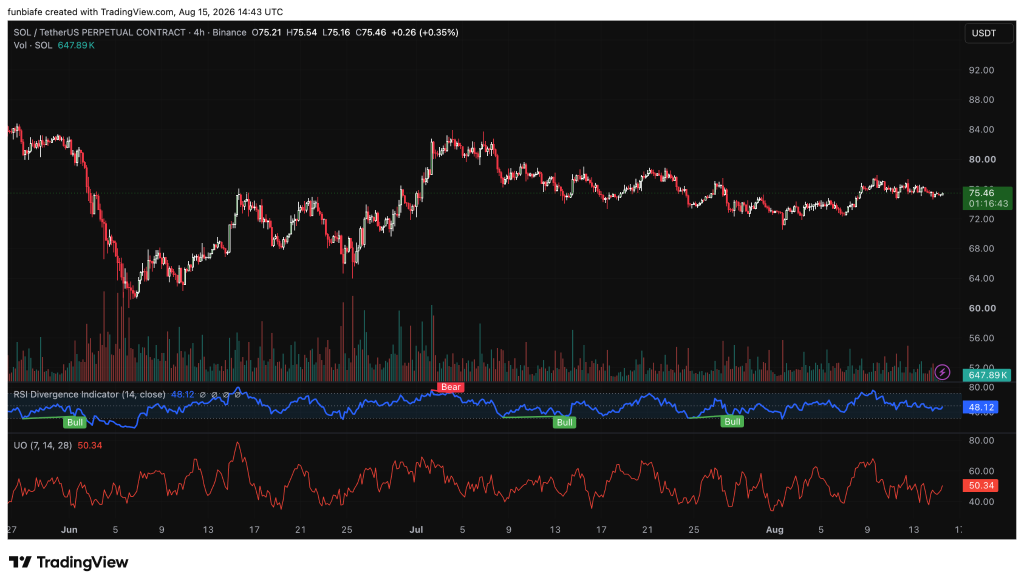
We had a look at the SOL/USDT chart, where the price was around $75.46. SOL has established a range between roughly $68 and $84, with $80 and $84 acting as important resistance levels. Its Ultimate Oscillator is at 50.34, giving SOL slightly stronger immediate momentum than KAS.
 Source: TradingView
Solana also has several potential catalysts ahead. Spot SOL ETF applications could provide an institutional route into the asset, while the Alpenglow upgrade is designed to improve finality and network efficiency. Proposals to reduce SOL inflation could also improve its supply economics over time.
There are risks, though. Cointelegraph reported that a Solana company generated $2.5 million in Q2 2026 revenue, largely from 31,200 SOL in staking rewards, but still recorded a $30.3 million net loss. So, a large ecosystem does not mean every business built around it is profitable.
Kaspa Needs Usage, Not Just Better Technology
This is ultimately why the market prefers Solana today. Kaspa has speed, proof-of-work security and an impressive scarcity profile. Its technology gives it a strong foundation, but the network still needs more applications, developers, users and liquidity.
Solana already has those ingredients at scale. For Kaspa, the next major test is whether Toccata and KRC-20 can translate its technology into genuine economic activity. Until that happens, the KAS price may continue to trade as a smaller, higher-risk asset, even with its limited remaining supply. Solana has already turned technology into an ecosystem. Kaspa now needs to do the same.
FAQs
Is Kaspa faster than Solana
Kaspa is designed to deliver very fast proof-of-work transactions, giving it a strong technical advantage within the PoW sector. Solana, however, combines high performance with a much larger application and liquidity ecosystem.
Can Kaspa overtake SolanaKaspa would need substantial growth in users, developers, applications, liquidity and transaction activity to close the current valuation gap. Its smaller market cap gives it greater percentage upside potential, but also makes the KAS price more volatile.
Subscribe to our YouTube channel for daily crypto updates, market insights, and expert analysis.
The post Kaspa Has Speed, Security, and Scarcity: Why Does the Market Still Prefer Solana? appeared first on CaptainAltcoin.


 LATEST: Solana Company reports Q2 2026 revenue of $2.5M, largely from 31,200