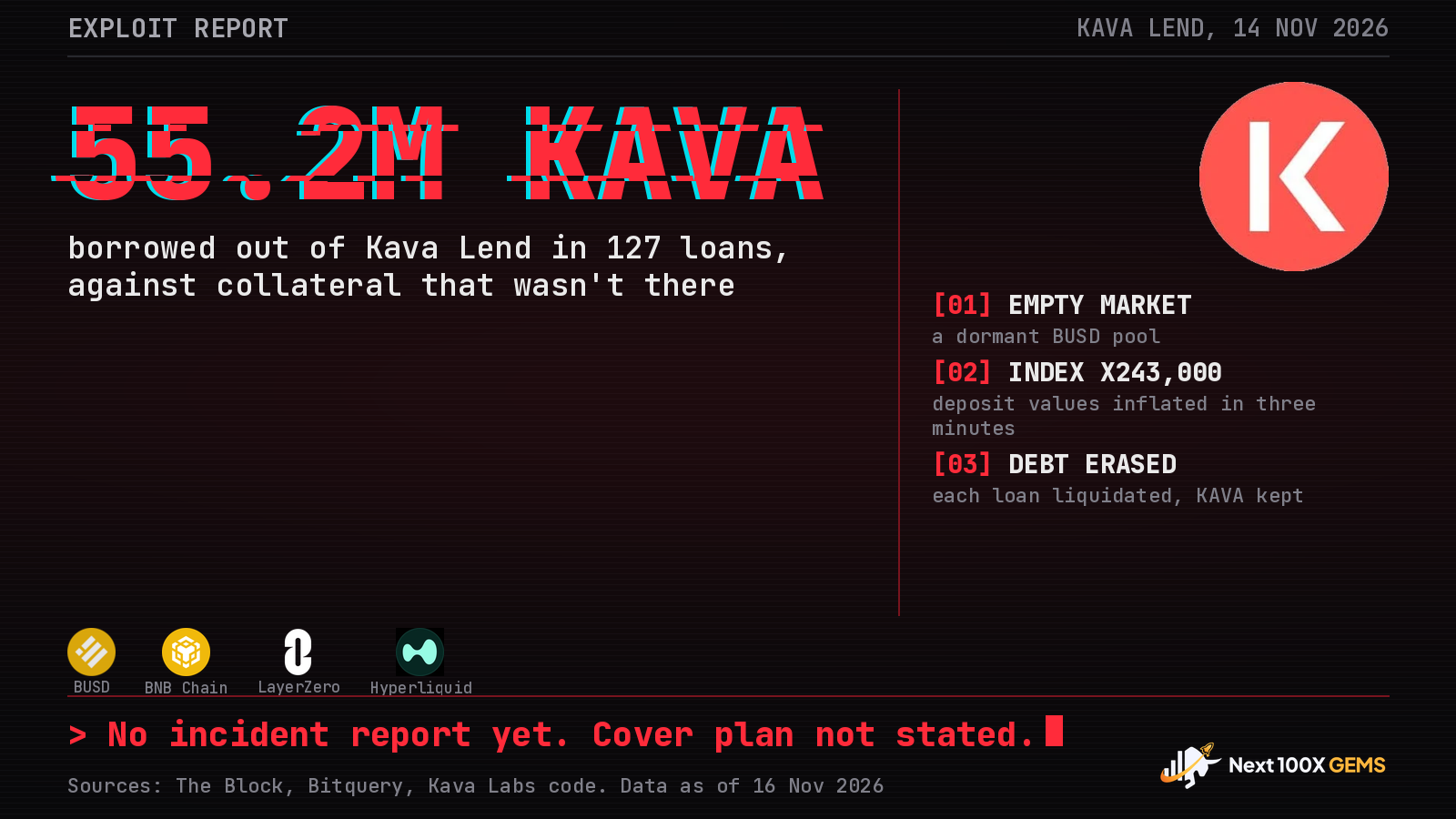
Kava Lend lost about 55.2 million KAVA, roughly 3.7 million dollars at the price before the attack, on 14 November after an attacker abused an almost empty BUSD market, according to on-chain
Kava Lend lost about 55.2 million KAVA, roughly 3.7 million dollars at the price before the attack, on 14 November after an attacker abused an almost empty BUSD market, according to on-chain reviews by The Block and Bitquery. Kava says the problem stayed inside Kava Lend and wasn't an infinite mint, meaning no new KAVA was created. As of 16 November the team hadn't published an incident report or said how depositors will be made whole.
Kava Lend is the lending app on the Kava chain. People deposit coins to earn interest, and others borrow them. Its KAVA pool held about 55.3 million KAVA before the attack, The Block reported. Afterward it held almost none.
Two wallets took the coins out in 127 loans over about 98 minutes, Bitquery counted. Each loan was then liquidated, and the liquidation wiped out the debt without bringing the KAVA back. The Block said the attacker used a second account to run those liquidations, which got around Kava Lend's cap on KAVA borrowing. The same report says the attacker had been running test deposit and borrow cycles in the BUSD market since 8 November.
At 0.068 dollars a coin, the pre-attack price The Block used, 55.2 million KAVA comes to about 3.76 million dollars. DefiLlama's hack database logs a slightly lower count, about 53.9 million KAVA and 3.7 million dollars. Kava hasn't given a loss figure of its own.
Kava Lend works out what depositors have earned by dividing the interest borrowers pay by the market's total supply. We read the function in Kava's public code repository on 16 November. It adds up cash and borrows, subtracts reserves, and returns a neutral factor of 1 if that total is exactly zero. Otherwise it divides. That's the gap The Block describes: a total of zero is handled, and a total of nearly zero isn't.
BUSD is a dollar stablecoin whose issuer, Paxos, stopped minting it in 2023, and Kava Lend's BUSD market had been close to empty ever since. Bitquery says the attackers pushed that market's supply down to two base units, which The Block puts at two hundred-millionths of a dollar. Over the next three minutes the BUSD interest index rose about 243,000-fold.
The BUSD the attacker had deposited earlier was suddenly counted as roughly 1.25 billion BUSD of collateral, The Block said. Borrowing every KAVA in the pool against that was just a matter of repeating the loan.
Kava hasn't confirmed this account, and we couldn't match our reading of the repository to the exact code running on the chain. The behavior on-chain does fit it.
The Block says about 49.2 million KAVA was bridged to BNB Chain through LayerZero. We checked the BNB Chain side directly. One wallet, 0x37d7…1042, received 48,358,600 KAVA in two bridge deposits on 14 November, then sent every token out in 46 transfers over about 35 minutes. It holds none now. That matches Bitquery's count of 48.4 million KAVA sold in 35 minutes, and we haven't reconciled it with The Block's higher figure.
The Block put the proceeds at 3,006.5 BNB and 231,557 USDT, about 2.09 million dollars. That's the money the sale brought in, not a second loss on top of the 3.7 million dollars. The market took the sale badly. Bitquery says KAVA fell 36% during the sale and by half within two hours, and The Block had it near 0.042 dollars later that day, down about 39% on 24 hours.
Some money was stopped. Bitquery says the Relay bridge blocked 612,416 USDT, about 29% of the proceeds, and marked the order as a blocked wallet. It also says most of the rest reached eight Hyperliquid accounts, none of which had moved when it last checked on 14 November. Nobody has said the blocked USDT will go back to depositors.
Kava's first public note, on 14 November, came more than seven hours after the attack began, according to The Block. It read: "We are tracking unexpected behavior originating from a dApp within the Kava ecosystem." A follow-up said "This is not an infinite mint" and called the event "isolated and contained within Kava Lend." The team also paused its Axelar bridge, though The Block notes the stolen KAVA left through LayerZero. Three Korean exchanges suspended KAVA transfers, per 0xCERT's advisory.
Kava promised "a complete incident report as soon as it is ready." We found none on Kava's website as of 16 November.
The biggest gap is the depositors. Bitquery's read is that lenders are owed about 55.2 million KAVA while the pool holds almost none, and no source we found says how that gets covered. Whether Kava Lend's other dormant markets carry the same weakness is also unanswered. 0xCERT advises Kava Lend users not to open new positions until the report lands, and to treat any unofficial refund or claim link as phishing. Our read is that the code flaw is the smaller story. A dormant market stayed open with a live path to the main pool, and the attacker was running test cycles against it from 8 November.
If your KAVA moved on an exchange during the sell-off, check that exchange's own notice before assuming anything about your balance.
- The Block, "Kava Lend loses roughly 3.8 million dollars to hack, sending KAVA token down nearly 40%" (14 Nov 2026)
- Bitquery, "Kava Hack: 55.2M Coins Drained, 612K dollars Blocked at Relay" (on-chain figures verified 14 Nov 2026)
- 0xCERT, advisory 0xCERT-2026-0352 (14 Nov 2026, updated 15 Nov)
- Kava (@KAVA_CHAIN) on X, first statements on the incident (14 Nov 2026)
- Kava Labs, public lending-module code, interest calculation (read 16 Nov 2026)
- Kava news page, checked for an incident report (16 Nov 2026)