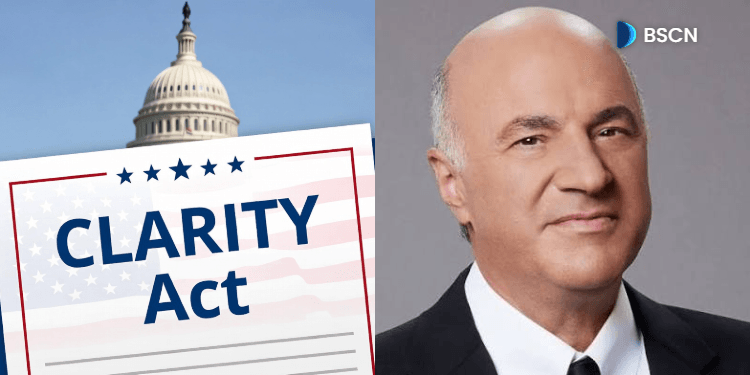
Read this article on bsc.news Investor Kevin O'Leary (@kevinolearytv) says institutional adoption of stablecoins and blockchain has stalled in the United States, and he argues that passage of
Read this article on bsc.news
Investor Kevin O'Leary (@kevinolearytv) says institutional adoption of stablecoins and blockchain has stalled in the United States, and he argues that passage of the CLARITY Act is needed to restart it.
Speaking on a FINTECH(.)TV segment, O'Leary blamed the lack of regulatory clarity. He said companies are waiting for clear rules before they expand their crypto operations.
O'Leary: GENIUS Act Was Only a Start
O'Leary said his own businesses already use $USDC for treasury management and cross-border settlement. He said many other firms are holding back because their compliance teams do not yet know the rules.
In his words on X: "The GENIUS Act was a start. We need the CLARITY Act to unlock the rest."
The GENIUS Act is the US stablecoin law. It introduced the first comprehensive federal framework for stablecoins, requiring full 1:1 backing, reserve audits and anti-money-laundering compliance. The CLARITY Act is aimed at the wider crypto market. It distinguishes between the jurisdictions of the Commodity Futures Trading Commission and the Securities and Exchange Commission, two regulators that have split crypto enforcement in sometimes confusing ways.
Where the CLARITY Act Stands
The bill's path has been difficult. It passed the House on July 17, 2025, by a vote of 294 to 134.The Senate Banking Committee advanced it 15 to 9 on May 14, 2026.
It then stalled on the Senate floor. A procedural motion received 49 votes in favor and 50 against, short of the 60 votes needed to advance the legislation to debate.DLA Piper said the outcome nearly eliminated the possibility that a digital asset market structure bill will be enacted this year.
The vote was procedural, so the Senate never debated or amended the bill. The bill is not formally dead, but its timing is uncertain. DLA Piper said that, given other legislative priorities and the time left in the 119th Congress, the bill may not move again until the new Congress convenes in January.The law firm added that stakeholders may use the period before the 120th Congress to plan their 2027 government affairs strategies.
For institutions, the practical question is timing. Until Congress settles which regulator oversees which crypto assets, O'Leary's argument is that compliance-led firms will keep their exposure limited to products such as stablecoins, where federal rules already exist.
Sources
DLA Piper: Senate fails to advance the CLARITY ActCointelegraph: US Senate fails to advance CLARITY ActEisnerAmper: The Clarity Act stalled and what it means for digital asset regulation
See more news on bsc.news