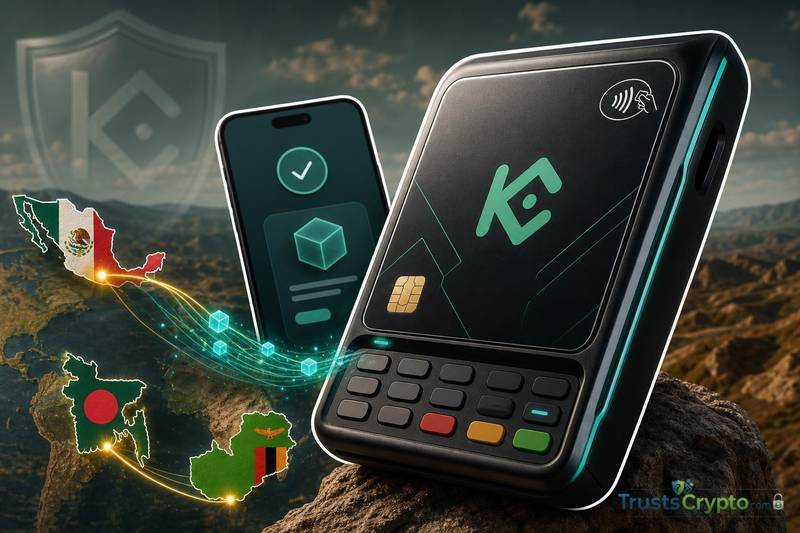
KuCoin Pay is expanding its crypto payments infrastructure into Bangladesh, Mexico and Zambia, adding local bank and mobile money support to connect digital assets with everyday payment rails
KuCoin Pay is expanding its crypto payments infrastructure into Bangladesh, Mexico and Zambia, adding local bank and mobile money support to connect digital assets with everyday payment rails in three high-growth markets.
The expansion targets countries with large unbanked or underbanked populations where mobile money and local bank transfers already serve as primary financial tools. By integrating with these existing rails, KuCoin Pay aims to make crypto spending and receiving practical for users who may never interact with traditional exchange interfaces. For related coverage, see Crypto: CoinShares drops SOL ETF; KuCoin wins MiCA; BTC dips.
KuCoin Pay targets three growth markets for crypto payments
The rollout covers Bangladesh, Mexico and Zambia, three countries that span South Asia, Latin America and Sub-Saharan Africa. Each represents a distinct payments environment, but all three share high mobile penetration and significant remittance corridors. For related coverage, see Thailand SEC Preps Rules for Crypto ETFs and Futures Trading.
KuCoin's announcement positions this as connecting digital assets with local banking and transfer rails, framing the update as a payments infrastructure play rather than a trading product launch. The focus is on enabling real-world settlement through channels users already trust. For related coverage, see Crypto today: Tether vs S&P Strategy BTC, Nasdaq tokenized stocks.
This is not the first time KuCoin has made moves to expand its regulatory and operational footprint. The exchange recently secured MiCA compliance in Europe, signaling a broader push toward legitimacy across multiple jurisdictions. For related coverage, see Crypto Exchanges Pledge $3M for Hong Kong Fire Relief Effort.
How local bank and mobile money support changes the user experience
Local bank support means users in these markets can move funds between their crypto holdings and domestic bank accounts denominated in local currency. This eliminates the need to route through international intermediaries or dollar-denominated stablecoins as an exit path.
Mobile money support is particularly relevant in markets like Zambia and Bangladesh, where mobile wallets often function as the primary financial account for millions of people. Linking crypto payments to these wallets could allow users to receive crypto and settle in local currency without needing a traditional bank account at all.
The practical effect is reduced friction. Instead of converting crypto to a stablecoin, transferring to a centralized exchange, selling for fiat, and withdrawing to a bank, users could potentially move value from crypto to a local mobile wallet in fewer steps. FinanceFeeds reported on the integration as linking crypto directly to local rails in all three countries.
What the rollout signals for crypto payment adoption
The three countries named in this expansion are all remittance-heavy markets. Mexico is one of the largest remittance recipients globally, Bangladesh receives billions annually from overseas workers, and Zambia has a growing diaspora sending money home. Crypto payment rails that connect to local settlement could offer a faster, cheaper alternative to traditional remittance corridors.
This rollout is about expanding utility rather than trading volume. KuCoin Pay's integration with familiar payment methods suggests a bet that crypto adoption in emerging markets will be driven by practical use cases, not speculation. As major players continue exploring tokenized financial infrastructure, the payments layer remains a critical piece of the puzzle.
Merchant acceptance is the other side of this equation. If businesses in these markets can receive crypto-funded payments and settle in local currency through their existing bank or mobile money accounts, it lowers the barrier to crypto acceptance without requiring merchants to hold digital assets themselves.
Key questions still unanswered
The announcement leaves several details unresolved. Launch timing for each country has not been specified, and it remains unclear whether all three markets will go live simultaneously or in a phased rollout.
The specific banking partners and mobile money providers have not been named. In Bangladesh, that likely means integration with bKash or similar platforms. In Mexico, SPEI or CoDi could be involved. In Zambia, mobile money operators like Airtel Money or MTN Mobile Money would be logical partners. None of these have been confirmed.
Supported cryptocurrencies, transaction fees, compliance requirements, and merchant integration tools also remain undisclosed. Users and merchants in these markets will need these details before evaluating whether KuCoin Pay offers a meaningful improvement over existing options.
FAQ
Which countries are included in the KuCoin Pay expansion?
Bangladesh, Mexico and Zambia are the three markets named in the expansion.
What does local bank and mobile money support mean?
It means users can connect their crypto payments to domestic bank accounts and mobile wallets, settling transactions in local currency without international intermediaries.
Does this signal wider crypto payment adoption?
Integrating with existing local payment rails in remittance-heavy markets suggests growing industry focus on practical crypto utility rather than purely speculative trading use cases. However, adoption will depend on execution details like fees, supported assets, and partner coverage that have not yet been disclosed.
Disclaimer: This article is for informational purposes only and does not constitute financial or investment advice. Cryptocurrency and digital asset markets carry significant risk. Always do your own research before making any investment decisions.
Read original article on trustscrypto.com