By the time he turned 30, Kyle Robertson had already experienced the extreme highs and lows of startup entrepreneurship. After leaving business school in 2018, Robertson moved to San Francisc
By the time he turned 30, Kyle Robertson had already experienced the extreme highs and lows of startup entrepreneurship. After leaving business school in 2018, Robertson moved to San Francisco to pursue an idea for a virtual, all-in-one mental healthcare platform.
That idea became Cerebral, which Robertson co-founded with Dr. Ho Anh and launched in early 2020—just weeks before the COVID-19 pandemic upended the healthcare industry. As lockdowns closed medical offices and disrupted traditional care, demand for virtual healthcare surged. Telehealth shifted almost overnight from an emerging convenience to essential infrastructure.
For Robertson, the experience offered more than an opportunity to build a healthcare company. It provided a firsthand education in scaling a technology business during a period of extraordinary demand, while navigating the operational, regulatory and financial pressures that accompany rapid growth.
After nearly three years as Cerebral’s CEO, Robertson left the company in May 2022. Rather than stepping away from entrepreneurship, he began applying what he had learned to another problem: how technology could make healthcare more accessible to consumers.
That effort became Zealthy, a telemedicine platform Robertson founded in 2023. The company focuses on direct-to-consumer healthcare, providing access to treatments and services spanning weight management, hair loss, sexual health, birth control and other personal health needs.
But Robertson’s experience building companies also led him to another question with implications well beyond healthcare: How can entrepreneurs build and finance startups more efficiently from the earliest stages?
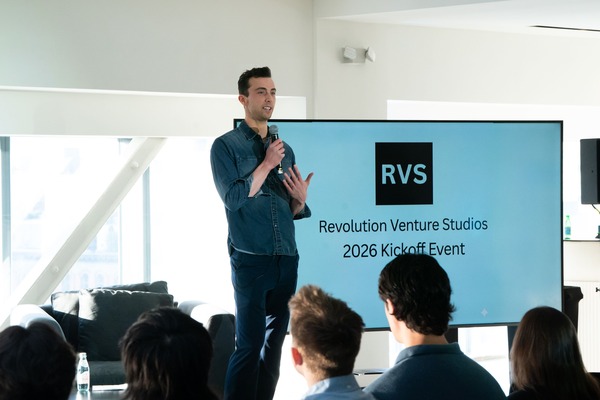
That question is at the center of Revolution Venture Studios (RVS), Robertson’s venture studio and startup-building platform.
A different model for startup capital
Traditional venture capital generally operates on a relatively simple premise: investors provide capital to independent companies in exchange for equity, with founders and management responsible for turning that capital into a scalable business.
Accelerators take a somewhat different approach, providing early-stage companies with mentorship, networks and relatively modest amounts of capital.
A venture studio sits somewhere between those models - and in some respects outside them.
RVS works with founders at an earlier stage, helping turn initial concepts into companies while providing seed financing, product development resources and operational expertise. Instead of simply writing a check and waiting for a company to develop, the studio becomes more deeply involved in building the business.
That approach reflects a broader evolution in the startup ecosystem. As software development becomes increasingly accessible and artificial intelligence reduces the cost and time required to build certain products, the scarce resources for early-stage founders are increasingly centered on execution, distribution, industry expertise and access to capital.
For venture studios, the opportunity is to combine those resources into a repeatable company-building process.
Robertson’s own experience is central to the model. His early days as a founder included sharing a one-bedroom apartment with two roommates and working with limited resources. Having experienced the challenges of getting a company off the ground himself, he now wants to provide emerging entrepreneurs with some of the resources he lacked.
From founder to capital allocator
For Robertson, RVS represents a transition from building a single company to helping build a portfolio of companies.
That distinction is significant. A founder typically concentrates capital, talent and operational attention on one business. A venture studio must instead decide where to deploy resources across multiple opportunities—and determine which ideas merit additional investment.
In that sense, Robertson’s role increasingly resembles that of a capital allocator as much as an entrepreneur.
RVS evaluates ideas, provides initial funding and helps founders develop their products and operations. The studio’s portfolio spans healthcare, personal wellness and artificial intelligence, with companies including Amara, a medspa roll-up business; CareBeam, an AI-powered healthcare note-taking platform; and Bioverse, a direct-to-consumer longevity company.
The underlying thesis is that hands-on involvement at the earliest stage can potentially increase the odds that a promising idea becomes a viable company.
For founders, that can mean access to more than capital. Product development, operational expertise, recruiting assistance and strategic guidance can all reduce the amount of time and money required to reach key milestones.
Why the venture-studio model matters now
The economics of startup creation are changing.
Historically, launching a technology company often required significant upfront spending on engineering, infrastructure and personnel before a product could even reach the market. Today, cloud computing, no-code tools, artificial intelligence and increasingly sophisticated software infrastructure have lowered some of those barriers.
That does not mean building a successful startup has become easy. Instead, the bottlenecks are shifting.
A founder may be able to create a prototype quickly, but turning that prototype into a durable company still requires capital discipline, regulatory knowledge, customer acquisition, product-market fit and operational execution.
That creates an opening for venture studios such as RVS, which aim to provide a combination of capital and company-building expertise rather than treating financing as a standalone transaction.
For the fintech industry, the model also offers a broader lesson about the changing relationship between capital and entrepreneurship. Financial technology has increasingly blurred the lines between traditional financial services and technology infrastructure. Venture studios are similarly experimenting with a new way of combining investment capital with operational resources.
Instead of selecting which startups to invest in, the venture studio considers which startups to build in the first place.
Building the next generation of founders
Robertson continues to run Zealthy while dedicating time to mentoring entrepreneurs through RVS. His philosophy is straightforward: founders should be willing to take calculated risks, commit deeply to their businesses and understand the jobs required across an organization.
The goal is not simply to create individual companies. RVS aims to create entrepreneurs who can repeatedly build and scale businesses.
Its mission—to “build companies that change the world for the better”—reflects a broader thesis about entrepreneurship: that financial capital is most valuable when paired with the people, technology and expertise necessary to deploy it effectively.
Robertson’s career has taken him from founding a groundbreaking telehealth company during one of the most disruptive periods in modern healthcare to building another successful platform and, now, helping other entrepreneurs launch companies of their own. For a founder who has both bootstrapped and worked with big institutional VC firms, this could be his most consequential and rewarding venture yet.