Lagos Life, a browser-based life simulation game, has crossed 1 million players in three days. ChatGPT took five days to reach the same mark after its launch in November 2022. At 7:15 a.m. on
Lagos Life, a browser-based life simulation game, has crossed 1 million players in three days. ChatGPT took five days to reach the same mark after its launch in November 2022.
At 7:15 a.m. on Oct 5, the game’s live counter showed 1,173,086 total players, 55,083 online and 9,122,244 visits all time. The numbers point to a bigger story than one viral game: access, not demand, may have been the real barrier for Nigerian games.

Shalom Rayhamen
A link beat the app store
Lagos Life drops players into a Sims-style version of the city. They meet, chat, buy virtual land, run businesses and spend nights in clubs like Quilox, all in a browser. Developer Shalom Rayhamen, in an earlier post, acknowledged that the game was inspired by The Sims 3 and Eureka’s Lagos Run.
There is no download, no app-store listing and no heavy data cost. A player clicks a link on X or TikTok, creates an avatar and finds themselves in the streets of Lagos, virtually.
Read also: Lagos Traffic 101: 10 ways Nigerians wish they could commute easily
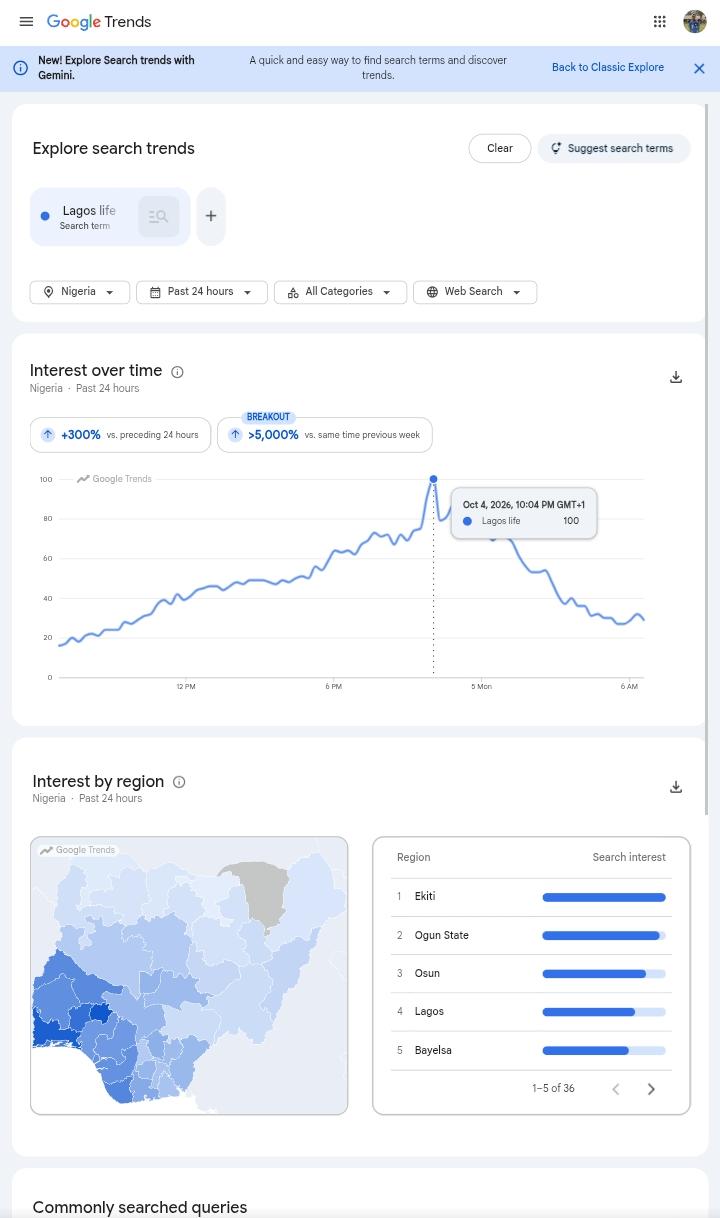
Google Trends shows the effect. Nigerian search interest in “Lagos life” broke out by more than 5,000% compared with the previous week, peaking at about 10 p.m. on Oct 4. Interest was strongest in Ekiti, Ogun, Osun and Lagos, and “lagos life app” and “lagos life game” were among the fastest-rising queries.
Nathan, CEO of Terra Industries, while reacting to Lagos Life’s success, wrote on X that “simulation gaming is entering a new era” of localised experiences.
What earlier Nigerian hits show
The speed is new to the ecosystem, but the pattern is not. Africa has more than 400 million gamers, yet most engagement has gone to global titles like PUBG Mobile, CODM, Free Fire and Candy Crush.
Local hits have built audiences slowly. Gamsole, one of Nigeria’s pioneer studios, passed 10 million global downloads across its catalogue, including Gidi Run, but over several years through Windows Phone and Android app stores. Ethiopia’s Kukulu, from Qene Games, reached hundreds of thousands of downloads and won international awards through the same route.
Lagos Run, the arcade-style danfo game that inspired Lagos Life, drew more than four million views across social platforms within days of its reveal. It was a single-session runner. Lagos Life turned that attention into a persistent multiplayer world.
Meanwhile, other consumer products took far longer to reach 1 million users. Instagram needed about 2.5 months, Spotify five months, Facebook 10 months and Netflix 3.5 years.
The harder part for Lagos life starts now
A million players is not yet a million regulars. A visit of a few minutes to explore the map counts towards the total, and viral browser games often lose players once the curiosity fades. Whether Lagos Life keeps them is unknown.
The game page already carries ads, which raises questions about revenue and server costs at this scale. Its in-game economy also had to be reset after hacked accounts produced trillion-naira balances. The team has wiped those balances, restored legitimate money and is adding features such as income tax.
Read also: Lagos Run is not the first Danfo game: Here’s why it’s the one everyone is playing
Players have mostly joked about it, saying they do not want real-life struggles in the game. If Lagos Life holds its audience, it will show that Nigerian players were never short of interest in games built around their own lives. They were short of ways to reach them cheaply.