On October 13, 2026, six House Democrats urged the Federal Aviation Administration (FAA) to pause the use of its new AI-assisted SMART tool. They want to receive answers regarding safety test
On October 13, 2026, six House Democrats urged the Federal Aviation Administration (FAA) to pause the use of its new AI-assisted SMART tool. They want to receive answers regarding safety testing, controller training, and accountability before the technology is implemented across the US. Although over two dozen lawmakers have signed the letter, it does not prevent this technology from being adopted.
Who signed the letter and what they want
Representatives Alexandria Ocasio-Cortez, April McClain Delaney, Don Beyer, Kweisi Mfume, Suhas Subramanyam and Sarah Elfreth led the joint letter to Transportation Secretary Sean Duffy and FAA Administrator Bryan Bedford. Ocasio-Cortez’s office announced it on October 13.
SMART, which is an acronym for Strategic Management of Airspace, Routes and Trajectories, was initiated on September 21, 2026, and has begun operations in the airspace of Reagan National, Dulles, and Baltimore/Washington International airports. With plans for a nationwide rollout within three months, members of the Congress would like to understand how SMART was tested and if it is capable of dealing with adverse weather conditions, as well as whether controllers were consulted and trained on the system.
Ocasio-Cortez said, “Air traffic control leaves zero margin for error.”
McClain Delaney cited the collision in January 2025 near Reagan National, which resulted in the death of 67 people. She commented that “the FAA owes this region answers.”
What SMART actually does
The FAA’s September 21 announcement said SMART combines 200 data streams, including weather, flight paths and staffing, to predict congestion and help manage traffic.
The agency stressed that people remain in control:
“All of SMART’s recommendations are reviewed by FAA staff.”
However, the National Air Traffic Controllers Association has informed Nextgov/FCW that it “has not been involved in the design, testing or implementation of SMART.”
Later, Beyer mentioned that a discussion with Bedford helped calm some of his worries. Bedford stated that experienced air traffic controllers made SMART and that the system is operating at a Warrenton, Virginia-based radar approach facility, and not at the airport towers.
The modernization backdrop
The concerns come amid a much larger FAA overhaul. A September 14, 2026, GAO report found the modernization program lacked a reliable lifecycle cost estimate and an integrated master schedule.
Congress appropriated $12.5 billion in July 2025, mostly for phase one. The FAA estimates another $10.2 billion for phase two, excluding facilities.
The GAO’s findings concern the broader program, not SMART’s specific safety testing.
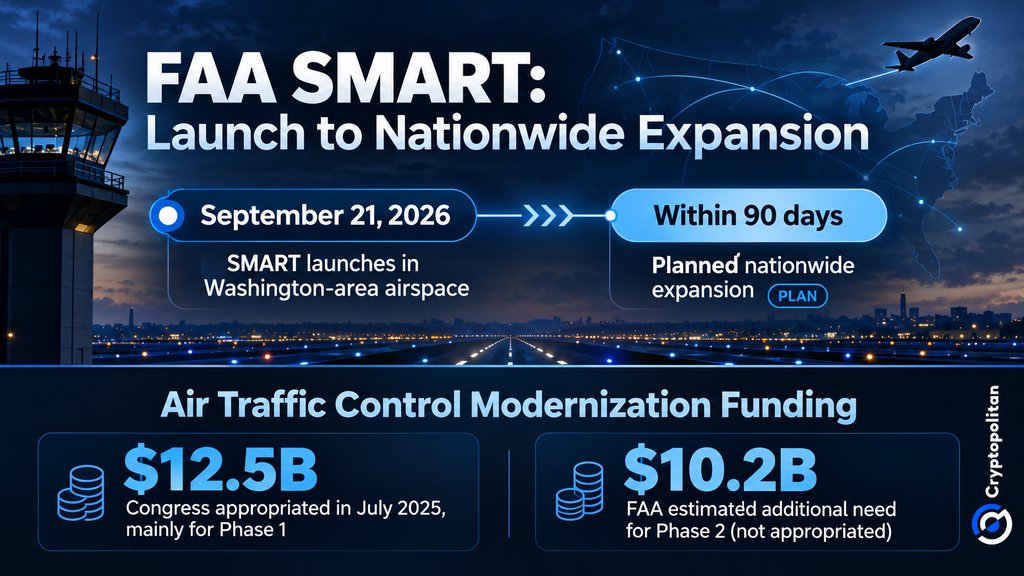 FAA SMART AI rollout timeline: 90-day expansion plan, $12.5B funding and $10.2B modernization estimate
Europe’s slower, documented path
Meanwhile, MarketsandMarkets expects aviation AI to grow from $1.76 billion in 2025 to $4.86 billion by 2030, representing 22.6% annual growth. Cryptopolitan previously reported a $2.67 trillion global AI spending forecast for 2026.
Europe is taking a more documented approach. Its aviation regulator released proposed AI guidance on June 3, 2026, covering safety assurance and human oversight. The guidance is not binding.
Similar US requirements could mean higher costs and slower deployments for AI vendors. For now, however, SMART’s expansion remains planned, and lawmakers are still seeking answers.
The smartest crypto minds already read our newsletter. Want in? Join them.