LayerZero Mainnet Launch Roadmap Reveals Seven Stages for Zero Network The LayerZero Mainnet Launch is close. Co-founder Bryan Pellegrino shared the plan on November 25, 2026. He said Zero, t
LayerZero Mainnet Launch Roadmap Reveals Seven Stages for Zero Network
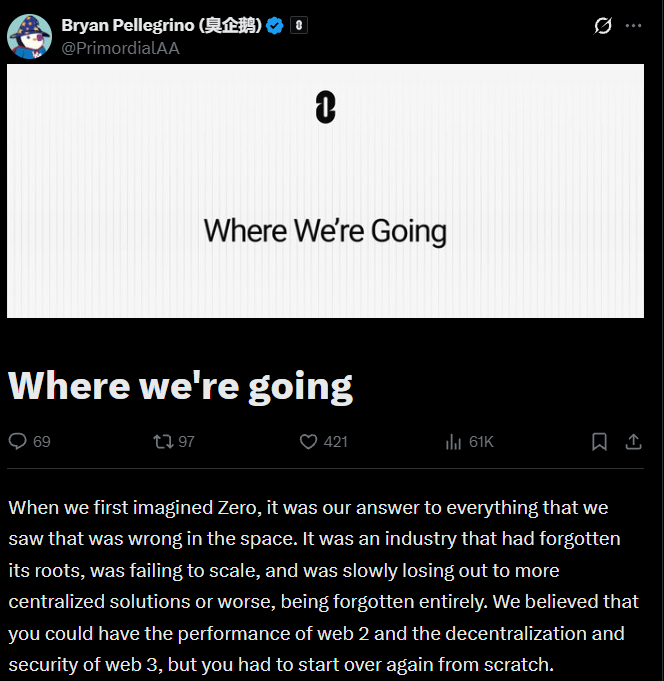
The LayerZero Mainnet Launch is close. Co-founder Bryan Pellegrino shared the plan on November 25, 2026. He said Zero, the new blockchain network, and ATLAS, a trading platform, will start in phases next Monday. Here is what the team has shared so far.
At a Glance
Date: The LayerZero Mainnet Launch begins in phases on November 30, 2026.
Network: Zero starts with 46 fixed validators.
Open access: Permissionless validation and delegated proof-of-stake (dPoS) are planned for March 31, 2027.
Trading: The LayerZero ATLAS trading platform goes live on the same day.
Roadmap: Seven stages will roll out over 12 to 24 months.
Source: Bryan Pellegrino, LayerZero Network co-founder, on X, November 25, 2026, as reported by Wu Blockchain.
What Launches on November 30
Zero starts with a Jolt-ZKVM design. It uses lattice-based cryptography, which is built to resist quantum attacks. A Trusted Execution Environment (TEE) acts as a backup layer. Pellegrino calls it a Guardian backstop.
At first, 46 fixed validators will run the chain. Until March 31, stake is split equally among them. After that date, anyone can validate. Users will also be able to delegate stake to any validator.
Source: Bryan X Post
The Seven Stages of the LayerZero Mainnet Launch
The team plans these stages over the next 12 to 24 months:
46 fixed validators, Jolt Pro ZK, the TEE Guardian, ATLAS, and an Interop Zone
A confidential Payment Zone and quantum-resistant
Permissionless validation and delegated stake
Permissionless on-chain governance
A permissionless, high-performance EVM Zone
A post-quantum Zero beacon chain
Full formal verification of Jolt Pro, then removal of the Guardian TEE
Contract deployment is limited at first. Only a small set of contracts will support moves in and out of ATLAS. Open deployment on the Zero-EVM zone arrives in stage 5. Until then, the Interop Zone will have a low cap on transactions per second. The team says this is enough for inflow and outflow needs.
ATLAS is a central limit order book (CLOB) platform. The team says it will have about 10 times more throughput and about 200 times lower latency than leading CLOBs today. These figures come from an internal profile. They are not independent tests.
The reported numbers are:
About 1,500,000 orders per second
More than 250,000 matches per second
Median wire-to-wire latency near 850 microseconds
Tail latency in the low single-digit milliseconds
Settlement on Zero will be fully ZK. Readers should treat the speed claims with care until outside tests confirm them.
Validator and Quantum Details
If proof generation fails, the chain replays transactions and checks them in witness mode. Because of this, early validator specs are higher than normal. Once stage 7 is done, Pellegrino says a Raspberry Pi class device could validate Zero.
Jolt-ZK is quantum-resistant from day one. The chain itself gains this trait by stage 6. The Payment Zone will launch quantum-resistant.
Conclusion
The LayerZero Mainnet Launch is a staged rollout, not a single event. November 30 brings Zero and ATLAS with tight limits. March 31 is the next key date, when validation opens. The bigger goals, such as open governance and a post-quantum chain, depend on later stages. Watch official LayerZero channels for updates, since timelines can change.
Disclaimer: This article is for information only. It is not financial, legal, or tax advice. Details come from public statements and may change. Cryptocurrency investments carry high risk, and prices can swing fast. You can lose all your money. Always do your own research and speak with a licensed financial advisor before you act.