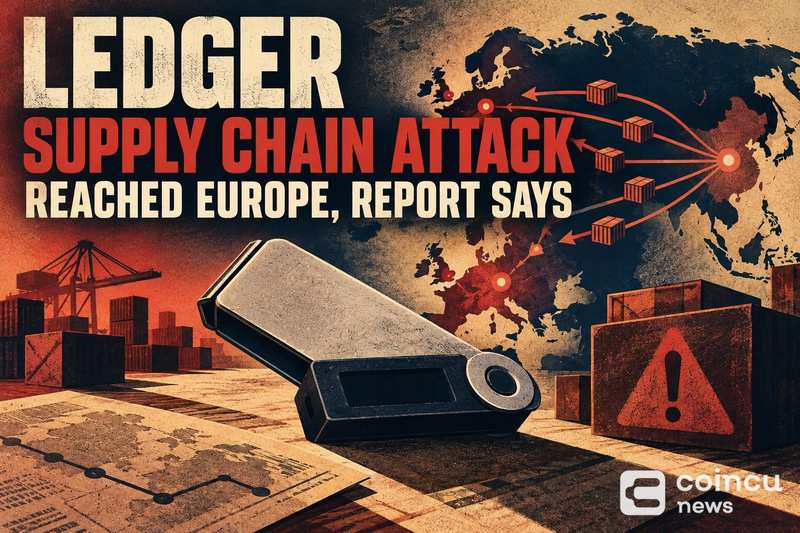
A report alleges that a Ledger supply-chain attack has reached Europe after a spy implant was discovered inside a hardware wallet sold through an official reseller, raising questions about de
A report alleges that a Ledger supply-chain attack has reached Europe after a spy implant was discovered inside a hardware wallet sold through an official reseller, raising questions about device integrity even when purchased through authorized distribution channels. The allegation, which has not been independently confirmed as of publication, mirrors a pattern of physical tampering claims that have surfaced around the hardware wallet sector before.
What the report alleges about the Ledger supply-chain attack
According to the circulating report, a hardware wallet bearing Ledger branding and sold by a reseller operating within Ledger's official distribution network was found to contain an implant not present in factory-issued devices. The report describes this as a supply-chain compromise, meaning the alleged modification occurred after the device left Ledger's manufacturing process and before it reached the end buyer. For related coverage, see G. Love Lost 5.92 BTC After Fake Ledger App Download on Apple App Store.
No device model, batch number, implant methodology, or reseller identity has been named in the available version of the report, making independent verification impossible at this stage. Ledger has not issued a public statement confirming or disputing the allegation as of this writing. Treating the claim as an established breach would be premature; treating it as implausible would ignore that Ledger has previously reported unauthorized hardware implant incidents in its supply chain, a documented precedent that adds seriousness to any new allegation of this type. For related coverage, see Papertrade Open Interest Falls 60% to $1.3B in 24 Hours.
Why an official reseller channel matters for the alleged implant's reach into Europe
The significance of this allegation rests partly on the sales channel. Hardware wallets purchased from unofficial marketplaces, second-hand platforms, or unknown vendors carry an acknowledged tamper risk that security practitioners routinely warn against. The report's claim that the affected device was sold by an official reseller removes that easy explanation and implies the compromise, if real, penetrated a vetted distribution tier. For related coverage, see CleanSpark Secures $2.276B Financing, Holds 13,530 BTC.
The claim that the incident reached Europe suggests a geographic scope beyond a single-country incident, though no affected country, city, or reseller has been identified in publicly available reporting. Prior supply-chain concerns in this sector, including a documented Ledger supply-chain attack that caused losses of $17.7 million in BTC, demonstrate that distribution-level compromise can carry severe financial consequences for users who proceed unaware.
What Ledger users and buyers should do now
Given that the allegation is unconfirmed and the affected batch, reseller, and device model remain unidentified, the appropriate response is defensive and reversible. Users who recently purchased a Ledger device through any European reseller should verify their purchase documentation and check that packaging seals, holographic stickers, and firmware verification steps were intact at unboxing.
Under no circumstances should users enter seed phrases or recovery words into any website, application, or support channel, regardless of whether it claims to be official. This holds whether or not a device is suspected of compromise; it is standard Ledger policy. The only verified path for firmware and software is Ledger Live downloaded directly from Ledger's official domain. Users aware of similar phishing vectors may recall that a fake Ledger app on the Apple App Store was sufficient to cause a loss of 5.92 BTC, illustrating how social-engineering attacks frequently accompany hardware security narratives.
Before taking any irreversible action, such as moving funds to a new wallet or wiping a device, wait for confirmed guidance from Ledger directly. Acting on unverified social-media claims in a supply-chain panic scenario is itself a vector that bad actors exploit.
What the report leaves unanswered
The allegation as currently available omits every piece of information needed to assess its scope: the identity and methodology of the reporting source, the specific Ledger device model and firmware version involved, the name and country of the official reseller, the date of purchase and date of discovery, and whether any user funds were confirmed stolen as a result of the implant. Ledger's response, or absence of one, has not been documented in the available source material.
Without these details, it is not possible to determine whether this represents an isolated incident, a targeted attack, or a broader campaign. Each of those scenarios carries materially different implications for how many users could be at risk and what remediation would look like.
How to follow credible updates on this developing story
Readers tracking this allegation should prioritize statements issued directly by Ledger through its official blog and social channels, disclosures from any named reseller, and findings from named security researchers who can provide technical evidence of the implant's design and capabilities. Social-media amplification of a supply-chain claim, absent those anchors, should be treated as unverified regardless of how widely it spreads.
When Ledger or a credible security firm publishes findings, the critical details to compare against this allegation are: the specific device batch or serial range affected, the implant's technical function (passive data capture, firmware modification, or other), and whether any on-chain evidence of fund drainage exists that can be traced to affected devices. Until those specifics are public, the story remains an allegation that warrants caution, not panic.
Additional source references: source document 1, source document 2.
Disclaimer: This article is for informational purposes only and does not constitute financial or investment advice. Cryptocurrency and digital asset markets carry significant risk. Always do your own research before making decisions.
The post Ledger Supply-Chain Attack Reached Europe, Report Says was initially published on Coincu.