Little Pepe Listing Price vs Market Price: What's the Difference? The Little Pepe listing story has moved from a project-stated launch price to actual exchange trading. Little Pepe's official
Little Pepe Listing Price vs Market Price: What's the Difference?
The Little Pepe listing story has moved from a project-stated launch price to actual exchange trading. Little Pepe's official presale page lists a $0.003 launch price, while LILPEPE is now displayed on exchange market pages at prices that can differ from that figure. The distinction matters because a project's stated launch price is not a guarantee of the price buyers and sellers will establish once a token trades openly.
Little Pepe Listing Price vs Market Price Explained
Three separate figures are circulating around this Little Pepe listing, and conflating them creates confusion:
Price type
Meaning
Presale price
The rate paid through the official Stage 13 dashboard, currently $0.0022
Stated launch price
The figure the project has publicly listed for exchange debut, $0.003
Market price
Whatever buyers and sellers actually settle on once open trading begins
The gap between $0.0022 and $0.003 works out to roughly 36.4%. That is a mathematical spread between two stated prices, not a guaranteed profit for anyone still buying into this Little Pepe listing cycle.
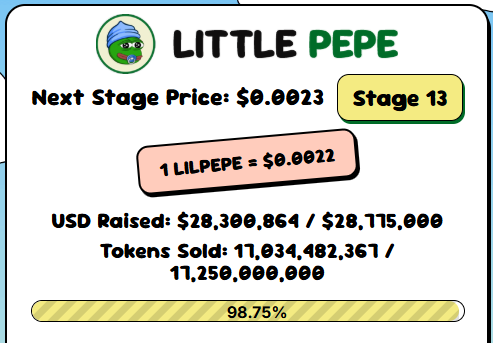 Source: official website
What Is Actually Confirmed So Far
LBank and Phemex have shown live LILPEPE trading activity at or near $0.003.
Binance's own listing page currently shows LILPEPE as not listed.
The official project website still describes tokens as claimable only after all presale stages close, and explicitly warns against buying LILPEPE on unauthorized DEXs.
No exchange should be treated as confirmed for this Little Pepe listing unless its own trading page or announcement verifies it directly.
Four Factors That Could Decide If $0.003 Holds
Liquidity. Thin order books mean even modest sell orders can move price sharply. Depth, locked liquidity, and withdrawal functionality all matter more than the headline number.
Circulating supply. A $0.003 price means something entirely different at 20 billion tokens in circulation versus 100 billion. Because circulating-supply figures can differ between data providers, market-cap calculations should be checked against the project's official token information and current exchange data.
Unlock schedule. The project's vesting page confirms 0% unlock at token generation, a three-month cliff, then 5% monthly releases. Limited presale selling in the early weeks may support price stability, but later unlocks introduce fresh supply that could pressure it.
Exchange access. Two smaller venues do not carry the same demand depth as several major exchanges combined. Broader access can bring buyers, but it also tends to increase volatility.
Three Market Scenarios, Not Predictions
Trading near $0.003: This could occur if buying and selling activity remains balanced around the stated launch price.
Trading above $0.003: This would indicate that market demand is exceeding available supply at that level.
Trading below $0.003: This could occur if selling pressure exceeds available buying demand.
Future Outlook: Expert Analysis
This Little Pepe listing sits at an inflection point common to large presale launches: a confirmed exchange price does not automatically become a sustainable market price. Liquidity depth, verified circulating supply, and the pace of token unlocks will likely matter more over the coming months than the initial $0.003 figure itself. Investors tracking this LILPEPE launch should watch unlock dates and exchange-volume data rather than anchoring expectations to day-one trading alone.
YMYL Disclaimer: This article is for informational purposes only and does not constitute financial, investment, or trading advice. Cryptocurrency and presale investments carry significant risk, including total loss of capital. Readers should independently verify all figures and consult a licensed financial advisor before making investment decisions. CoinGabbar does not guarantee the accuracy of third-party pricing data referenced in this article.