UK crypto access is again under scrutiny after a crypto advocacy group reported thousands of customer complaints about difficulties transferring money from major banks to cryptocurrency platf
UK crypto access is again under scrutiny after a crypto advocacy group reported thousands of customer complaints about difficulties transferring money from major banks to cryptocurrency platforms. The allegations center on uneven or restrictive outbound transfer policies, ranging from hard limits per transaction to outright bans.
According to a report reviewed by Cointelegraph, Stand With Crypto says 9,803 people submitted 10,092 complaints to UK banks over a 90-day period between May and August 2026. The group collected submissions through its online tool, targeting restrictions on transfers to crypto platforms as the UK prepares to move toward a new digital asset regulatory regime in 2027.
Key takeaways
- Stand With Crypto reports 10,092 complaints to UK banks between May and August 2026 regarding crypto-related transfer restrictions.
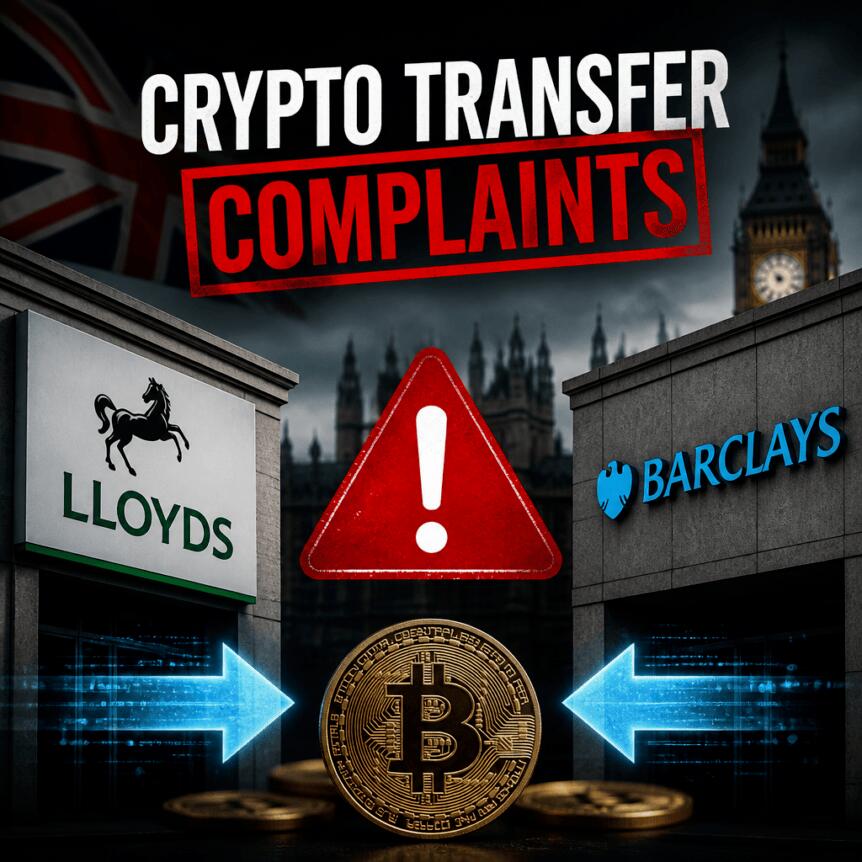
- Lloyds Banking Group received the highest number of complaints (2,297), followed by Barclays (1,569) and NatWest Group (1,278).
- Some banks are reported to limit crypto transfers to £2,500 per transaction and £10,000 over 30 days, while others reportedly ban crypto-related transfers entirely.
- Some institutions were described as having no published restrictions despite still receiving customer complaints.
- Even with planned FCA oversight for crypto firms, access to business banking may remain outside the new authorization framework.
Thousands of complaints point to inconsistent banking rules
The reported complaints highlight a patchwork of customer experiences with outbound transfers linked to cryptocurrency platforms. Stand With Crypto says its tool received 10,092 complaints from 9,803 users over the 90-day window ending in August 2026.
While the numbers do not by themselves prove wrongdoing, the pattern—complaints concentrated among large retail banks—suggests that bank-level risk controls and transfer screening processes can materially affect whether customers can reach crypto services. The report’s attention to large banking groups also matters because those institutions serve a significant share of the UK’s retail customer base.
Which banks drew the most scrutiny
Stand With Crypto’s review, as assessed by Cointelegraph, found the highest complaint volume at Lloyds Banking Group with 2,297 reports. Barclays followed with 1,569 complaints, and NatWest Group recorded 1,278.
The reported distribution is notable because it frames the issue as one affecting major on-ramps to the crypto market. When banks with large customer bases restrict transfers, the impact can extend beyond individual transactions and into broader questions about the UK’s accessibility for crypto users.
Limits, bans, and “no published restriction” claims
The report also distinguishes between banks that publicly describe transfer constraints and those that do not appear to publish clear limits—or at least not in a way that users or the advocacy group could identify.
Barclays and HSBC UK were listed as limiting crypto transfers to £2,500 per transaction and £10,000 over a 30-day period. In contrast, six banks, including Starling Bank, TSB and Chase UK, were listed as banning crypto-related transfers entirely.
Stand With Crypto’s findings further complicate the picture with two categories that appear to reflect either policy ambiguity or practical enforcement differences. The group classified Lloyds Banking Group and Revolut as having no published crypto transfer restrictions, even though they were among the banks that still received complaints.
Revolut’s support page says some transfers are unsupported
Cointelegraph reported that Revolut’s official support materials state that transfers to “some cryptocurrency exchanges” are unsupported. A Stand With Crypto spokesperson suggested this looked more like a technical issue than an explicitly stated policy.
For users, the practical distinction may be less important than the outcome: if transfers are declined consistently, the end result is a barrier to accessing crypto services. At the same time, the existence of “unsupported” transfer messaging raises an interpretive question—whether banks and fintechs are setting clear boundaries through published policy, enforcing internal risk rules without detailed public guidance, or both.
Beyond the immediate customer complaints, the dispute ties into broader UK ambitions to position itself as a global crypto hub. Nick Jones, founder and CEO of Zumo, told Cointelegraph that banking restrictions are a common hurdle for UK crypto founders and could undermine competitive growth.
Jones argued that restricted access to banking services needs urgent attention so UK crypto firms can operate on a more level basis and scale without being hamstrung by inconsistent banking practices.
Crucially, Jones cautioned that the UK’s incoming crypto regulatory regime may not directly address the banking problem. Although companies are preparing for mandatory approval under the Financial Conduct Authority framework in October 2027, Jones said that access to a business bank account sits outside that authorization structure.
His warning is that a firm could successfully obtain the required regulatory status while still facing obstacles to opening or operating a business banking relationship in the UK. In that scenario, regulatory authorization would not automatically translate into operational accessibility—leaving a gap between formal compliance and day-to-day feasibility.
What to watch next
For UK crypto users and founders, the key unknown is whether these complaints reflect temporary technical failures, risk-policy changes, or long-standing enforcement of outbound transfer controls. The next developments to monitor are how banks and fintechs explain their transfer handling rules—and whether the 2027 regulatory rollout meaningfully improves access to business banking, not just crypto oversight.
This article was originally published as Lloyds and Barclays Targeted in UK Crypto Transfer Complaints, Group Says on Crypto Breaking News – your trusted source for crypto news, Bitcoin news, and blockchain updates.