Louisiana prediction markets are at the center of a legal fight after state officials sought to block event contracts and the Commodity Futures Trading Commission (CFTC) responded with a fede
Louisiana prediction markets are at the center of a legal fight after state officials sought to block event contracts and the Commodity Futures Trading Commission (CFTC) responded with a federal lawsuit. NewsBTC reported the clash on November 16. It could shape whether states can restrict products the federal agency says fall under its authority.
- Louisiana sued 32 entities on November 12 over event-contract offerings, according to the CFTC’s account of the state complaint.
- A state judge issued a temporary order requiring defendants to block access for Louisiana residents unless they have state authorization, The Block reported.
- The United States and CFTC sued Louisiana on November 13, arguing federal commodities law preempts restrictions on contracts traded on CFTC-registered markets.
- The dispute covers sports, elections, awards and other event contracts. The temporary order is not a final ruling that every product is unlawful.
- The next reported hearing on Louisiana’s preliminary-injunction request is November 30.
Timeline of the Louisiana prediction markets dispute
- November 5, 2026: The CFTC issued guidance on impartial access for designated contract markets. It said its rules generally don’t allow exchanges to exclude otherwise eligible US participants based on location.
- November 12, 2026: Louisiana Attorney General Liz Murrill sued 32 entities in Tangipahoa Parish state court, seeking a temporary restraining order, a preliminary injunction and civil penalties over event contracts. Judge Jeffrey Johnson issued an ex parte temporary order later that day. The Block reported it bars offering or facilitating contracts to Louisiana residents without a state license and requires geographic restrictions.
- November 13, 2026: The United States and CFTC filed a federal complaint seeking a declaration that Louisiana gambling laws are preempted as applied to CFTC-regulated event contracts, and an injunction against enforcing or extending the state order. The federal complaint states the government’s legal position, not a court’s conclusion.
- November 14, 2026: The Block reported sharp public criticism from Murrill and CFTC Chairman Michael S. Selig as both sides defended their positions.
- November 30, 2026: The state’s preliminary-injunction hearing is scheduled for this date, according to The Block. The federal lawsuit has a separate process and timetable.

Louisiana sought emergency restrictions in state court on November 12.
Why Louisiana prediction markets raise a jurisdiction question
The central issue is how to classify a contract whose outcome depends on an event. The CFTC says event contracts traded on its registered designated contract markets are swaps under the Commodity Exchange Act and fall within its exclusive jurisdiction. Louisiana’s case seeks to apply state licensing requirements to certain event-contract offerings, while the federal complaint argues that state gambling laws are preempted as applied to CFTC-regulated contracts.
The courts haven’t settled where the boundary lies. As NewsBTC explained, platforms may offer different contract types, making the state order’s scope and future rulings important. A temporary order addresses an immediate dispute; it doesn’t decide whether every prediction-market product is lawful nationwide.
The case tests how federal market rules interact with state authority.

The lawsuits ask courts to define the boundary between state and federal authority.
The CFTC’s November 5 guidance said location-based limits could conflict with impartial-access requirements for eligible participants. CoinDesk reported on November 6 that the agency also warned geographic restrictions could fragment liquidity and impair price discovery. Critics quoted in the report said the position could encourage platforms to resist court orders.
The CFTC has described Louisiana’s action as an overreach. In its November 13 announcement, Chairman Michael S. Selig called the state’s move “naked lawfare and a cynical political stunt.” The agency said Louisiana was the 12th state it had sued over its claimed exclusive authority over derivatives markets. Its public statement on the lawsuit sets out that position.
Murrill responded on November 14, calling Selig an “obsequious standard bearer” for prediction markets and arguing that states have regulated gambling for 250 years, according to The Block. Kalshi said the dispute shows why Congress gave the CFTC exclusive jurisdiction. Polymarket argued for a federal framework instead of a state-by-state patchwork.
Companies named in coverage include Kalshi, Polymarket, Coinbase and Robinhood, among others. Their products and legal positions may differ, and a ruling about one contract or platform wouldn’t automatically resolve every market category.
What the cases could mean for users and operators
Conflicting requirements could lead platforms to geofence customers, pause products or change contract terms. Availability for users may depend on location, while the regulator overseeing a dispute could affect which protections apply. These are possible consequences, not outcomes ordered in every case.
The Block reported that the temporary restraining order would expire after 10 days unless extended, with the preliminary-injunction hearing set for November 30. That makes the state hearing an immediate checkpoint, not a final verdict. The federal case may proceed on a different schedule.
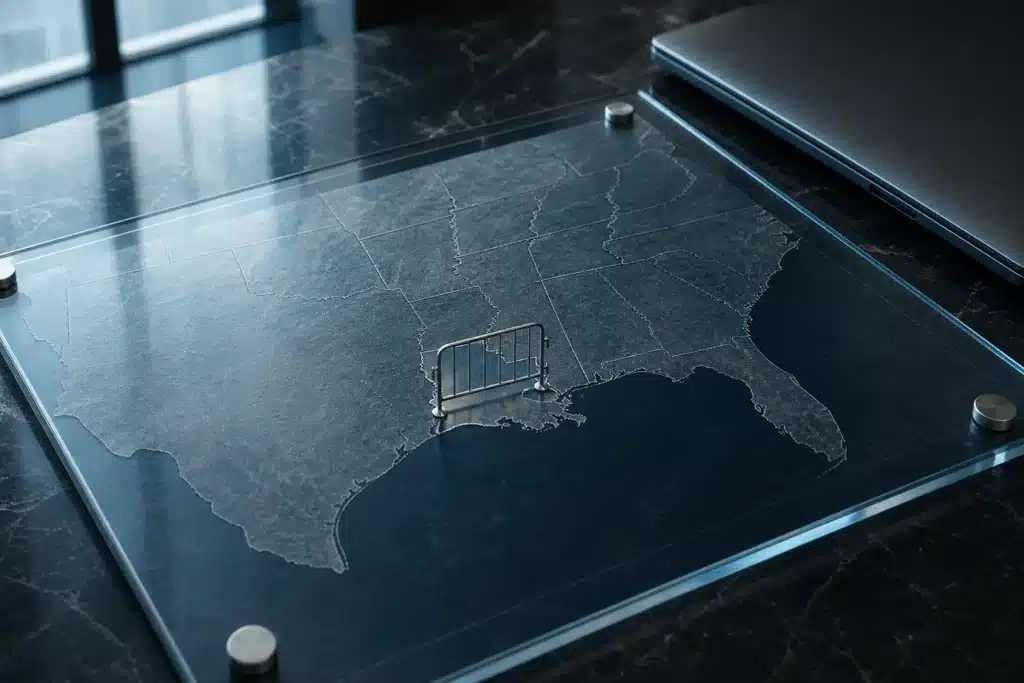
A court ruling could determine whether platforms must restrict access by location.
Outlook for Louisiana prediction markets
Key developments include whether the state court extends, changes or lets the temporary restrictions lapse, and whether the federal court grants requested relief. The wording matters: a broad jurisdiction ruling could have a different practical effect from one limited to specific products or defendants.
The dispute may affect platform access and operating costs. Its outcome remains uncertain while the state and federal cases proceed, and the cited reporting focuses on legal and regulatory questions.
FAQ
What is the Louisiana prediction markets lawsuit about?
Louisiana says certain event contracts require state authorization. The CFTC and federal government argue that contracts on CFTC-registered designated contract markets are federally regulated derivatives and fall outside the state restrictions at issue.
Does the temporary order settle whether prediction markets are legal?
No. It’s an interim measure in Louisiana while the case proceeds. It doesn’t establish that every event contract or platform is unlawful across the United States.
When is the next major hearing?
The state preliminary-injunction hearing is reported for November 30, 2026. The federal lawsuit is separate and may follow a different timetable.
Related Articles
Sources
This article is for informational purposes only and does not constitute financial or investment advice. Cryptocurrencies are highly volatile; always do your own research before investing.
Read More:Louisiana Prediction Markets Face a Federal-State Showdown">Louisiana Prediction Markets Face a Federal-State Showdown