TL;DR CryptoQuant’s 14-day average altcoin-Bitcoin correlation has fallen to around 0.26–0.27, indicating weaker co-movement. Analysts say the low correlation reflects market dispersion, not
TL;DR
- CryptoQuant’s 14-day average altcoin-Bitcoin correlation has fallen to around 0.26–0.27, indicating weaker co-movement.
- Analysts say the low correlation reflects market dispersion, not a confirmed altcoin season or bullish decoupling.
- The current setup resembles early May, when altcoins briefly moved more independently before market dynamics shifted.
- Narrow market leadership suggests capital is flowing into select altcoins instead of the broader market.
The relationship between Bitcoin and the wider altcoin market has weakened significantly, according to fresh on-chain data, but analysts say investors should avoid interpreting the trend as evidence of an impending altcoin season.
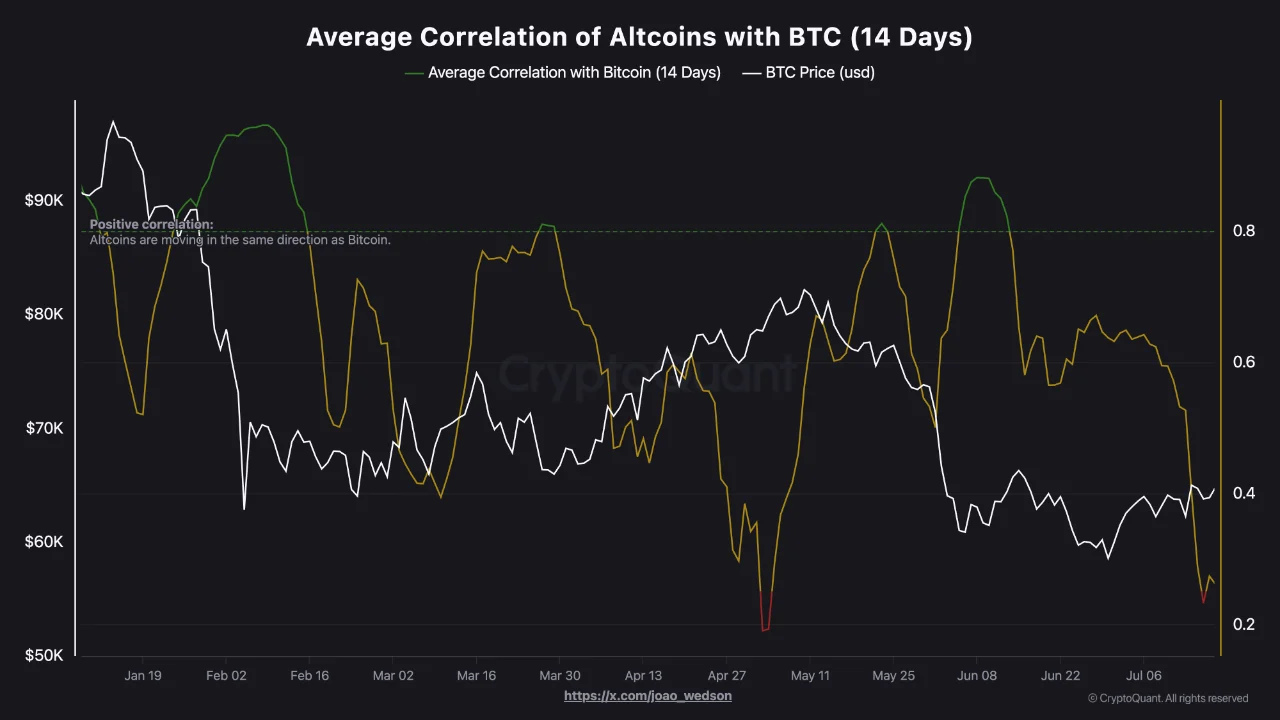
CryptoQuant’s latest 14-day average correlation metric shows altcoins currently have a correlation of roughly 0.26–0.27 with Bitcoin, one of the lowest readings in recent months. While lower correlation means altcoins are moving more independently from BTC, analysts argue the data reflects increasing market fragmentation rather than widespread strength across alternative cryptocurrencies.
Altcoin Data | Source:
CryptoQuantAltcoins are no longer moving in lockstep with Bitcoin
Correlation measures how closely assets move together. A reading close to 1.0 indicates nearly identical price movements, while lower values suggest the assets are behaving more independently.
CryptoQuant’s latest data shows the average correlation between Bitcoin and major altcoins has dropped to approximately 0.26, well below the levels seen during periods when the broader crypto market moves as a single asset class.
The accompanying chart shows a similar decline occurred in early May, when Bitcoin and altcoins briefly decoupled before market dynamics shifted again. Although lower correlation often sparks speculation about an approaching altcoin rally, analysts caution that the metric alone does not signal that altcoins are outperforming Bitcoin across the board.
Instead, it indicates that price action has become increasingly dispersed, with only select tokens attracting meaningful investor attention.
Narrow leadership replaces broad participation
Historically, strong crypto bull markets tend to lift most digital assets together.
However, as market rebounds mature, leadership frequently narrows, with capital rotating into a smaller number of outperforming projects while the majority of altcoins struggle to keep pace.
The current low-correlation environment appears consistent with that pattern.
Rather than signaling widespread bullish momentum, the data suggests investors are becoming increasingly selective, concentrating capital in a handful of stronger-performing assets while many other cryptocurrencies trade independently or lag behind.
This type of market fragmentation has become more common as institutional investors focus on projects with stronger fundamentals, clearer regulatory positioning, or growing real-world adoption.
Bitcoin remains the market’s primary driver
Despite the weakening correlation, Bitcoin continues to set the broader direction of the digital asset market.
Recent weeks have seen Bitcoin benefit from renewed institutional demand, with U.S. spot Bitcoin ETFs returning to net inflows after several sessions of volatility. At the same time, whale wallets have continued accumulating BTC, while exchange reserves have remained relatively subdued, reinforcing the view that long-term investors are maintaining confidence.
Against that backdrop, analysts warn that today’s low-correlation environment could quickly reverse if Bitcoin experiences a meaningful correction.
Should BTC begin to decline, independent altcoin performance may fade as investors reduce risk across the sector, causing the market to return to its more familiar Bitcoin-led trading behavior.
Dispersion remains the key signal
The current data does not necessarily point to weakness in the crypto market, but it does suggest investors should avoid assuming that all altcoins will benefit equally from improving sentiment.
Periods of low Bitcoin-altcoin correlation often coincide with increased dispersion, where a limited number of projects outperform while many others underperform or trade sideways.
For traders and portfolio managers, this places greater emphasis on asset selection rather than relying on broad market exposure.
Until correlation begins rising again or participation expands across a wider range of cryptocurrencies, analysts say the market is likely to remain highly selective.The next major signal may come from Bitcoin itself.
If BTC continues climbing steadily, the current fragmented environment could persist, allowing market leadership to remain concentrated among a small group of altcoins.
However, if Bitcoin experiences renewed volatility or a broader pullback, analysts expect correlations to increase again as risk appetite weakens across the crypto market.
For now, CryptoQuant’s latest data suggests the current environment is better described as one of dispersion rather than decoupling, reminding investors that low correlation alone should not be mistaken for evidence of a broad-based altcoin rally.
The post Low Altcoin–Bitcoin Correlation Points to Market Fragmentation Rather Than a Broad Rally appeared first on Blockonomi.