Every place in Nigeria now has an identity. The harder question has always been: what is the best way to get there? That is the question Maiaddy says it is answering today. The Aba-based loca
Every place in Nigeria now has an identity. The harder question has always been: what is the best way to get there? That is the question Maiaddy says it is answering today.
The Aba-based location company is expanding Maimaps from a search-and-navigate layer built on Loccodes into a routing engine for logistics platforms, delivery services, and mobility companies. The same identifier that tells a rider where a shop sits can now be passed into a route request that calculates how to reach it, when to arrive, and how to replan when the road in front of the rider disappears.
Founder and CEO Obinna Onyejeli put the ambition in a single sentence. “When you build routing on top of Loccodes, every coordinate is trustworthy, every route is calculated on real data, and every arrival time means something,” he said. “We could have built this as a separate product. We built it inside Maimaps instead, because a location platform that can’t tell you the best way to reach a place is only half finished.”
Nigeria’s logistics and mobility markets have grown faster than the addressing infrastructure underneath them. Dispatch rooms still run on a ritual that operators know too well. A written address, two or three confirmation calls, a voice note, a landmark, and a hope that the rider and the customer are describing the same landmark.
“Delivery companies make multiple confirmation calls before dispatching a rider because they cannot trust that a written address will resolve to the right location,” Onyejeli said. “Drivers navigate by voice note and landmark description. Route planning is often manual or dependent on tools built for markets where addresses are standardised and reliable.”

Obinna Onyejeli, founder and CEO of Maiaddy
Maiaddy’s argument is that the stack had to be built in sequence. Loccodes, launched in November 2024, were meant to solve identity: a short, stable, machine-readable code for every street in Nigeria, with notable landmarks getting their own. Maimaps, launched on July 28, 2026, was meant to solve accessibility: a consumer app and developer API where a Loccode could be typed, pasted, searched, and navigated without converting it into another address format. Routing intelligence is the third layer. One identity, one map, one API: find, share, reach, and now optimise.
What shipped under Maimaps’ new precision routing API?
The product is not a new consumer brand. It is an expansion of the existing Maimaps developer API. Origins, destinations, and waypoints can be expressed as Loccodes that resolve to verified coordinates rather than interpreted street text. Before a route is calculated, the same API can geocode and verify the address. After that, Maiaddy says the engine can optimise against live traffic, road closures, and delivery demand; produce arrival times from current conditions rather than historical averages; and guide riders to exact pickup and drop-off coordinates instead of an approximate street corner.
That last point matters in a market where “the street” is often not precise enough. A Loccode in Maiaddy’s model is assigned per street. The routing layer then tries to learn the last few metres. “While the loccodes are per street, the API’s model can learn things like if an order is regularly placed from a certain point on a loccode, the exact pickup and drop-off point is probably within 5 metres of that spot,” Onyejeli said.
For consumers, the company says smarter navigation will appear automatically in the latest Maimaps app. For developers, the pitch is consolidation. The Loccode that identifies a destination in the consumer app can be dropped straight into a route request. Documentation and SDKs are live on Maiaddy Developers.
The commercial claim is broader than a map update. E-commerce and delivery platforms get verification before dispatch. Ride-hailing services get a tighter match between where a passenger thinks the car will stop and where it actually stops. Multi-stop logistics operators get fleet-level optimisation that, in theory, keeps recalculating as conditions change.
The obvious objection is scale. Global routing engines lean on open datasets and dense probe-vehicle telematics. Secondary cities like Aba and the informal edges of Lagos do not behave like those training grounds. Roads appear, erode, get blocked by markets, or vanish behind informal barricades.
Onyejeli did not pretend Maiaddy already has Google’s fleet density. “Maimaps already incorporates the same technologies you’d find in a global tech giant. What we currently lack and are working on is adoption at scale. This is what makes fleet telematics work best,” he said. “So we’re currently playing catch-up in terms of live traffic data, but we’re probably on par in terms of road graph because Nigeria is currently our sole focus and we have individuals making contributions. We are probably ahead in navigation experience, though.”
That last clause is the company’s real bet: that a Nigeria-only graph, maintained by people who live inside the mess, can outperform a global product that treats Nigeria as one more market. Dynamic disruptions, unannounced construction, localised flooding, and impromptu checkpoints are ingested the same way. “We rely heavily on information and data provided by our users,” Onyejeli said. “But once new information is verified and implemented, the resulting manifestation can be reasonably described as ‘immediately’.”
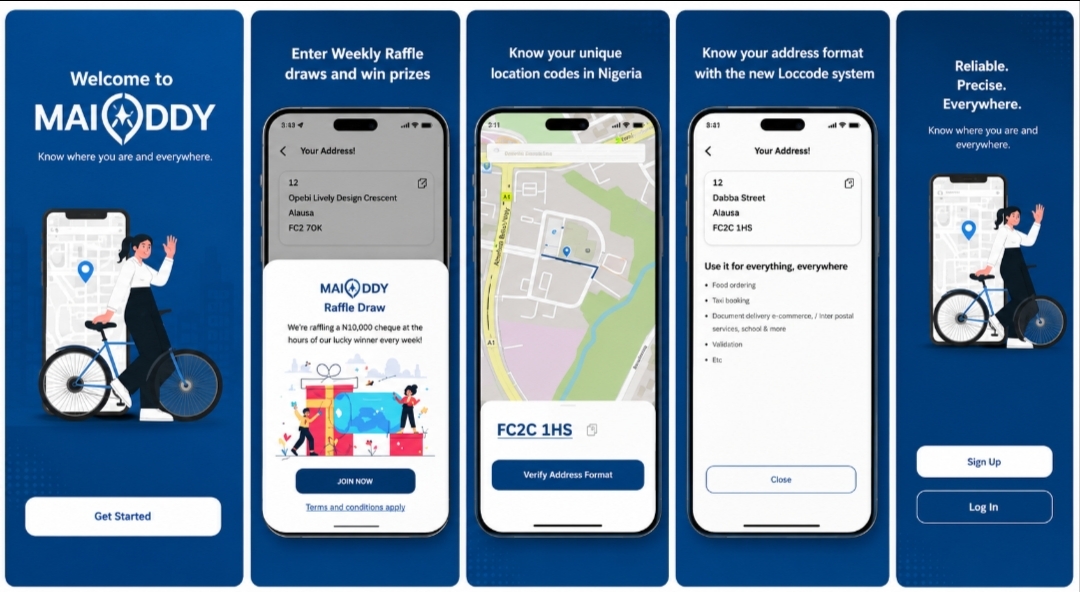
Maiaddy
Asked what happened when early enterprise users put the routing layer into live dispatch, Onyejeli said, “Zero failures for everyone who had experienced failed deliveries.
Maiaddy: One API, priced in Naira
Engineering teams that have spent years wrapping Google Maps and Mapbox will ask a more practical question than terrain algorithms: how painful is the rewrite, and what does it cost?
Onyejeli’s answer was deliberately local. “I like to describe the integration of our APIs as being Apple-grade in terms of engineer-user experience. All the relevant documents are available and detailed. As a Nigerian company, our pricing is in naira, and we won’t be beaten on price in Nigeria because it is our own turf.”
The developer surface already includes a Loccode API for address resolution and a Maimaps API for vector maps, place search, reverse geocoding, and now routing, with TypeScript SDKs and a console for key management. The strategic idea is that operators should not need one vendor for identity and another for movement.
Routing intelligence that dies when the rider leaves a Tier-1 data corridor is not intelligence. Onyejeli treated low bandwidth as a design constraint, not a footnote.
“Low-bandwidth corridors are a mainstay in the Nigerian reality, and every serious business building for our market accounts for this in the engineering process,” he said. “The Maimaps mobile app has an ‘offline maps’ feature going live in Q4. This feature makes it possible to resolve loccodes locally.”
The NIPOST shadow
No Maiaddy story is complete without the postal service. In 2024, the company offered NIPOST Loccodes for free and heard nothing. That silence is why Maimaps exists at all. Technext has previously reported that Onyejeli emailed the postmaster-general, tagged the institution in public, and used intermediaries. None of it produced a partnership. So Maiaddy built the distribution layer itself.
The federal government is now rolling out its own GIS-enabled digital alphanumeric postcode, with a nationwide launch framed around October 2026, 11-character building-level codes, and a growing conversation about linking location to national identity. NIPOST has also talked about routing on top of that system.
Onyejeli is not pretending the two efforts occupy different planets. He is also not impressed.
“Routing is very complex and resource-heavy, so if NIPOST takes on that, I’d be very surprised,” he said. “That aside, I’m generally bearish on their new postcode system for a few reasons: (1) Eleven characters for a postcode seems excessive to me; (2) Having your home findable directly from your postcode, especially in a country where ‘Abduction as a Service’ is a business model, seems off to me despite the advertised benefits; (3) and even worse, the plan to link it to NIN is perhaps the biggest recipe for disaster in the entire endeavour.”

He then stepped back from a pure rivalry frame. “We’re not competing with them in the traditional sense since there are What3words and Codes alongside various national addressing systems. Ultimately, people and businesses will implement what works for their specific use case, and we’re open to collaboration.”
Maiaddy now spans three layers: Loccodes for place identity, Maimaps for consumer navigation, and enterprise routing APIs for movement. The question hanging over the stack is whether the company wants to remain invisible infrastructure inside other logistics apps or to take the consumer map fight across Africa.
Onyejeli refused the binary. “The possibilities are far beyond what is conceivable right now in the B2B and consumer verticals, and we intend to push to fully explore the depths of what’s possible.”
The opportunity is the thing Onyejeli keeps returning to. Nigeria does not suffer from a shortage of map tiles. It suffers from a shortage of trustworthy places and trustworthy paths between them.
“Nigeria is one of the most dynamic economies in the world, but for too long, the inability to reliably identify and reach a location has created friction that slows everything down,” he has said. “We built Maimaps for every Nigerian who has ever had to describe their location in a voice note.”