Tether has given the last users of its gold-backed lending platform just weeks to pull their assets out before it closes for good. The company is best known for USDT, the world's largest stab
Tether has given the last users of its gold-backed lending platform just weeks to pull their assets out before it closes for good.
The company is best known for USDT, the world's largest stablecoin, a digital token designed to trade at a fixed value, in this case one U.S. dollar.
Related: Popular gold holder shuts down dollar experiment
That peg is maintained by a large reserve portfolio. As of Tether's second-quarter 2026 attestation, reviewed by accounting firm BDO, the reserves totaled about $187.8 billion and were held mostly in U.S. Treasury bills and cash-equivalents (roughly 80%), alongside about $18.8 billion in gold, roughly $7 billion in Bitcoin, and a smaller pool of secured loans and other investments.
That gold pile is what makes Tether unusual. The company reported holding more than 146 metric tons of physical bullion at the end of the second quarter — worth roughly $18.8 billion and stored in a private Swiss vault — after adding 14 tons during the quarter.
That makes Tether the largest known private holder of physical gold outside of central banks and sovereign governments, with more bullion than many national reserves.
What Tether is shutting down
In June, Tether said it would wind down Alloy, a separate platform it launched in 2024 that let users mint a dollar-pegged token called aUSDT. New minting has already closed.
Unlike USDT, aUSDT was not backed by dollars or Treasuries. It was backed by Tether Gold (XAUT), Tether's token that represents ownership of physical gold, with each XAUT standing for one troy ounce of a London Good Delivery bar held in a vault.
Alloy's design was unusual. Rather than holding cash reserves, it let users lock up their Tether Gold tokens as collateral and mint aUSDT against them — an "overcollateralized" model, meaning the gold backing was always worth more than the dollars issued, to cushion against gold's price swings.
The countdown to Sep. 17
Alloy users now have until Sep. 17 to return their aUSDT and reclaim their underlying XAUT tokens representing gold ownership.
As of Aug. 11, that leaves 37 days on the clock.
After the deadline, anyone who has not returned their aUSDT will lose the ability to recover their XAUT gold from the platform, making the coming weeks the last window to act.
For all the finality, the data shows how small the experiment stayed.
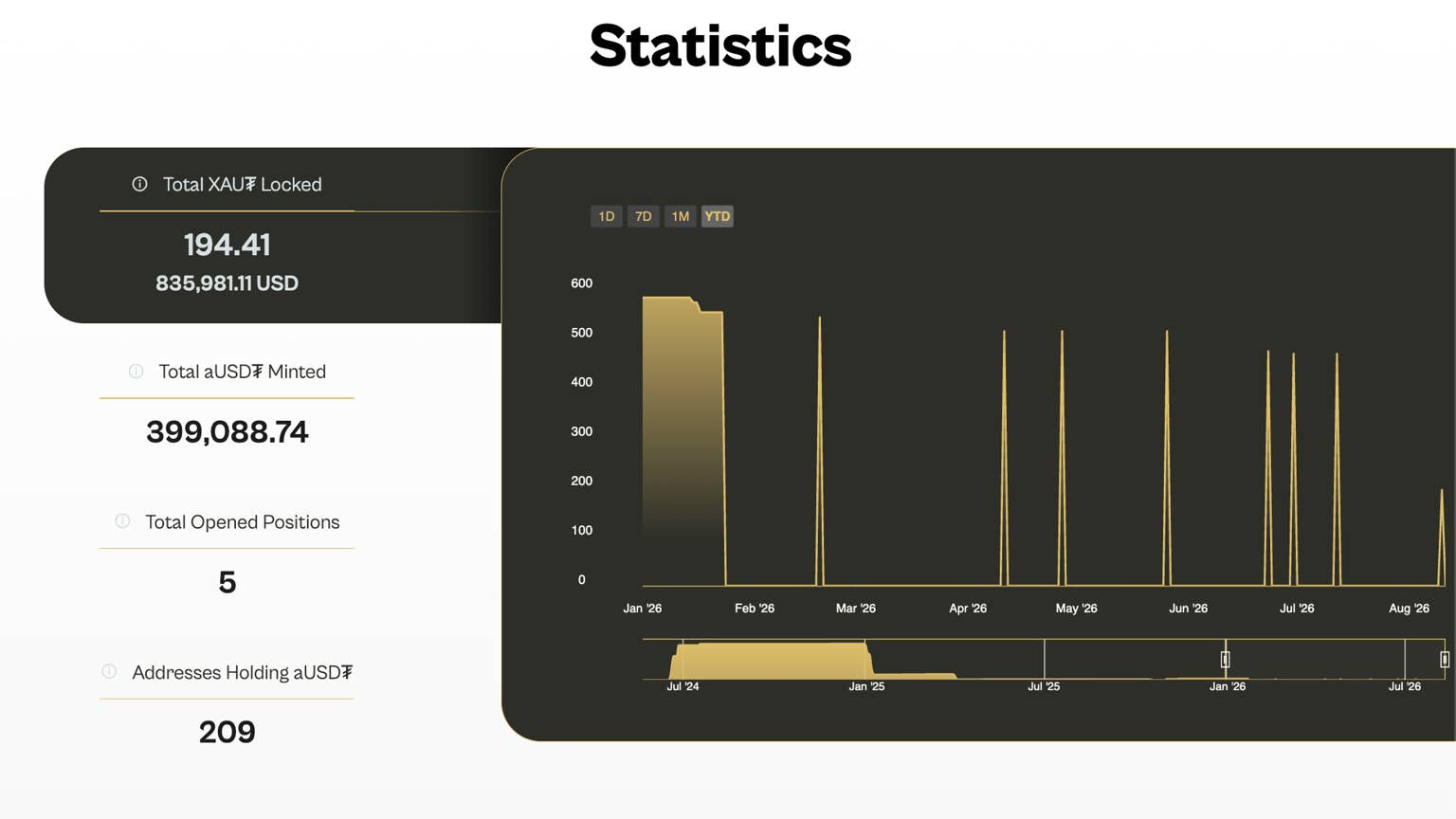
Alloy's statistics page lists just five open positions remaining, with about 399,089 aUSDT still owed against 194.41 units of Tether Gold, worth roughly $836,000, held as collateral.
The platform has drawn 209 addresses holding aUSDT over its lifespan.
Trending on TheStreet Roundtable:
Nearly all the outstanding balance sits with three holders: one owes about 300,750 aUSDT, another 95,308, and a third 3,008.
Set against Tether Gold as a whole, the amount locked in Alloy is tiny. By one illustration from when the wind-down was announced, for every $10,000 of Tether Gold in circulation, only around $3 sat inside Alloy, leaving the vast majority of the token untouched.
Tether Alloy Statistics
Gold stays, the experiment goes
Tether has been clear that it is not stepping away from gold. Tether Gold (XAUT) remains one of the products the company says it wants to focus on. What is ending is Alloy and the aUSDT token built on top of it.
Tether called the decision as a way to "focus resources on areas where it is seeing stronger user demand, deeper liquidity, and broader long-term market opportunity, including XAUT and other core products across its ecosystem."
Related: Bitcoin miner pledges 18,750 BTC for $600M, here's what it means