TLDR Major US equity indexes declined Wednesday amid a surge in government bond yields. The benchmark 10-year Treasury yield broke above 5%, marking its highest point in seventeen years. Tech
TLDR
- Major US equity indexes declined Wednesday amid a surge in government bond yields.
- The benchmark 10-year Treasury yield broke above 5%, marking its highest point in seventeen years.
- Technology shares experienced significant selling pressure following consecutive record closes for the Nasdaq.
- Market participants are focused on Thursday’s scheduled summit between President Trump and Chinese President Xi Jinping.
- Crude oil prices continued their ascent as geopolitical tensions involving Iran and inflation worries persisted.
US stocks experienced losses Wednesday as government bond yields surged dramatically, creating headwinds for technology companies while market participants anticipated the upcoming meeting between President Donald Trump and Chinese President Xi Jinping.
The Dow Jones Industrial Average retreated approximately 0.3%, while the S&P 500 shed roughly 0.4%. The Nasdaq Composite declined around 0.8% following its achievement of back-to-back all-time highs during the previous sessions.
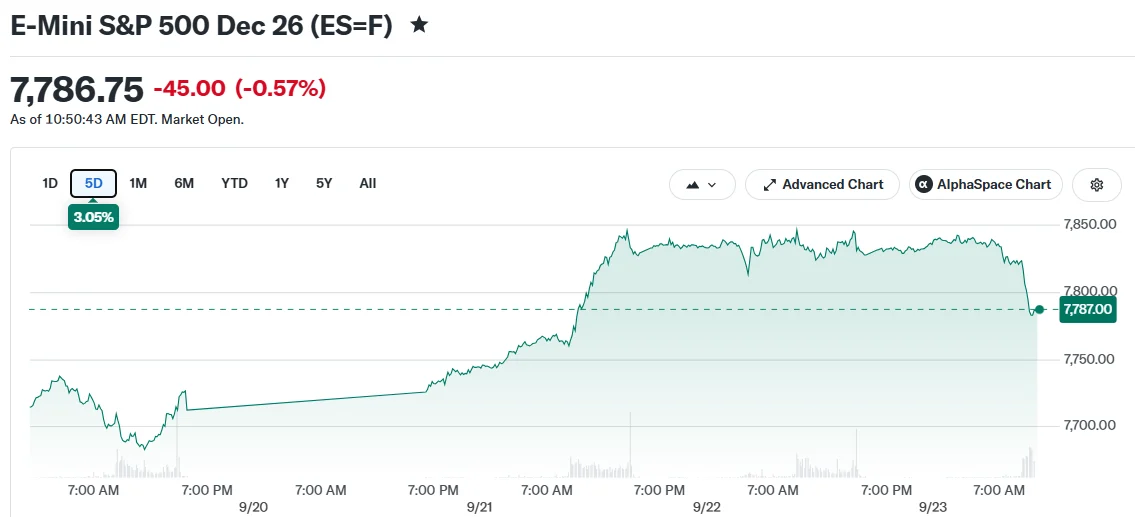 E-Mini S&P 500 Dec 26 (ES=F)
Benchmark Treasury Yield Breaches Critical 5% Level
The primary source of market pressure originated from fixed-income markets. The 10-year Treasury yield advanced past 5.05%, representing its most elevated reading since 2007, after crossing back above the psychologically significant 5% threshold.
Elevated yields typically create substantial headwinds for growth-oriented and technology equities because they diminish the calculated present value of anticipated future profits. The upward movement occurred as market participants continued evaluating inflationary risks connected to energy commodity prices and the continuing strength of the US economic environment.
S&P Global’s preliminary US composite PMI indicated business activity expansion exceeded forecasts, while simultaneously highlighting elevated input costs associated with energy expenses. This data strengthened concerns that inflationary pressures could prove challenging to contain.
Crude oil prices amplified these concerns. Brent crude advanced beyond $101 per barrel, while West Texas Intermediate approached $92 following recent volatility related to the conflict in Iran and expectations for potential diplomatic progress.
Trump-Xi Summit Commands Market Attention
Financial markets are positioning themselves for Thursday’s scheduled dialogue between Trump and Xi in Washington. Reuters has indicated that discussions will likely encompass trade relations, rare earth element supplies, artificial intelligence development, Taiwan issues, and Iran diplomacy.
Xi is conducting his US visit from September 23 through September 25, representing his first American state visit in several years. Market participants generally aren’t anticipating comprehensive breakthrough agreements, but any statements regarding tariff policies, semiconductor export restrictions, or rare earth mineral trade could significantly impact technology and chip manufacturing equities.
Artificial intelligence topics will receive particularly intense scrutiny following competition between Washington and Beijing becoming a defining element of their economic relationship. Reuters noted that investors maintain exposure to AI development ecosystems in both nations despite mounting political tensions and expanding technology transfer limitations.
Iran continues to factor into market calculations. Trump indicated that US-Iran negotiations were progressing and expressed optimism that an eventual settlement could materialize, though geopolitical risk factors remain substantially elevated.
For market participants, the immediate market trajectory may hinge less on Wednesday’s equity declines than on whether yields maintain levels above 5%, oil prices remain at elevated levels, and Thursday’s Trump-Xi discussions yield any unanticipated policy announcements.
The post Markets Tumble as Treasury Yields Break Through 5% Barrier appeared first on Blockonomi.

 LATEST:
 President Xi Jinping just left Beijing to meet President Trump in Washington, his first state visit to the US capital since 2015.