Key Takeaways Shares of Marvell (MRVL) climbed more than 4% on Monday following reports that Nvidia’s Kyber NVL144 system encountered production challenges, delaying its rollout until 2028. A
Key Takeaways
- Shares of Marvell (MRVL) climbed more than 4% on Monday following reports that Nvidia’s Kyber NVL144 system encountered production challenges, delaying its rollout until 2028.
- According to research firm SemiAnalysis, Nvidia has also scrapped its NVL72x2 rack design after receiving negative feedback from major cloud providers and hyperscalers.
- These obstacles create uncertainty around Nvidia’s ability to scale its Rubin Ultra chip, presenting opportunities for competitors like Marvell to gain traction.
- In its latest quarterly report, Marvell delivered revenue of $2.42 billion, representing a 27.6% increase year over year, with earnings per share of $0.80 aligned with expectations. The company projects Q2 EPS between $0.88 and $0.98.
- Wall Street maintains a “Moderate Buy” consensus on MRVL stock, with price objectives extending to $345, while institutional holders control 83.51% of shares.
Shares of Marvell Technology (MRVL) advanced approximately 4.37% to $256.00 during premarket trading Monday, responding to a report from SemiAnalysis revealing significant production hurdles facing Nvidia’s Kyber NVL144 AI infrastructure platform.
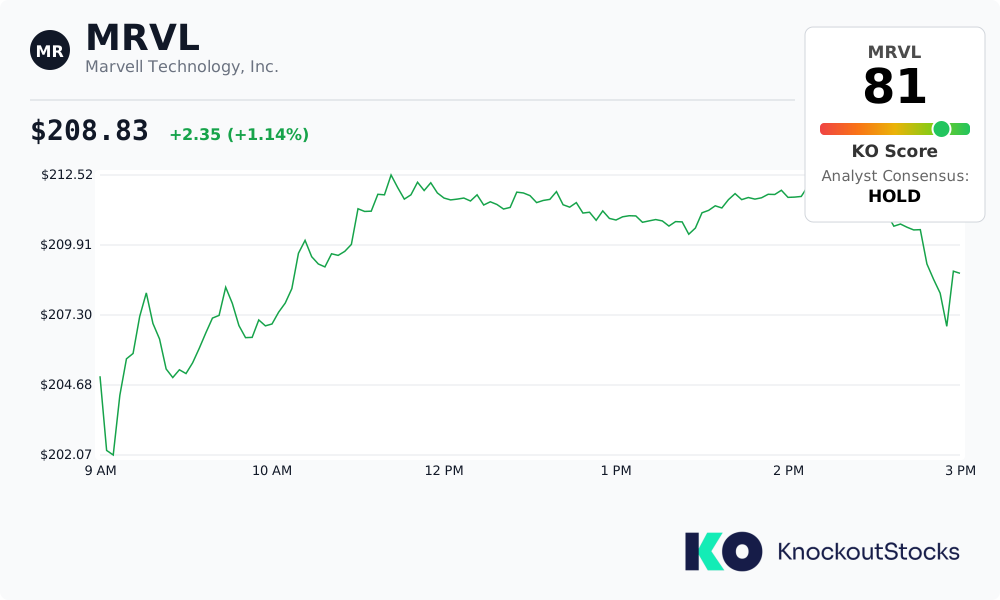 Marvell Technology, Inc., MRVL
The analysis, published on X Sunday evening, indicated that the Kyber NVL144 system encountered serious manufacturing complications merely three months following its unveiling by Nvidia CEO Jensen Huang at the GTC conference. The commercial deployment timeline has reportedly shifted by over a year, now targeting 2028.
According to SemiAnalysis, the delays stem from two primary technical obstacles: complications with the PCB midplane architecture and difficulties surrounding co-packaged optics (CPO) integration.
Compounding matters, Nvidia abandoned its contingency strategy. The company discontinued development of its NVL72x2 back-to-back rack configuration, which was designed to enhance copper NVLink capabilities through dual Oberon rack deployment, following substantial resistance from cloud infrastructure providers and hyperscalers concerned about implementation complexity and operational requirements.
Combined, these developments leave Nvidia without a straightforward pathway to expand capacity for its forthcoming Rubin Ultra processor. SemiAnalysis suggested this situation benefits rivals, specifically mentioning AMD’s MI500X and Google’s TPUv8i Broadfly as positioned to capitalize. The four-compute-die variant of Rubin Ultra has also been terminated.
For Marvell, these circumstances arrive at an opportune moment. The semiconductor company has steadily established itself as a credible alternative in AI infrastructure solutions, especially within optical networking technologies. CNBC’s Jim Cramer recently emphasized Marvell’s positioning in this sector, echoing Huang’s previous statement that Marvell could eventually achieve a trillion-dollar market valuation.
Marvell disclosed its Q1 results on May 27. The company generated revenue of $2.42 billion, marking a 27.6% year-over-year improvement, while delivering earnings per share of $0.80 that precisely met analyst consensus. Management issued Q2 2027 EPS guidance ranging from $0.88 to $0.98. Wall Street analysts project full-year EPS of $3.07.
The company also declared a quarterly dividend of $0.06 per share, scheduled for payment on July 30 to shareholders of record by July 10. This translates to an annualized dividend yield of approximately 0.1%.
MRVL stock trades within a 52-week range of $61.44 to $329.88, carrying a market capitalization near $214.58 billion. Shares opened Monday’s session at $245.29.
Institutional Holdings and Wall Street Outlook
Institutional investors collectively hold 83.51% of outstanding shares. Multiple investment firms expanded their positions during Q1 and Q2. Elevation Point Wealth Partners nearly doubled its holdings, increasing its stake by 98.2% to 15,828 shares. Baird Financial Group expanded its position by 22.7% in the second quarter.
Wall Street sentiment tilts decidedly positive. B. Riley elevated its price objective from $240 to $345 while maintaining a Buy rating. Needham increased its target from $118 to $270, also rating the stock as Buy. William Blair reaffirmed its Outperform recommendation.
Among 37 analysts providing coverage, three assign a Strong Buy rating, 28 recommend Buy, and six rate it Hold. The consensus price target stands at $239.81.
Regarding insider transactions, CEO Matthew Murphy divested 7,500 shares at $177.26 in May, while CFO Daniel Durn sold 2,250 shares at $281.01 in June.
From a technical perspective, MRVL is experiencing a pullback within a broader upward trend. The stock currently trades 9.1% beneath its 20-day moving average of $282.05, though it remains 14.6% above the 50-day moving average at $223.63. The Relative Strength Index registers 46.40, indicating neutral momentum conditions.
The post Marvell (MRVL) Stock Surges 4% as Nvidia Production Setbacks Create New Opportunities appeared first on Blockonomi.