Key Takeaways Shares of Meta Platforms climbed 2% Tuesday morning before settling at a 0.75% gain following reports of accelerated custom AI chip deployment scheduled for early 2027. The prop
Key Takeaways
- Shares of Meta Platforms climbed 2% Tuesday morning before settling at a 0.75% gain following reports of accelerated custom AI chip deployment scheduled for early 2027.
- The proprietary processor, designated MTIA 450 or Arke, represents Meta’s third-generation custom silicon initiative developed alongside Broadcom and TSMC.
- Development of a subsequent fourth-generation chip, named Astrid, will complete its design phase within approximately 30 days, with deployment targeted for late 2027.
- This strategic initiative targets decreased dependence on Nvidia hardware while simultaneously reducing energy consumption and infrastructure expenses.
- Wall Street maintains a Strong Buy consensus on META stock with a mean 12-month price objective of $758.03, suggesting 13.5% appreciation potential.
Meta Platforms (META) shares experienced upward movement Tuesday morning, surging as high as 2% following a Bloomberg report revealing the social media giant’s intentions to deploy proprietary AI processors across its data centers in the first half of 2026. Trading later moderated to approximately 0.75% gains.
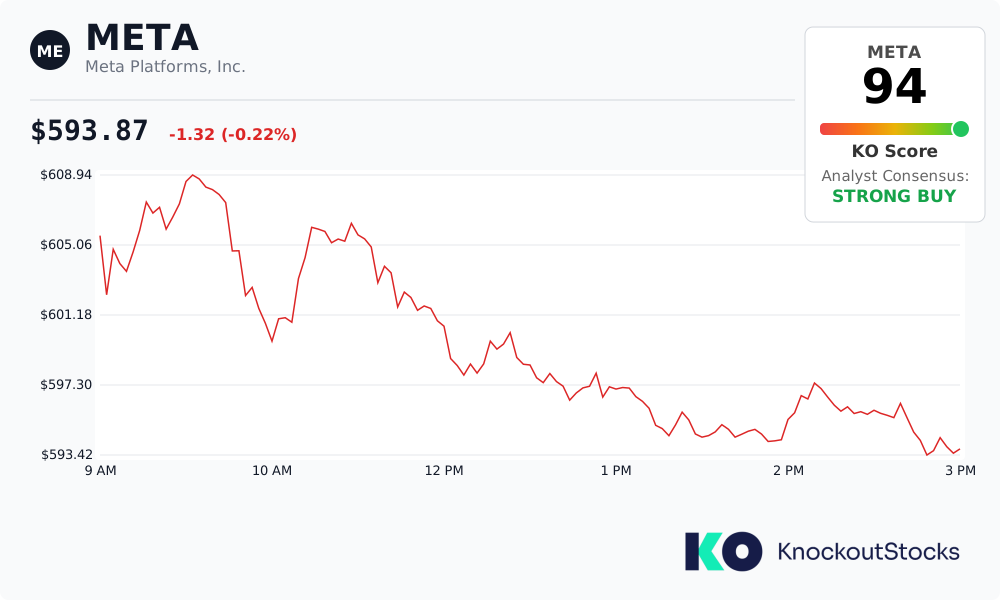 Meta Platforms, Inc., META
The processor generating market attention is designated MTIA 450, alternatively referenced as Arke. This represents the third iteration within Meta’s custom semiconductor initiative, which was initially unveiled in 2023.
Currently, Meta is conducting testing procedures on the Arke processor. A subsequent fourth-generation variant, internally code-named Astrid, is projected to complete design finalization within the coming month, with deployment across data centers anticipated by late 2027.
Yee Jiun Song, serving as Meta’s vice president of engineering and director of the custom semiconductor program, informed Bloomberg that successive chip generations consistently achieve superior performance metrics per watt of energy consumption and per dollar invested when benchmarked against commercially available alternatives.
Song further indicated that these processors can execute AI model operations with greater efficiency than existing Nvidia solutions, especially for inference operations, which represent the phase where AI systems produce real-time responses.
Diminishing Nvidia Reliance
Meta engineered these processors through collaborative partnerships with Broadcom handling design elements and Taiwan Semiconductor Manufacturing (TSMC) managing production operations. The strategic objective centers on diminishing the company’s dependence on Nvidia technology for executing AI computational workloads.
Meta has allocated resources exceeding one gigawatt’s worth of proprietary chips spanning a 12-month timeframe. Song emphasized that operating at such magnitude, absorbing a 30% cost elevation proves financially impractical, underscoring the significance of the internally developed solution.
The initial shipment consisting of 12 test processors arrived from TSMC on September 1. Performance metrics aligned within 2% to 3% variance from design simulations. Immediately upon receipt, engineering teams executed Meta’s proprietary AI models alongside third-party tools from DeepSeek and Alibaba.
Prioritizing Inference Operations
Meta had previously pursued development of a processor designated Olympus, scheduled for 2028 or 2029 deployment, which was architected to manage both model training and inference functions. The company terminated that initiative citing cost considerations.
The current semiconductor strategy concentrates exclusively on inference operations, maintaining reduced costs while fulfilling Meta’s requirements for operating AI tools at substantial scale.
Meta Superintelligence Labs contributes to this effort by communicating forthcoming model specifications to the engineering division, enabling processors to be architected around practical deployment scenarios.
Tuesday’s stock appreciation extends recent positive momentum following Meta’s introduction of the Muse AI agent.
Per TipRanks data, META currently maintains a Strong Buy consensus assessment derived from 44 analyst evaluations conducted over the previous three months. The distribution includes 38 Buy recommendations and six Hold ratings.
The mean 12-month price objective registers at $758.03, indicating 13.5% appreciation potential from present trading levels.
The post Meta (META) Stock Climbs on Custom AI Chip Deployment Strategy appeared first on Blockonomi.