Key Takeaways Meta planned “Project OT” to slash workforce by potentially 60% in certain divisions, substituting human workers with artificial intelligence agents CEO Mark Zuckerberg reversed
Key Takeaways
- Meta planned “Project OT” to slash workforce by potentially 60% in certain divisions, substituting human workers with artificial intelligence agents
- CEO Mark Zuckerberg reversed course mere hours before the second layoff round, capping reductions at 10% (~8,000 positions)
- While AI-generated code surged 220% annually, actual user-visible feature enhancements increased only 36%
- Legal action alleges Meta employed AI systems to specifically identify employees on medical or family leave for termination
- The company intends to allocate at least $130 billion toward AI infrastructure in 2026, potentially exhausting its entire operating cash flow
Shares of Meta (META) gained 1.21% as new revelations emerged about the company’s controversial workforce transformation initiative, pending litigation, and mounting concerns over return on massive AI investments.
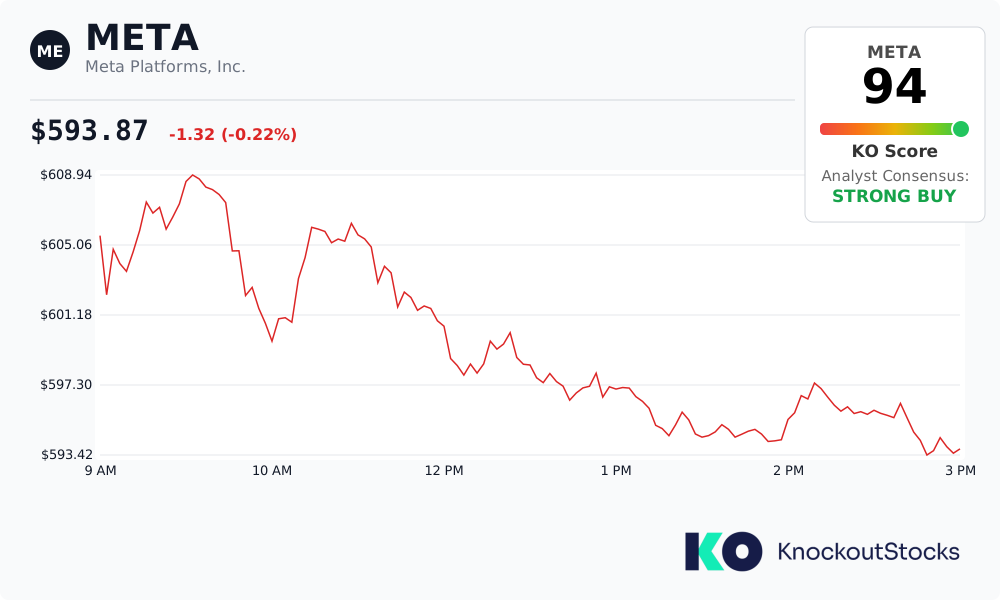 Meta Platforms, Inc., META
On August 26, Reuters released an extensive investigation drawing from confidential company documents and interviews with over 20 sources, exposing the complete picture of Meta’s behind-the-scenes workforce strategy.
The initiative bore the code name Project OT, representing Organization Transformation. Conceived during Meta’s January leadership summit at Zuckerberg’s Hawaiian estate, the program aimed to transform Meta into an “AI native” organization where artificial intelligence agents would assume responsibilities currently handled by human staff.
During strategic planning sessions, leadership contemplated workforce reductions reaching 60% in select departments. The overhaul was designed to unfold across two phases, with phase one launching May 20 and a subsequent phase scheduled for November targeting additional positions.
At that juncture, Meta employed approximately 79,000 people. A 20% reduction would have meant eliminating close to 16,000 positions.
The Strategy Falls Apart
Just hours before the initial round of terminations on May 19, Zuckerberg reversed his decision. Meta proceeded with the 10% workforce reduction the following morning, affecting roughly 8,000 employees, but completely abandoned the planned November phase.
Zuckerberg subsequently assured staff members he did “not expect other company-wide layoffs this year.”
The abrupt change of direction occurred as internal metrics cast doubt on the effectiveness of the AI implementation. While code generation utilizing AI platforms increased 220% year-over-year, modifications producing new or enhanced features visible to end users grew merely 36%.
Security breaches and technical malfunctions, encompassing service outages and potential data compromises, escalated 40% compared to the previous year. Employee hours dedicated to resolving these issues climbed 70%.
Staff resistance was also mounting. Meta had deployed monitoring software on U.S. employees’ computers to record keystrokes and cursor movements, with the goal of training AI agents to mimic human work patterns. Numerous workers concluded they were essentially training their own replacements.
Employee satisfaction plummeted from 74% positive to 55% positive in Meta’s biannual Pulse survey.
The Legal Challenge
A distinct lawsuit initiated in July alleges Meta utilized AI-driven systems to pinpoint and terminate employees who were on medical absence or taking leave to care for family members.
Meta rejected the allegations, declaring that “workforce management and organizational decisions were and are made by people, not AI.”
Employment attorneys cited in Forbes indicated the case may depend on whether Meta’s selection methodology disproportionately impacted employees on leave, and observed that California and New York, where affected employees work, both maintain robust employment protections.
Current Situation
Meta acknowledged Project OT’s existence, characterizing it as a cost-reduction and reorganization initiative. The company clarified it never planned to eliminate 60% of its total workforce, and that multiple major divisions were excluded from the program.
During an internal all-hands meeting in early July, Zuckerberg admitted that AI agent technology had not “accelerated” at the pace he anticipated, though he projected significant advancements within the following three to six months.
Meta intends to commit at least $130 billion to AI processors and infrastructure throughout 2026. Financial analysts predict this expenditure will absorb the company’s complete operating cash for that fiscal year.
META stock was up 1.21% when this report was published.
The post Meta (META) Stock: How Internal AI Rebellion Stopped Zuckerberg’s Mass Layoff Plan appeared first on Blockonomi.