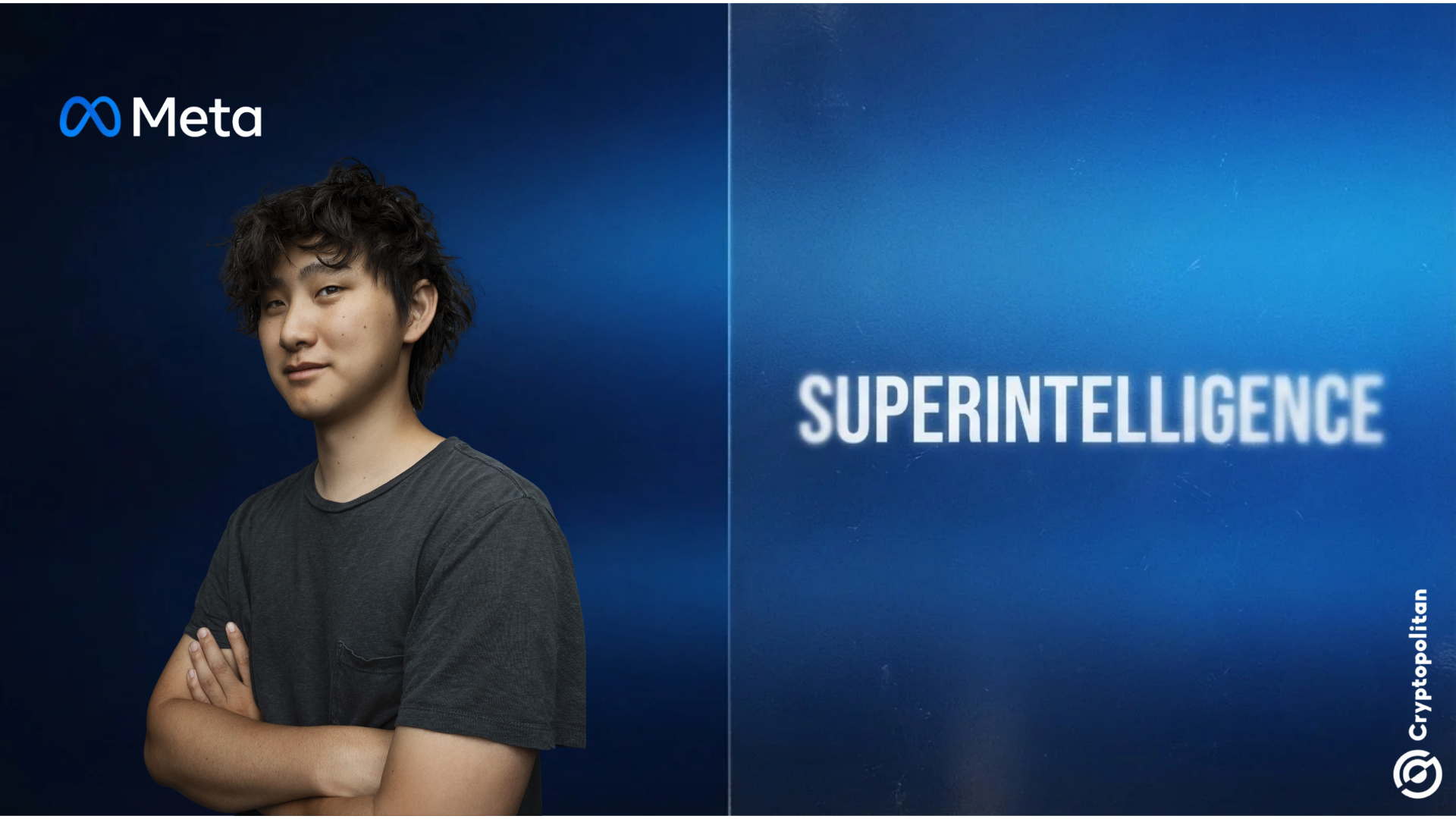
Meta’s Chief AI Officer, Alexandre Wang, sent out a warning on the capabilities of superintelligence and the threat it poses to humanity not being able to control it via an article on X. The
Meta’s Chief AI Officer, Alexandre Wang, sent out a warning on the capabilities of superintelligence and the threat it poses to humanity not being able to control it via an article on X.
The article titled “Superintelligence is arriving” begins with a warning that the decisions humanity makes over the course of the next year could have massive implications for the kind of world future generations inherit.
In June 2025, Meta paid $14.3 billion for a 49% stake in Scale AI, a deal that brought Wang in as Chief AI Officer. He now leads Meta Superintelligence Labs. In his article, he argued that the difficult part of building smarter-than-human systems is probably done. The gaps left, he wrote, come down to domain know-how and the plumbing needed to run experiments.
A Riemann Proof Set Off the Warning
On November 20, Anthropic mathematician Levent Alpöge said he had found a proof of the Riemann Hypothesis while working with Claude. The hypothesis predicts that prime numbers, the ones that only divide by one and themselves, are spread out according to a hidden pattern. The problem dates to 1859 and carries a $1 million Millennium Prize.
Wang described this discovery through AI as “the absolute pinnacle of intellectual accomplishment” for anybody who has studied math.
Alpöge published the proof in Lean, which is a programming language that lets a computer check every step of a math argument.
Wang Says Control is the Open Question
Wang’s biggest contention with the advancements in AI is that he can’t see a scenario where humans can continue to stay in charge of models that improve themselves without any sort of limits. “It is equally hard to imagine a world where humanity maintains control with superintelligence that is 1000x smarter and more capable than humans in every field,” he wrote.
His post urges the need to work on keeping AI safe while under human control with the same level of urgency the industry gives toward releasing new, more capable models. He also took aim at what he called “lazy thinking,” where superintelligence is assumed to be inevitable and safety gets handled later.
One Lawmaker Wants AI Dealt With on Day One
Wang’s post lands in a fight already underway in Washington. Rep. Yassamin Ansari (D-Ariz.) wants the incoming Democratic-led Congress to deal with AI first. After Democrats won both chambers in the November midterms, she posted on X: “Top of the Democratic agenda on day 1 needs to be a pause on advanced AI development, regulation of this out of control industry, and a ban on artificial superintelligence.”
She is an original co-sponsor of the Ban Artificial Superintelligence Act of 2026. Sen. Bernie Sanders (I-Vt.) and Rep. Greg Casar (D-Texas) introduced it in September as S. 5493 and H.R. 10538.
The bill would freeze training, fine-tuning and release of any model built with at least 10^25 operations until a new Department of Artificial Intelligence is staffed and has written safety rules. Superintelligence would be banned for good. Reckless violations could carry up to 20 years in prison.
The Bill Still Has a Long Road
Neither version has cleared committee. The new Congress takes its seats in January 2027, and President Donald Trump has pushed for US dominance in AI rather than a slowdown.
Ansari now has a warning from the head of Meta’s superintelligence effort to point to. Whether it changes any votes is a different question.
Don’t just read crypto news. Understand it. Subscribe to our newsletter. It's free.