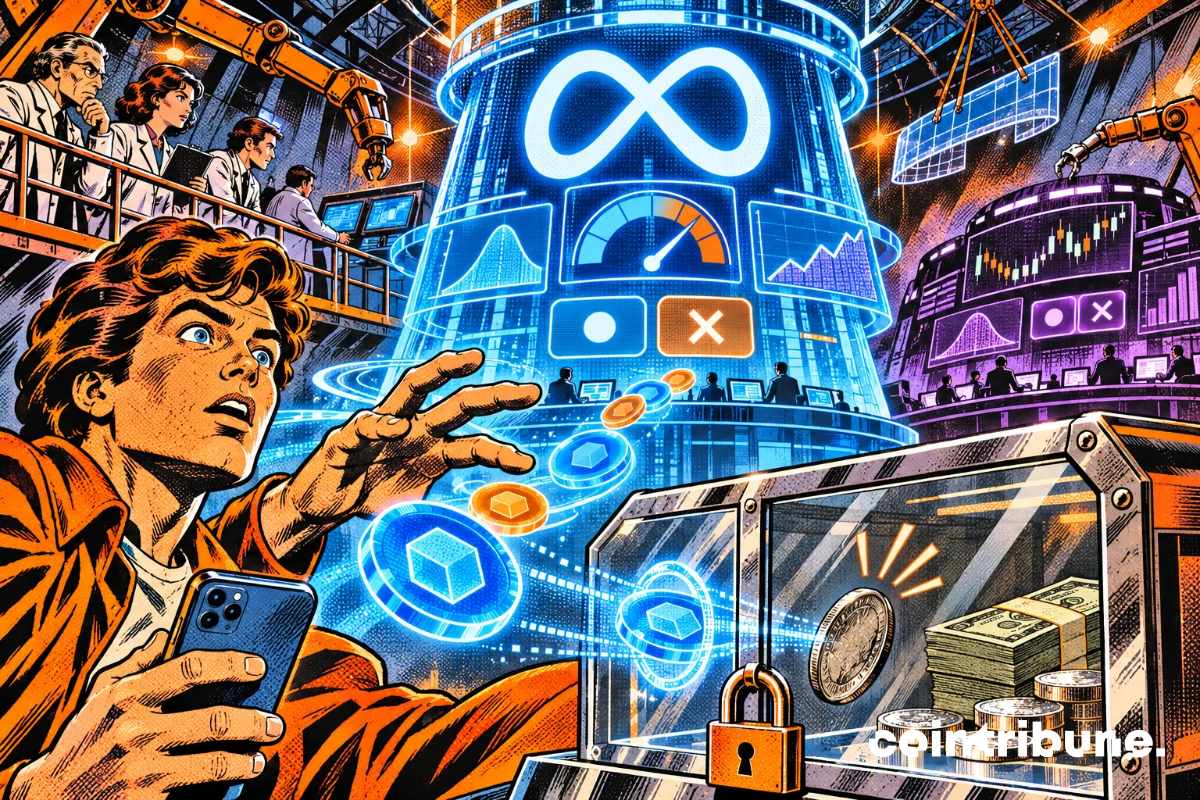
Meta advances in the field of prediction markets, already heavily frequented by crypto players. Mark Zuckerberg’s company is testing an application called Takes, which allows betting virtual
Meta advances in the field of prediction markets, already heavily frequented by crypto players. Mark Zuckerberg’s company is testing an application called Takes, which allows betting virtual points on future events. Unlike Polymarket and Kalshi, no real money is involved. The project remains reserved for Meta employees, with no announced public launch date.
En bref
Meta moves to a new stage. In June 2026, the company was already working on Arena, a prediction market project intended to compete with Polymarket. Five months later, the app is tested by its employees under the name Takes.
The operation is relatively simple. Participants must predict the outcome of an event or answer a question about the future. They bet virtual points called “cred,” an abbreviation of the English word credibility.
A correct prediction allows winning points. A wrong answer results in a loss. No financial transaction is necessary. Among the questions tested would notably be the name of Nvidia’s next leader or the winner of an American TV show.
The project was assigned to a small team on the instruction of Mark Zuckerberg. The CEO wanted to develop an application independent from Meta’s main social networks.
The company would thus have a new service likely to interest users attracted by prediction markets. The start is still limited. Takes is not open to the public. Meta has confirmed neither launch schedule nor definitive business model. The company also has not specified whether points might someday be converted into real money.
Start your crypto adventure safely with OKXThis link uses an affiliate program.
An application without crypto compared to the Polymarket model
The difference between Takes and Polymarket is mainly in their financial operation. Polymarket uses the Polygon blockchain and digital assets to allow participants to trade contracts related to future events.
Since April 2026, the platform notably uses pUSD, a token backed at parity by USDC, as collateral asset. Transaction settlement relies on USDC. Users therefore commit a real financial value.
If their prediction proves wrong, they can lose their stake. Kalshi also operates with financial contracts, but under a different infrastructure. The American platform is registered with the Commodity Futures Trading Commission (CFTC).
Meta is currently taking another direction. With Takes, points do not represent a cryptocurrency and have no announced monetary value. This choice would allow the company to offer an experience close to predictive markets without asking users to invest money.
This comes as existing platforms face several legal proceedings in the United States. Some states notably consider that contracts tied to sporting events fall under gambling laws. The companies concerned defend their federal regulation.
The disputes are not new. In May, Kalshi was already accusing Polymarket of regulatory laxity, notably regarding identity checks. The absence of real money in Takes could reduce some risks associated with financial betting. However, it does not imply that the application would automatically escape all regulation.
The potential arrival of Meta deserves the attention of crypto platforms. The company already has a global audience through Facebook, Instagram, WhatsApp, and Messenger. It could use this presence to introduce predictions to a much wider audience.
Younger users form an interesting target. A survey from S&P Global Market Intelligence Kagan indicates that more than 60% of Polymarket and Kalshi users are under 35 years old.
Meta is precisely seeking to maintain the interest of this generation in its applications. Takes’ business model remains unknown. The company could focus on rankings, virtual rewards, or social interactions, but none of these additional features have been officially detailed.
No immediate commercial threat yet to Polymarket. The two services do not currently offer the same experience. On Polymarket, users can commit capital, trade positions, and obtain financial gains. Takes relies solely on points.
A potential public opening could nevertheless strengthen the competition for users’ attention. The crypto sector is pursuing its own developments in parallel. In October, Polymarket reignited speculation around a possible token, without announcing a launch. For Meta, the next step remains simpler: deciding if Takes deserves to be offered to the general public. For now, the app remains an internal test.