One week after the Markets in Crypto-Assets Regulation reached full implementation across the European Union, 21 stablecoin issuers and more than 270 crypto asset service providers have obtai
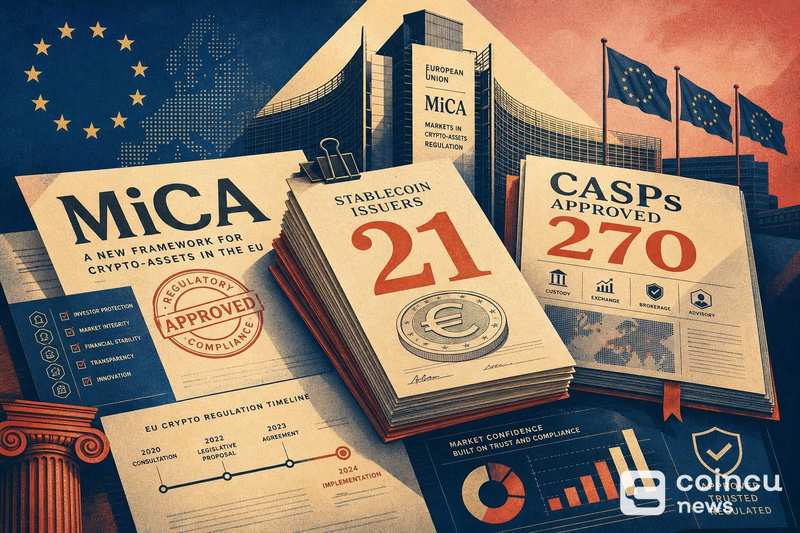
One week after the Markets in Crypto-Assets Regulation reached full implementation across the European Union, 21 stablecoin issuers and more than 270 crypto asset service providers have obtained regulatory authorization, marking the first measurable snapshot of Europe's new digital asset licensing regime.
What the first week of full MiCA implementation shows
The figures represent a one-week snapshot rather than a long-term scorecard. The European Securities and Markets Authority, which oversees MiCA's implementation, maintains public registers tracking authorized entities across member states. For related coverage, see Hong Kong Sets 2025 for Stablecoin Ordinance Implementation.
The 21 authorized stablecoin issuers and 270-plus crypto service providers reflect firms that completed the licensing process under MiCA's phased rollout. These authorizations cover the full 27-member bloc, replacing the prior patchwork of national-level crypto regulations. For related coverage, see GENIUS Act Delays Stablecoin Compliance Until 2026.
This early compliance wave suggests that a significant number of firms prepared well in advance of the deadline. MiCA's transitional provisions gave existing operators time to align with the new requirements, and the initial authorization count indicates substantial industry uptake. For related coverage, see Hong Kong to Implement Stablecoin Ordinance on August 1, 2025.
Why stablecoin issuer authorization carries outsized weight
Stablecoin issuers are tracked separately from broader crypto service providers under MiCA because regulators treat them as systemically important. Stablecoins function as settlement rails across decentralized finance and centralized exchanges alike, making their regulatory status a policy priority.
The specific count of 21 authorized issuers points to a tracked compliance benchmark maintained through ESMA's public registers. MiCA imposes distinct requirements on stablecoin issuers, including reserve backing obligations, redemption rights for holders, and capital requirements that differ from those applied to exchanges or custodians.
European regulators have steadily tightened expectations for stablecoin operators. Binance, for instance, has already adjusted its stablecoin offerings to comply with MiCA rules, delisting certain tokens that did not meet the new standards.
The regulatory scrutiny extends beyond Europe. Jurisdictions including Hong Kong are preparing their own stablecoin ordinances, creating a global trend toward formal licensing of stablecoin issuers. The EU's head start with MiCA positions it as the reference framework other regulators are watching.
What 270-plus authorized crypto service providers means
The broader category of crypto asset service providers, or CASPs, encompasses exchanges, custodians, brokers, portfolio managers, and advisory firms operating in the crypto space. The 270-plus authorization figure suggests a licensing wave well beyond stablecoin issuance alone.
For users, authorization means these firms meet baseline standards around custody safeguards, conflict-of-interest policies, and complaint-handling procedures. For the firms themselves, a MiCA license functions as a passport to operate across all EU member states without seeking separate national approvals.
The scale of the provider count also signals competitive dynamics. Authorized firms gain immediate legitimacy advantages in marketing to institutional clients and retail users who prioritize regulatory compliance. Firms that have not yet secured authorization face growing pressure as MiCA moves from legal text to active enforcement.
Meanwhile, tougher standards under new MiCA guidelines continue to raise the bar for all market participants, suggesting the authorization process will remain demanding for late applicants.
First-mover advantage and compliance pressure
Firms that secured early authorization hold a tangible advantage. They can operate without interruption, market their regulated status, and attract users migrating from unauthorized platforms. In a market where trust remains a competitive differentiator, being among the first 270-plus licensed providers carries reputational weight.
Conversely, firms without authorization face mounting pressure. MiCA's enforcement provisions empower national competent authorities to restrict or prohibit unauthorized crypto services within their jurisdictions. The transition period that shielded existing operators is narrowing.
The stablecoin segment faces particular scrutiny. The GENIUS Act in the United States has pushed stablecoin compliance timelines to 2026, meaning European-authorized issuers currently operate under a more mature regulatory framework than their American counterparts.
Whether the initial authorization count expands rapidly or plateaus will depend on how efficiently national regulators process remaining applications. The first-week numbers establish a baseline, but the trajectory over the coming months will determine whether MiCA achieves its goal of comprehensive market coverage.
FAQ about MiCA implementation and crypto authorization
What does MiCA implementation mean?
MiCA, the Markets in Crypto-Assets Regulation, is the EU's comprehensive legal framework for regulating digital assets. Full implementation means all provisions are now legally binding, and firms must hold authorization to offer crypto services or issue stablecoins within the EU.
Why are stablecoin issuers and crypto service providers counted separately?
MiCA treats stablecoin issuers as a distinct category because stablecoins carry specific financial stability risks. Issuers face separate requirements around reserve backing and redemption rights that do not apply to exchanges, custodians, or other service providers.
What happens to crypto firms that have not obtained MiCA authorization?
Unauthorized firms risk enforcement action from national regulators, including potential service restrictions or bans within EU member states. MiCA's transitional provisions allowed existing operators time to apply, but that window is closing as full enforcement begins.
Disclaimer: This article is for informational purposes only and does not constitute financial or investment advice. Cryptocurrency and digital asset markets carry significant risk. Always do your own research before making decisions.
The post MiCA Implementation: 21 Stablecoin Issuers, 270 CASPs Approved was initially published on Coincu.