As the major regulatory deadlines approach, the global crypto ecosystem is experiencing an unprecedented restructuring phase that is redefining the balance of power among the industry giants.
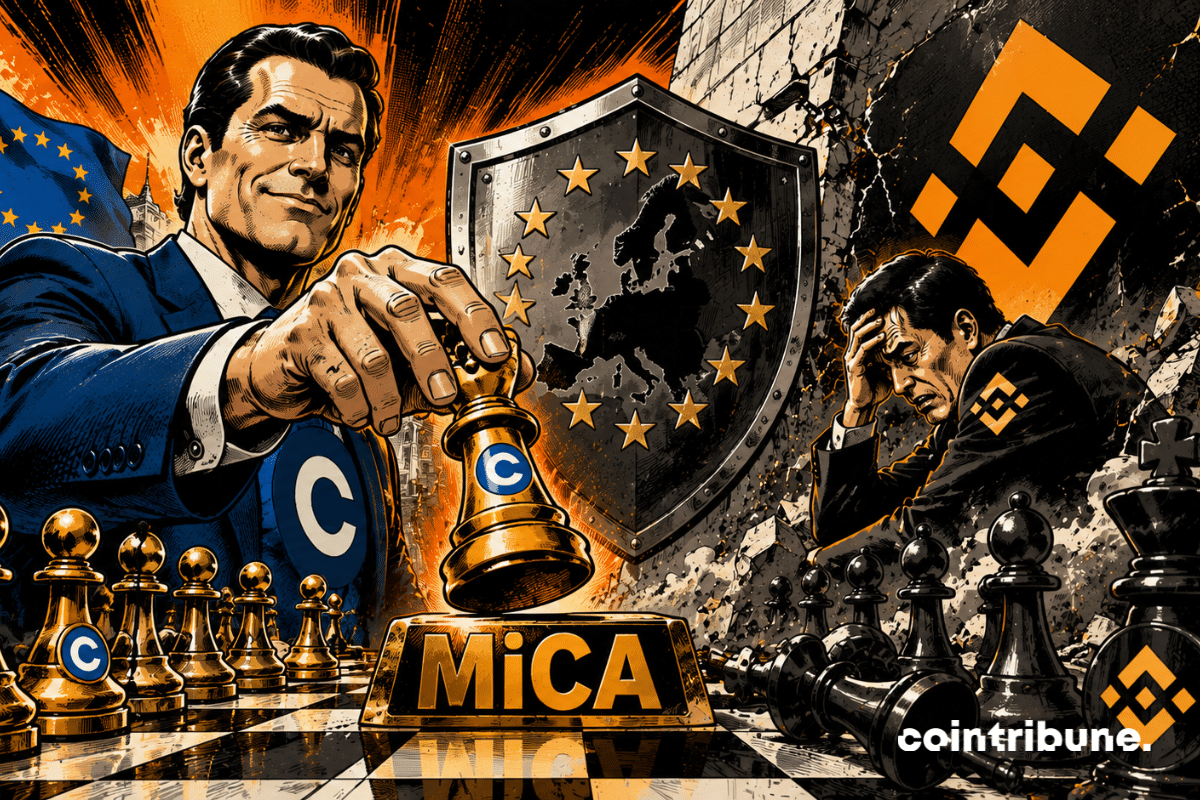
As the major regulatory deadlines approach, the global crypto ecosystem is experiencing an unprecedented restructuring phase that is redefining the balance of power among the industry giants. The countdown is now triggered for the definitive application of the crypto market regulation (MiCA) in the European Union on July 1st, 2026. This historic law aims to harmonize the industry across the Old Continent, forcing exchange platforms to choose between strict compliance or simple exclusion from a strategic market of over 450 million consumers. Just days away from this legislative deadline, the two American and international figures of trading (Coinbase and Binance) are separated by a spectacular rift.
In Brief
- Coinbase takes a strategic lead by making Luxembourg its official European hub before MiCA enforcement.
- Binance suffers a setback in Greece, a new obstacle complicating its race for a European license.
- MiCA regulatory requirements reshuffle the cards, making compliance a decisive competitive advantage for exchange platforms.
- The future of the European market remains open, as Coinbase consolidates its position while Binance tries to maintain its place with regulators.
Coinbase’s Institutional Anchoring: Luxembourg’s Strategic Choice
On June 24, 2026, the American company Coinbase took a significant step by officially opening its new offices in Luxembourg. Here are the essential facts of this regulatory integration :
- A centralized hub : the Grand Duchy officially becomes the nerve center for Coinbase to serve all 27 European Union member states under the MiCA framework ;
- A political inauguration : the event took place in the presence of Coinbase’s Chief Strategy Officer, Faryar Shirzad, and Luxembourg’s Finance Minister, Gilles Roth ;
- A strategic statement: on this occasion, Faryar Shirzad asserted : “Luxembourg has established itself as the main crossroads of the European Union for institutional crypto and tokenization” ;
- An official registration : under the entity Coinbase Luxembourg S.A., the firm is now formally listed in the register of the European Securities and Markets Authority (ESMA), securing a unique operational passport.
This successful integration is explained by a rigorous regulatory foresight policy implemented long ago by the American platform. In fact, Coinbase had already obtained its MiCA license from the Luxembourg Commission for the Supervision of the Financial Sector (CSSF) as early as June 2025, over a year before the European regulation’s application deadline.
Furthermore, the operator was already holding specific national authorizations in six EU countries, including France and Germany. This position is strengthened by the transparency resulting from its public listing on Nasdaq since 2021, thus offering European regulators years of audited and verifiable financial reports, an essential advantage to reassure public authorities in face of strict ESMA requirements.
Binance’s Setback in Greece and the Burden of Regulatory Legacy
Unlike this straightforward path, the Binance platform is experiencing significant regulatory turbulence on the eve of the transition to the MiCA regime. The exchange has just confirmed the collapse of its application in Greece, which chose to withdraw its request for regulatory approval from Greek authorities just a few days before the deadline.
This strategic withdrawal leaves Binance currently completely absent from the ESMA centralized register, thereby making its claim to an immediate European passport more difficult. European regulators still have to contend with the company’s heavy historical baggage, notably illustrated by its 2023 guilty plea in the United States for violating anti-money laundering laws and international sanctions. This U.S. proceeding ended with a record fine exceeding $4.3 billion and the forced departure of its historic founder, Changpeng Zhao.
Your 1st cryptos with CoinbaseThis link uses an affiliate program.Binance’s Counter-Offensive and the Uncertain Future of the European Market
Although it suffered a defeat in Greece, Binance refuses to give up and is preparing its response to maintain a presence on the continent. Management has announced that it intends to request a MiCA approval from another European Union member state, based on a massive internal scaling that today mobilizes nearly 1,500 full-time professionals dedicated to compliance issues.
To reaffirm the company’s determination amid widespread skepticism, Gillian Lynch, Binance’s head for Europe and the UK, assured that: “Binance will not abandon Europe”. The platform’s goal today is to demonstrate to a new national regulatory authority that its current security standards have definitively addressed past shortcomings and fully meet the requirements imposed by European institutions.
The analysis of this situation shows how much the post-MiCA era could long-term transform the hierarchy of crypto exchanges. To date, more than 230 companies have successfully validated their registration process and appeared alongside Coinbase or its direct competitors, such as Kraken, on ESMA’s official list, showing that compliance has become the main driver of commercial competitiveness.
While Coinbase enjoys a clear competitive advantage in attracting institutional capital flows thanks to its Luxembourg showcase, Binance’s future will depend on its ability to quickly negotiate a new state anchoring. The coming months will reveal whether the European market is heading toward a balanced duopoly or a definitive alignment with the state structures’ requirements of the players.