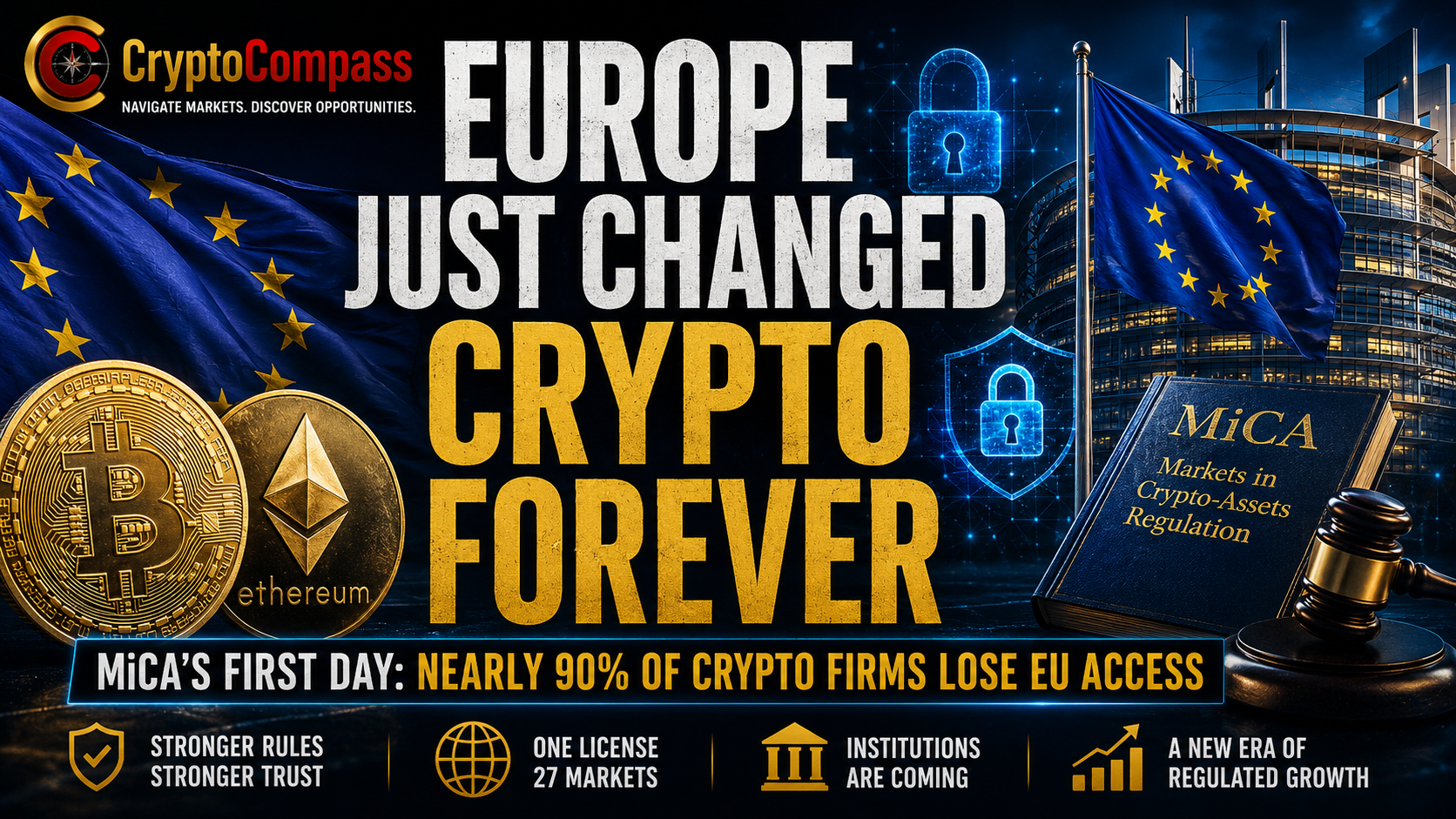
Too innovative to fit inside traditional financial laws.Too global to be regulated by a single jurisdiction.Too large to ignore.That era officially came to an end on July 1, 2026.
For more than fifteen years, the cryptocurrency industry has operated in a regulatory gray zone.
Too innovative to fit inside traditional financial laws.
Too global to be regulated by a single jurisdiction.
Too large to ignore.
That era officially came to an end on July 1, 2026.
After years of political negotiations, technical consultations, and an eighteen-month transition period, the European Union fully implemented the Markets in Crypto-Assets Regulation—better known as MiCA.
To many investors, this appears to be another regulatory headline.
It is not.
It is arguably the single most important structural change the crypto industry has experienced since Bitcoin was launched in 2009.
Because for the first time, one of the world's largest economic blocs has done something no other major jurisdiction has accomplished.
It has created a unified legal framework for digital assets.
The immediate headlines are dramatic.
Hundreds of firms received authorization.
Thousands did not.
Many exchanges can no longer legally offer services throughout Europe without obtaining a MiCA licence.
The crypto industry is understandably focused on who survived.
History, however, may remember something entirely different.
Not the companies that disappeared.
But the moment crypto officially became part of modern financial infrastructure.
Every Industry Eventually Grows Up
Every technological revolution follows a surprisingly similar pattern.
The first phase rewards experimentation.
Rules are almost nonexistent.
Innovation moves faster than regulators can understand.
Companies appear overnight.
Capital floods into the sector.
Consumers chase opportunity.
The second phase rewards expansion.
Competition intensifies.
Business models mature.
Infrastructure begins replacing experimentation.
The third phase rewards trust.
Suddenly, innovation alone is no longer enough.
Institutions arrive.
Banks begin paying attention.
Governments become involved.
Public markets demand transparency.
Capital starts flowing toward businesses capable of operating inside established legal frameworks.
Crypto has officially entered that third phase.
For years, the industry celebrated the absence of regulation.
Many entrepreneurs viewed regulation as an obstacle.
Many investors viewed compliance as unnecessary bureaucracy.
That perception made sense during crypto's early years.
The ecosystem was small.
Retail dominated trading.
Institutional participation remained limited.
Systemic financial risks were minimal.
None of those assumptions remain true today.
Bitcoin has become a trillion-dollar asset.
Stablecoins process hundreds of billions of dollars every month.
BlackRock manages tokenized funds.
Banks settle transactions using blockchain infrastructure.
Governments explore digital currencies.
Crypto is no longer experimenting on the edge of finance.
It is gradually becoming part of finance itself.
That transition changes everything.
Why Europe Acted First
One question naturally emerges.
Why Europe?
Why did the European Union become the first major economic bloc to establish comprehensive crypto legislation while the United States continues debating regulatory jurisdiction?
The answer has surprisingly little to do with crypto.
It has everything to do with how Europe approaches regulation.
Historically, the European Union prefers building comprehensive legal frameworks before industries become too large.
The philosophy is straightforward.
Innovation is welcome.
But innovation should operate inside clearly defined rules.
We have already seen this philosophy shape multiple industries.
GDPR fundamentally changed global data privacy.
European sustainability reporting rules influenced multinational corporations worldwide.
The AI Act established one of the first comprehensive legal frameworks governing artificial intelligence.
Crypto represents the latest chapter in that strategy.
Rather than regulating individual scandals as they emerge, Europe attempted something far more ambitious.
It designed an operating system for the entire industry.
Whether one agrees with that philosophy or not, its influence cannot be ignored.
When Europe regulates, global companies usually adapt.
Not because Europe is the largest market.
But because maintaining different operating models for different jurisdictions is expensive.
History suggests many firms simply adopt the European standard everywhere possible.
GDPR demonstrated exactly that.
MiCA may eventually do the same.
The Shadow Of Libra
Ironically, one of MiCA's biggest catalysts was not Bitcoin.
It was Facebook.
In 2019, Facebook announced Libra.
The proposal immediately attracted worldwide attention.
Unlike Bitcoin, Libra possessed something unprecedented.
Instant access to billions of users.
Suddenly, policymakers imagined a private corporation capable of issuing a global digital currency at internet scale.
The reaction inside Europe was swift.
Central banks worried about monetary sovereignty.
Finance ministries questioned consumer protection.
Regulators realized existing financial legislation had never contemplated something like Libra.
Although Libra ultimately failed and evolved into the much smaller Diem project before shutting down entirely, its political impact survived.
European policymakers concluded that waiting was no longer an option.
Crypto was no longer a niche technology.
It had become a potential component of the global financial system.
The legislative work that eventually became MiCA accelerated significantly after that realization.
Sometimes, history is shaped not by successful products, but by the fears they create.
Libra never achieved its vision.
Yet without Libra, MiCA may have taken much longer to emerge.
Crypto's Original Promise Was Freedom
Bitcoin was born during the global financial crisis.
Its genesis block famously referenced the bailout of British banks.
The message was unmistakable.
Crypto represented an alternative.
No central authority.
No government.
No bank.
No permission required.
That philosophy attracted millions of supporters.
Decentralization became the industry's defining narrative.
The idea resonated far beyond technology.
It became cultural.
Almost ideological.
Yet over time, something interesting happened.
The infrastructure surrounding crypto became increasingly centralized.
People still traded decentralized assets.
But they did so through centralized exchanges.
They stored assets with centralized custodians.
They borrowed from centralized lenders.
They relied upon centralized stablecoin issuers.
The blockchain remained decentralized.
Much of the surrounding financial infrastructure did not.
Regulators recognized this distinction.
Rather than attempting to regulate Bitcoin itself, they focused on regulating the companies providing services around Bitcoin.
This distinction is fundamental.
MiCA does not regulate Bitcoin's protocol.
It regulates businesses.
Exchanges.
Custodians.
Issuers.
Brokerages.
Wallet providers under certain circumstances.
Crypto itself remains decentralized.
The companies interacting with consumers increasingly do not.
The Industry Earned Regulation
Some crypto enthusiasts argue that governments imposed regulation upon an unwilling industry.
The historical record tells a more complicated story.
Consider what happened between 2014 and 2023.
Mt. Gox collapsed.
QuadrigaCX disappeared.
FTX failed spectacularly.
Celsius froze withdrawals.
Voyager entered bankruptcy.
Three Arrows Capital imploded.
Billions of dollars vanished.
Millions of customers suffered losses.
Every collapse reinforced the same political conclusion.
Innovation without adequate governance carries systemic risk.
It would be intellectually dishonest to ignore that reality.
The overwhelming majority of crypto companies operated responsibly.
A minority did not.
Unfortunately, financial regulation is almost always written after the minority creates enough damage.
Traditional banking regulation emerged after banking crises.
Securities regulation expanded after stock market crashes.
Insurance regulation followed insolvencies.
Crypto is following the same historical pattern.
MiCA is not simply a reaction to technological innovation.
It is also a reaction to repeated failures of corporate governance.
That distinction matters.
Because the regulation targets the intermediaries that repeatedly failed—not the underlying blockchain technology itself.
From Registration To Authorization
One of the least discussed—but most significant—changes introduced by MiCA is linguistic.
Before MiCA, many companies merely registered under national virtual asset frameworks.
Registration sounds reassuring.
In reality, registration often meant very little.
Authorities acknowledged that a company existed.
Nothing more.
Authorization is fundamentally different.
Authorization requires regulators to actively evaluate whether a business satisfies predefined operational standards before allowing it to provide services.
That changes incentives.
Instead of asking:
"Does this company exist?"
Regulators now ask:
"Can this company safely manage customer assets?"
Those questions produce very different industries.
To receive authorization, firms must demonstrate governance structures, cybersecurity procedures, operational resilience, internal controls, capital adequacy, consumer disclosure policies and risk management systems.
These are characteristics traditionally associated with banks, investment firms and regulated financial institutions.
Crypto businesses are increasingly expected to meet the same standard.
That is not merely legal evolution.
It represents cultural evolution.
For much of crypto's history, moving fast was considered the ultimate competitive advantage.
MiCA suggests something different.
Perhaps the next decade will reward firms capable of moving responsibly.
The Economics Of Compliance
Compliance is expensive.
Extremely expensive.
Legal teams.
Risk officers.
Compliance departments.
Technology upgrades.
Cybersecurity audits.
External consultants.
Capital requirements.
Insurance.
Reporting obligations.
These costs disproportionately affect smaller companies.
Large exchanges can spread compliance expenses across millions of customers.
Smaller firms often cannot.
This creates a powerful economic force.
Consolidation.
Regulation rarely eliminates industries.
It reshapes competitive dynamics.
The largest institutions become stronger.
Mid-sized firms merge.
Smaller firms either specialize or disappear.
Traditional banking followed this pattern.
Asset management followed this pattern.
Insurance followed this pattern.
Crypto is unlikely to prove different.
For investors, this has profound implications.
The industry's next generation of winners may not necessarily build the best technology.
They may build the strongest institutions.
Crypto Needed A Common Language
Imagine trying to build the European banking system if every country had completely different rules.
A bank licensed in France could not necessarily operate in Germany.
A payment company approved in Italy might need to repeat the entire licensing process in Spain.
Consumers would face inconsistent protections.
Companies would spend enormous resources navigating twenty-seven different legal systems.
Until MiCA, this was effectively how crypto operated.
Each European nation interpreted digital assets differently.
Some countries became crypto-friendly.
Others remained highly restrictive.
Some required extensive licensing.
Others required little more than registration.
This fragmentation created opportunity.
But it also created uncertainty.
A company seeking to serve all European customers often needed separate legal strategies for multiple jurisdictions.
That model was never sustainable.
MiCA solves this problem by replacing dozens of fragmented national frameworks with a single regulatory language.
For crypto companies, the value of that change cannot be overstated.
Instead of building twenty-seven compliance strategies, firms can increasingly build one.
That dramatically reduces long-term regulatory complexity.
Ironically, stricter regulation may ultimately make expansion easier.
Passporting: One License, Twenty-Seven Markets
One of MiCA's most powerful innovations is something most retail investors will never notice.
Passporting.
The concept already exists in traditional European finance.
Once an institution receives authorization from one competent authority, it can generally provide services across the European Economic Area without repeating the licensing process country by country.
MiCA applies that same principle to crypto.
This transforms the economics of expansion.
Instead of treating Europe as twenty-seven individual markets, companies can increasingly view it as one unified financial market.
That creates significant economies of scale.
Compliance costs remain high.
But once those costs are absorbed, expansion becomes dramatically more efficient.
The companies capable of obtaining authorization first therefore receive a structural competitive advantage.
This is why the race toward MiCA authorization became so intense.
The reward is not merely regulatory approval.
The reward is access to one of the largest integrated financial markets in the world.
Why Licensing Is Becoming A Competitive Moat
Many crypto entrepreneurs have historically viewed regulation as a cost.
Institutional investors increasingly view it as an asset.
This difference in perspective explains much of what is happening today.
Imagine two exchanges.
Exchange A operates without meaningful supervision.
Exchange B holds a recognized MiCA licence.
Both offer identical trading products.
Both charge similar fees.
Which platform is a European pension fund more likely to choose?
Which platform will multinational corporations trust?
Which platform will banks integrate with?
Which platform will insurance companies insure more comfortably?
The answer becomes obvious.
Regulation creates credibility.
Credibility attracts institutional capital.
Institutional capital creates liquidity.
Liquidity attracts more users.
This creates a feedback loop.
Compliance therefore becomes more than legal protection.
It becomes a commercial advantage.
MiCA Is Quietly Changing Crypto's Business Model
For years, many exchanges competed primarily on three variables.
Lower fees.
More token listings.
Higher leverage.
MiCA changes those incentives.
Future competition increasingly shifts toward:
Operational resilience.
Risk management.
Security.
Institutional services.
Cross-border scalability.
Regulatory credibility.
That is a profound transformation.
It also mirrors the historical evolution of nearly every mature financial industry.
Early markets compete on innovation.
Mature markets compete on trust.
Crypto appears to be entering that transition.
Stablecoins: The Real Heart Of MiCA
Many observers assume MiCA is primarily about exchanges.
It is not.
One of the regulation's most ambitious objectives concerns stablecoins.
In many respects, stablecoins have become the plumbing of the digital economy.
They settle trades.
Provide liquidity.
Facilitate cross-border payments.
Support decentralized finance.
Move billions of dollars every day.
If stablecoins fail, much of the crypto ecosystem immediately experiences stress.
European policymakers recognized this long before many investors did.
As a result, MiCA introduced one of the world's most comprehensive legal frameworks governing stablecoin issuance.
Issuers must satisfy strict reserve requirements.
Provide transparency around backing assets.
Maintain redemption mechanisms.
Demonstrate operational resilience.
Protect consumers.
The objective is simple.
Stablecoins should increasingly resemble regulated financial products rather than loosely supervised digital instruments.
Why Circle May Benefit More Than Tether
One of the most discussed consequences of MiCA concerns the competitive landscape between the world's largest stablecoin issuers.
Circle spent years building relationships with regulators.
Transparency became a central part of its strategy.
USDC positioned itself as the institutional stablecoin.
Tether followed a different path.
It prioritized global liquidity.
Speed.
Distribution.
Market penetration.
Those strategies reflected different philosophies.
Under MiCA, however, regulatory alignment becomes significantly more valuable.
This does not automatically mean one issuer wins and another loses.
Global crypto markets extend far beyond Europe.
Tether remains the largest stablecoin by circulation.
Yet within regulated institutional markets, compliance increasingly becomes part of the product itself.
That subtle shift could reshape stablecoin competition throughout the coming decade.
The battle may no longer revolve solely around market capitalization.
It may revolve around regulatory credibility.
Consumer Protection Is Not The Enemy Of Crypto
Few topics divide the crypto community more than consumer protection.
Critics argue regulation limits freedom.
Supporters argue trust cannot exist without safeguards.
Both perspectives contain elements of truth.
The challenge lies in balancing innovation with responsibility.
Consider a retail investor purchasing digital assets for the first time.
How should risks be disclosed?
Who verifies custody arrangements?
What happens if an exchange becomes insolvent?
How are conflicts of interest managed?
These questions are not anti-crypto.
They are fundamental questions every financial market eventually answers.
MiCA attempts to answer them before the next major crisis rather than after it.
That proactive approach distinguishes Europe from many previous regulatory responses.
Instead of reacting solely to failures, policymakers attempted to build preventative infrastructure.
Whether they succeeded remains an open question.
But the intent itself represents an important evolution.
Market Abuse Comes To Crypto
Traditional financial markets prohibit insider trading.
Market manipulation.
Wash trading.
False disclosures.
Spoofing.
Pump-and-dump schemes.
For years, crypto operated in an environment where many of these behaviors remained difficult to police consistently across jurisdictions.
MiCA changes that.
Market abuse provisions extend regulatory oversight into behaviors previously associated with the industry's most chaotic years.
This matters because institutional investors evaluate market integrity almost as carefully as expected returns.
Capital prefers predictable environments.
Reducing manipulation therefore benefits not only regulators.
It benefits long-term investors.
Ironically, stronger enforcement may ultimately encourage greater participation rather than reduce it.
Why Banks Suddenly Feel More Comfortable
Banks are conservative institutions.
They are designed to manage risk before pursuing opportunity.
For much of crypto's history, regulatory uncertainty prevented meaningful engagement.
Even institutions interested in blockchain technology often hesitated because legal obligations remained unclear.
MiCA changes that equation.
Banks now possess a clearer framework governing custody, partnerships, compliance expectations and operational standards.
This does not guarantee immediate adoption.
Large financial institutions move slowly.
But they generally move once legal uncertainty declines.
That may prove one of MiCA's greatest long-term achievements.
Not encouraging crypto-native firms.
Encouraging traditional finance to participate.
And traditional finance controls far more capital than crypto currently does.
Every Regulation Creates Winners
Markets often describe regulation as a burden.
History tells a different story.
Every major regulatory reform eventually redistributes market share.
When the United States introduced the Securities Acts after the Great Depression, thousands of poorly governed companies disappeared while professionally managed firms flourished.
After the 2008 financial crisis, Basel III fundamentally reshaped global banking.
Large institutions became larger.
Compliance departments expanded.
Risk management became a competitive advantage.
The same process is beginning inside crypto.
MiCA does not eliminate competition.
It changes the basis upon which companies compete.
For more than a decade, crypto exchanges fought over listings.
Who listed the newest token first.
Who offered the highest leverage.
Who launched perpetual futures earliest.
Who charged the lowest trading fees.
That era is gradually ending.
The next decade will reward an entirely different set of capabilities.
Regulatory execution.
Institutional trust.
Operational resilience.
Cybersecurity.
Governance.
Capital efficiency.
The winners of Crypto 1.0 were entrepreneurs.
The winners of Crypto 2.0 may increasingly resemble financial institutions.
Coinbase Built For This Moment
Few companies illustrate this transition better than Coinbase.
For years, many crypto-native users criticized Coinbase.
Its listing process appeared slow.
Its compliance standards appeared conservative.
Its leverage offerings were limited.
Compared with offshore exchanges, Coinbase often looked cautious.
Today that caution looks remarkably strategic.
While competitors expanded aggressively into loosely regulated markets, Coinbase spent years building relationships with regulators, auditors, banks and institutional investors.
Those investments rarely produced exciting headlines.
But they created something increasingly valuable.
Trust.
MiCA rewards precisely that kind of long-term investment.
The same characteristics that once made Coinbase appear conservative now make it highly compatible with the institutional era of crypto.
This represents an important lesson.
Sometimes the most profitable strategy is not maximizing short-term growth.
It is preparing for structural change before competitors recognize it.
Kraken, Bitstamp And Europe's Quiet Advantage
Another consequence of MiCA is the renewed importance of exchanges that spent years cultivating European operations.
Kraken.
Bitstamp.
Several regional institutional custodians.
Unlike newer exchanges that expanded rapidly across emerging markets, these companies invested heavily in legal infrastructure throughout Europe.
That investment now produces a measurable advantage.
Institutional clients rarely switch service providers every month.
Once custody systems, treasury operations, accounting workflows and compliance reporting become integrated, relationships tend to last for years.
Winning institutional customers therefore creates recurring strategic value.
MiCA strengthens this dynamic.
Instead of competing solely for retail traders, exchanges increasingly compete for banks, family offices, pension funds and corporate treasuries.
Those clients generate lower excitement.
But much higher lifetime value.
Binance Faces A Different Kind Of Competition
No discussion about MiCA is complete without Binance.
Binance remains one of the largest crypto exchanges in the world.
Its liquidity, product breadth and international reach remain unmatched in many markets.
Yet MiCA highlights something larger than any individual company.
Scale alone is no longer enough.
For years, crypto's largest firms expanded faster than regulation evolved.
Now regulation is beginning to catch up.
This changes competitive dynamics.
The question is no longer:
"Who has the most users?"
It is becoming:
"Who can satisfy institutional standards while maintaining global scale?"
That is a far more difficult challenge.
Large organizations move more slowly.
Compliance becomes exponentially more complicated as operations span multiple jurisdictions.
MiCA therefore introduces a different type of competition.
Not technological competition.
Institutional competition.
The Hidden Winners
Whenever regulation is discussed, most attention focuses on exchanges.
Yet some of the largest beneficiaries may be businesses that consumers rarely notice.
Compliance software providers.
Identity verification companies.
Blockchain analytics firms.
Cybersecurity vendors.
Institutional custodians.
Audit firms.
Insurance providers.
Legal consultancies.
Every regulated financial industry creates an ecosystem surrounding compliance.
Crypto is beginning to develop the same supporting infrastructure.
These businesses rarely issue tokens.
They rarely trend on social media.
Yet collectively they may generate billions of dollars in economic value over the next decade.
Crypto infrastructure extends far beyond blockchains themselves.
Why Venture Capital Will Change
MiCA is also likely to reshape venture capital.
During crypto's earliest years, investors primarily evaluated products.
How innovative is the protocol?
How fast is the blockchain?
How attractive is tokenomics?
Increasingly, another question enters every investment committee.
Can this business survive inside regulated financial markets?
Governance becomes investable.
Compliance becomes investable.
Operational resilience becomes investable.
These characteristics rarely excite retail investors.
Institutional venture capital thinks differently.
Large funds care about exit opportunities.
Public listings.
Acquisitions.
Regulatory durability.
A startup that cannot survive regulation eventually becomes difficult to finance.
This changes what founders build.
And eventually changes what users experience.
Europe Is Exporting More Than Regulation
One of Europe's most underestimated strengths is regulatory influence.
The European Union does not dominate technology.
It does not dominate venture capital.
It does not dominate AI.
Yet European regulation repeatedly shapes global corporate behavior.
Why?
Because multinational companies prefer standardization.
Operating one global system is cheaper than operating ten different regional systems.
This phenomenon became widely known after GDPR.
American companies changed privacy policies worldwide.
Asian firms adopted European standards.
Latin American governments borrowed legal language.
Not because Europe forced them.
Because building separate systems was inefficient.
MiCA may produce the same effect.
A crypto exchange capable of satisfying Europe's standards is already much closer to satisfying future regulations elsewhere.
This creates a powerful incentive.
Instead of building different compliance architectures for every country, companies increasingly build around MiCA.
If that happens, Europe will influence crypto far beyond its own borders.
The New Geography Of Crypto
For years, crypto companies selected headquarters primarily according to tax policy.
Regulatory flexibility.
Corporate simplicity.
That calculation is changing.
Future location decisions increasingly depend upon regulatory credibility.
Jurisdictions offering legal certainty become more attractive than jurisdictions offering regulatory ambiguity.
This explains why several crypto firms have strengthened operations in Luxembourg, France, Germany and Ireland.
These countries increasingly function as gateways into the European institutional market.
The importance of regulatory hubs may therefore increase over time.
Just as London became a global banking center.
Just as New York became a capital markets hub.
Europe may gradually develop specialized crypto regulatory centers.
DeFi Remains The Biggest Open Question
Perhaps the most fascinating unanswered question concerns decentralized finance.
MiCA primarily regulates identifiable service providers.
Companies.
Issuers.
Custodians.
Centralized exchanges.
But what happens when no company exists?
Who receives a licence for autonomous smart contracts?
Who becomes legally responsible for decentralized governance?
Who supervises protocols controlled by token holders scattered across dozens of countries?
These questions remain largely unresolved.
And they represent one of crypto's most important frontiers.
The future relationship between DeFi and regulation will likely define the industry's next chapter.
MiCA answers many questions.
It intentionally leaves others open.
That flexibility may prove wise.
Technology continues evolving faster than legislation.
No regulation can permanently solve every future challenge.
Regulation Does Not Kill Innovation
Perhaps the industry's biggest misconception is that regulation inevitably destroys innovation.
History repeatedly suggests the opposite.
Well-designed regulation often expands markets.
The introduction of securities regulation did not eliminate equity investing.
It helped create modern capital markets.
Commercial aviation regulations did not destroy airlines.
They made global air travel trustworthy.
Electronic payment regulations did not prevent Visa and Mastercard from growing.
They created confidence.
Crypto now faces the same test.
Innovation alone built the first fifteen years.
Trust may build the next fifteen.
The Industry Has Been Asking The Wrong Question
For years, one question dominated nearly every discussion surrounding crypto regulation.
Will regulation slow innovation?
It is an understandable concern.
Bitcoin itself emerged outside the traditional financial system.
Ethereum gave developers permissionless infrastructure.
DeFi attempted to recreate banking without banks.
The industry's DNA has always favored openness over bureaucracy.
Yet that question misses a much larger one.
What if regulation actually unlocks the next phase of adoption?
History repeatedly shows that technological revolutions do not reach mass adoption simply because the technology improves.
They reach mass adoption when ordinary people trust them.
The internet did not become mainstream because websites became prettier.
It became mainstream because payment systems improved, consumer protection evolved, broadband expanded, and legal certainty increased.
The same pattern occurred with online banking.
E-commerce.
Cloud computing.
Digital payments.
Every major technology eventually reached a point where infrastructure became more important than innovation.
Crypto is approaching that same point.
Trust Is An Economic Asset
One lesson financial history teaches repeatedly is that trust is not merely a social concept.
It is an economic asset.
Markets function because participants believe rules will be enforced.
Investors buy securities because they trust ownership rights.
Depositors place money in banks because they trust withdrawal systems.
Insurance exists because policyholders trust contracts.
Trust reduces friction.
Lower friction attracts capital.
More capital produces larger markets.
This relationship explains why institutional investors consistently prioritize governance over excitement.
Retail investors often chase narratives.
Institutions allocate capital toward predictability.
That difference is fundamental.
A pension fund managing $500 billion is not looking for the highest-return exchange.
It is looking for the safest operational environment.
The largest pools of capital in the world think differently from crypto Twitter.
MiCA was largely written for those institutions.
Regulation Is Becoming Infrastructure
Most investors think of regulation as something external to markets.
Taxes.
Restrictions.
Reporting obligations.
In reality, regulation is infrastructure.
Roads make transportation possible.
Legal systems make commerce possible.
Accounting standards make investing possible.
Property rights make capitalism possible.
Financial regulation performs the same function.
It creates common expectations.
Without those expectations, scaling becomes difficult.
Imagine BlackRock tokenizing trillions of dollars of assets inside an industry with no common legal standards.
Imagine JPMorgan providing blockchain settlement services without knowing how custodians should operate.
Imagine insurance companies underwriting crypto exchanges without defined operational requirements.
The entire institutional economy depends upon predictable rules.
That is why MiCA matters.
It is not simply regulating crypto.
It is constructing the legal infrastructure necessary for institutions to participate confidently.
Why Europe Is Playing The Long Game
Critics often argue that Europe regulates too early.
Supporters argue Europe regulates before problems become unmanageable.
Both views contain some truth.
But Europe's broader strategy deserves attention.
The European Union rarely attempts to dominate emerging technologies through venture capital.
It competes differently.
It attempts to shape the legal architecture within which those technologies eventually operate.
Consider previous examples.
GDPR influenced global privacy.
The AI Act influenced artificial intelligence governance.
MiCA may influence digital assets.
This represents a different type of geopolitical power.
Not technological leadership.
Regulatory leadership.
If companies worldwide voluntarily adopt MiCA standards because maintaining multiple compliance systems is inefficient, Europe achieves influence far beyond its own borders.
That possibility should not be underestimated.
Could MiCA Become Crypto's GDPR?
The comparison is increasingly common.
Before GDPR, privacy policies differed dramatically around the world.
After GDPR, many multinational companies standardized global practices around European requirements.
Consumers outside Europe benefited from rules originally written for Europeans.
Something similar may happen with MiCA.
Imagine a global exchange.
Operating different custody standards.
Different disclosure rules.
Different governance structures.
Different reporting frameworks.
For every region.
The operational complexity becomes enormous.
Instead, many firms may simply adopt MiCA-level compliance across their global business.
Not because regulators require it everywhere.
Because standardization lowers long-term operational costs.
If that happens, MiCA will evolve from European regulation into an international benchmark.
History suggests that outcome is entirely plausible.
America Chose Enforcement
Europe Chose Legislation
Perhaps the most striking contrast in global crypto policy is the divergence between Europe and the United States.
For much of the past several years, American crypto regulation has largely developed through enforcement actions, litigation and agency interpretations.
Europe pursued another route.
It attempted to write a dedicated legal framework specifically for crypto assets.
These are fundamentally different philosophies.
One allows courts to define industry boundaries.
The other attempts to define those boundaries through legislation before conflicts emerge.
Neither model is perfect.
Both contain strengths and weaknesses.
But the practical consequence is clear.
Today, many global companies possess greater regulatory certainty regarding Europe than the United States.
That would have seemed almost unimaginable only a few years ago.
What MiCA Does Not Solve
It would be a mistake to portray MiCA as the final answer to crypto regulation.
No legislation could accomplish that.
Entire areas remain unresolved.
How should decentralized autonomous organizations be supervised?
How should fully decentralized protocols be treated?
How should permissionless smart contracts interact with regulated financial institutions?
How should AI-powered autonomous financial agents be governed?
What happens when tokenized real-world assets span multiple jurisdictions simultaneously?
These questions extend far beyond MiCA.
They will likely define the next generation of financial regulation.
MiCA should therefore be viewed not as the conclusion of crypto regulation, but as its foundation.
The industry will continue evolving.
So will the rules.
Stablecoins May Be The Biggest Story Nobody Notices
Most headlines surrounding MiCA focus on exchanges.
Yet stablecoins may ultimately prove far more important.
Stablecoins increasingly function as settlement infrastructure.
They connect centralized finance with decentralized finance.
They facilitate international payments.
They support tokenized securities.
They provide dollar access in emerging economies.
They increasingly resemble financial plumbing rather than speculative assets.
This explains why policymakers dedicated significant attention to them.
The battle over stablecoins is not simply about crypto.
It is about the future architecture of money.
And Europe intends to influence that architecture rather than observe it from the sidelines.
The Institutional Domino Effect
Large institutions rarely move first.
They move together.
Once legal uncertainty declines, several industries often begin participating almost simultaneously.
Asset managers.
Custodian banks.
Accounting firms.
Auditors.
Insurance providers.
Commercial banks.
Payment processors.
Technology vendors.
This phenomenon creates what economists sometimes call institutional network effects.
One participant reduces uncertainty for the next.
Eventually adoption accelerates.
MiCA may represent the first domino rather than the last.
The regulation itself is important.
The institutions it enables may prove even more important.
Why Crypto Companies Must Change How They Think
Perhaps the most profound consequence of MiCA is psychological rather than legal.
For years, success in crypto meant shipping products quickly.
Moving faster than competitors.
Launching before regulators noticed.
That mindset produced remarkable innovation.
It also produced spectacular failures.
The next phase demands different capabilities.
Risk management.
Governance.
Internal controls.
Board oversight.
Operational resilience.
Enterprise cybersecurity.
Institutional reporting.
These characteristics rarely generate excitement.
But they generate longevity.
Crypto's future leaders may look increasingly like financial institutions that happen to use blockchain technology, rather than technology startups experimenting with finance.
That transition has already begun.
Most investors simply have not recognized it yet.
Crypto Is Becoming Boring
That may be the industry's biggest achievement.
"Boring" sounds like an insult.
In finance, it is often the highest compliment.
People rarely describe Visa as exciting.
Nobody calls SWIFT revolutionary anymore.
Few investors wake up wondering whether the New York Stock Exchange will still function tomorrow.
These systems became successful precisely because they became predictable.
Crypto spent its first fifteen years attracting attention through volatility.
The next fifteen may be defined by reliability.
Markets mature when infrastructure becomes invisible.
Consumers do not think about TCP/IP every time they browse the internet.
Businesses do not think about payment settlement every time they accept a credit card.
Likewise, future users may not think about blockchains every time they move money.
That transformation—from visible innovation to invisible infrastructure—is one of the strongest signals that a technology has reached maturity.
MiCA accelerates that transition.
It encourages crypto companies to think less like disruptive experiments and more like permanent financial institutions.
Bitcoin Doesn't Need MiCA
Bitcoin deserves a separate discussion because one of the most common misconceptions surrounding MiCA is that it somehow "regulates Bitcoin."
It does not.
Bitcoin's protocol remains permissionless.
Anyone can still download the software.
Run a node.
Mine blocks.
Hold private keys.
Broadcast transactions.
Nothing inside the Bitcoin network changed on July 1.
What changed were the rules governing businesses that provide services around Bitcoin.
Exchanges.
Custodians.
Brokerages.
Institutional trading platforms.
Payment providers.
This distinction is critical.
Bitcoin remains decentralized.
Access to Bitcoin increasingly becomes institutionalized.
Those are two very different ideas.
And they can coexist.
In fact, they already do.
Ethereum May Benefit Even More
While Bitcoin attracts most public attention, Ethereum and the broader tokenization ecosystem may quietly become some of MiCA's largest beneficiaries.
Why?
Because Ethereum increasingly functions as financial infrastructure rather than merely a cryptocurrency.
Stablecoins.
Tokenized government bonds.
Money market funds.
Private credit.
Real estate.
Institutional settlement.
Nearly every major tokenization initiative launched over the past several years has involved Ethereum or Ethereum-compatible infrastructure.
Institutional finance does not simply require blockchain technology.
It requires legal certainty surrounding blockchain technology.
MiCA provides part of that certainty.
As tokenization expands, regulatory clarity becomes increasingly valuable.
In that sense, Ethereum's future may depend as much on legal infrastructure as technological infrastructure.
The Tokenization Economy
Many people still think crypto primarily means speculative trading.
That perception grows less accurate every year.
Quietly, another industry is emerging.
Tokenization.
The idea is deceptively simple.
Instead of issuing paper ownership records, financial assets become blockchain-based digital instruments.
Government bonds.
Treasury bills.
Corporate debt.
Private credit.
Real estate.
Equity.
Carbon credits.
Intellectual property.
Virtually every financial instrument can theoretically become tokenized.
The advantages are substantial.
Faster settlement.
Programmable ownership.
Lower administrative costs.
Fractional investment.
Greater transparency.
Twenty-four-hour markets.
These characteristics explain why institutions from BlackRock to Franklin Templeton have invested heavily in tokenization initiatives.
MiCA arrives precisely as this transformation accelerates.
That timing is unlikely to be coincidental.
Stablecoins Are Becoming The Internet's Dollar
Perhaps no segment illustrates crypto's evolution more clearly than stablecoins.
Originally viewed as trading tools inside exchanges, stablecoins increasingly perform functions far beyond speculative markets.
Cross-border payments.
International commerce.
Treasury management.
Payroll.
Settlement infrastructure.
Corporate cash management.
Emerging market dollar access.
Developers increasingly build applications assuming stablecoins exist as programmable dollars.
That changes their importance.
Stablecoins no longer represent merely another crypto asset.
They increasingly resemble public infrastructure.
Whenever infrastructure becomes systemically important, regulation eventually follows.
This pattern appears throughout financial history.
Stablecoins are unlikely to be an exception.
MiCA acknowledges that reality.
Banks Are Not Replacing Crypto
They Are Joining It
One persistent misconception is that institutional participation somehow replaces crypto-native innovation.
History suggests something different.
Banks rarely eliminate successful technologies.
They integrate them.
Banks adopted the internet.
They adopted cloud computing.
They adopted smartphones.
They adopted electronic trading.
Blockchain appears to be following the same path.
The next decade is unlikely to become a contest between crypto and banks.
It is more likely to become a partnership.
Banks provide trust.
Blockchains provide efficiency.
Stablecoins provide settlement.
Smart contracts provide automation.
Each contributes something the other lacks.
MiCA encourages precisely this convergence.
Why Emerging Markets Will Watch Europe Closely
Although MiCA applies only within Europe, its influence will likely extend far beyond European borders.
Emerging economies face a difficult challenge.
They want technological innovation.
They also want financial stability.
Building an entirely new regulatory framework from scratch requires enormous legal expertise.
Many governments simply adapt existing models.
This is exactly what happened after GDPR.
Privacy legislation around the world increasingly borrowed European concepts.
MiCA could become the same type of template.
Not every country will copy it.
Many will adapt elements of it.
Particularly those seeking to attract institutional capital while maintaining financial oversight.
Europe may therefore become less important because of its domestic crypto market than because of its regulatory exports.
The Cost Of Remaining Outside The System
One unintended consequence of MiCA may be growing pressure on jurisdictions that choose regulatory ambiguity.
Institutional capital values predictability.
If Europe offers legal certainty while another jurisdiction remains unclear, investment naturally migrates toward certainty.
This creates competitive pressure.
Governments increasingly compete not only through taxation.
They compete through regulatory quality.
Crypto companies increasingly choose jurisdictions based on legal stability rather than merely low compliance costs.
The economics are changing.
For years, the cheapest jurisdiction often appeared most attractive.
In the institutional era, the most credible jurisdiction may prove far more valuable.
Crypto Is Becoming A Capital Markets Story
For much of its history, crypto was discussed alongside technology.
Software.
Coding.
Mining.
Developers.
Open source communities.
That conversation is evolving.
Increasingly, crypto belongs inside discussions about capital markets.
Treasury management.
Settlement infrastructure.
Custody.
Securities.
Asset management.
Payment systems.
Institutional portfolios.
MiCA reflects this conceptual shift.
Europe is no longer asking whether crypto is technology.
It is asking how crypto should operate as financial infrastructure.
That subtle change in framing may ultimately prove more important than any individual regulatory provision.
Because once policymakers begin treating crypto as infrastructure, the industry's future becomes significantly larger than speculative trading.
The Most Important Shift Is Invisible
The biggest consequence of MiCA will not appear immediately.
Markets rarely transform overnight.
The most profound changes usually happen gradually.
Hiring decisions.
Corporate governance.
Institutional partnerships.
Treasury allocations.
Bank integrations.
Insurance underwriting.
Audit standards.
Accounting systems.
These changes rarely generate headlines.
Collectively, they reshape industries.
Years from now, investors may struggle to remember exactly when crypto stopped behaving like an experimental technology sector and started behaving like a mature financial industry.
July 1, 2026 may eventually stand out as one of those moments.
Not because prices changed.
Because expectations changed.
The Next Battle Will Not Be Between Crypto And Banks
One of the biggest misconceptions still surrounding the industry is that crypto exists to replace traditional finance.
That narrative was powerful in Bitcoin's earliest years.
It inspired developers.
It attracted entrepreneurs.
It challenged decades of financial orthodoxy.
Yet markets rarely evolve through replacement.
They evolve through integration.
The internet did not eliminate newspapers overnight.
It forced them to evolve.
Cloud computing did not eliminate enterprise software.
It transformed how software was delivered.
Artificial intelligence is unlikely to eliminate human workers entirely.
It will fundamentally change how work is performed.
Crypto appears to be following the same historical path.
The winners of the next decade may not be the companies trying to destroy banks.
They may be the companies building infrastructure that banks cannot ignore.
That distinction is subtle.
It is also enormously important.
Why Wall Street Wanted Rules Before Capital
Retail investors often assume institutions simply need convincing.
In reality, institutions have largely been waiting for something else.
Rules.
Consider the investment committee of a pension fund managing $300 billion.
The committee already understands Bitcoin.
It understands Ethereum.
It understands blockchain technology.
What it cannot justify is allocating billions of dollars into markets where legal responsibilities remain unclear.
Who becomes liable if custody fails?
How should digital assets appear on financial statements?
Which counterparties satisfy regulatory obligations?
What insurance standards apply?
How should operational risks be measured?
These questions rarely appear on Crypto Twitter.
Inside institutional boardrooms, they dominate every conversation.
Technology was never the largest obstacle.
Governance was.
MiCA does not answer every institutional concern.
But it answers enough of them to move the conversation forward.
That may ultimately prove more valuable than any individual technical innovation introduced over the past five years.
Why Retail Investors Should Care
Many retail investors immediately associate regulation with restrictions.
Higher compliance.
Fewer token listings.
More identity verification.
Less leverage.
Those consequences certainly exist.
But there is another side to the equation.
Trust attracts capital.
Capital increases liquidity.
Liquidity reduces volatility.
Lower volatility encourages institutional participation.
Institutional participation expands infrastructure.
Infrastructure creates larger markets.
Eventually, retail investors benefit from stronger market depth, more sophisticated financial products, lower counterparty risk and greater long-term stability.
This process rarely feels exciting while it is happening.
Neither did the modernization of equity markets.
Yet today's investors benefit enormously from reforms introduced decades ago.
Crypto may now be entering a similar phase.
The speculative culture that defined its first decade is gradually giving way to institutional market structure.
That transition may feel slower.
It may also prove healthier.
The Coming Consolidation Wave
MiCA is unlikely to produce immediate consolidation.
The process has already begun.
Smaller exchanges now face a difficult decision.
Invest heavily in compliance.
Merge with larger competitors.
Specialize in niche markets.
Or exit regulated jurisdictions altogether.
Large exchanges face different challenges.
Maintaining multiple regulatory approvals.
Expanding institutional custody.
Strengthening governance.
Building relationships with banks.
Improving operational resilience.
The competitive battlefield is changing.
The winners of Crypto 2030 may look very different from the winners of Crypto 2020.
Not because blockchain changed.
Because markets changed.
What Happens To DeFi?
No serious discussion about MiCA is complete without acknowledging its largest unresolved question.
Decentralized finance.
MiCA primarily regulates identifiable legal entities.
Companies.
Issuers.
Custodians.
Service providers.
True DeFi challenges every one of those assumptions.
Who receives a licence when governance is distributed across thousands of token holders?
Who becomes legally responsible for autonomous smart contracts?
How should regulators supervise software that no single organization controls?
These questions remain unanswered.
And that is understandable.
DeFi continues evolving faster than legislation.
The next generation of crypto regulation will almost certainly focus on this frontier.
Not because governments oppose decentralization.
But because decentralized infrastructure is becoming economically significant enough to require legal clarity.
MiCA should therefore be viewed as Chapter One.
Not the final chapter.
The Stablecoin Decade
If Bitcoin defined the first decade of crypto...
Stablecoins may define the second.
Bitcoin introduced digital scarcity.
Ethereum introduced programmable assets.
Stablecoins are introducing programmable money.
That difference is enormous.
Money is the foundation upon which every financial system is built.
Payments.
Lending.
Treasury management.
International trade.
Settlement.
Payroll.
Corporate finance.
All increasingly intersect with stablecoin infrastructure.
Europe recognized this early.
That explains why MiCA dedicates so much attention to stablecoin issuers.
Whoever controls compliant digital money will influence the future architecture of finance itself.
This is no longer merely a crypto story.
It is a monetary story.
Could MiCA Slow Innovation?
This remains perhaps the most legitimate criticism.
Compliance requires resources.
Large companies generally possess more resources than startups.
Could MiCA unintentionally reduce competition?
Possibly.
Every regulatory framework involves trade-offs.
More oversight generally increases costs.
Higher costs often reduce experimentation.
Yet history suggests another possibility.
Clear rules may actually encourage larger pools of capital to finance innovation.
Institutional investors rarely fund industries governed entirely by uncertainty.
Predictable regulation lowers investment risk.
Lower risk increases available capital.
Greater capital finances more ambitious innovation.
Whether this positive effect outweighs compliance costs remains uncertain.
The answer will become clearer over the coming decade.
Crypto's Identity Crisis Is Ending
For years, the crypto industry struggled with a basic question.
What exactly is crypto?
Technology?
Money?
Infrastructure?
Speculation?
An investment?
A payment network?
The answer increasingly appears to be:
All of the above.
The industry has become too large to fit inside one category.
Bitcoin resembles digital reserve assets.
Ethereum resembles programmable financial infrastructure.
Stablecoins resemble payment networks.
Tokenization resembles capital markets.
Crypto exchanges increasingly resemble financial institutions.
The ecosystem has diversified beyond its original identity.
MiCA reflects this evolution.
Rather than forcing crypto into existing legal definitions, Europe created an entirely new framework.
That alone represents a remarkable acknowledgment of the industry's maturity.
The 2030 Outlook
By 2030, several trends appear increasingly likely.
Large financial institutions will operate blockchain infrastructure as routinely as they operate payment networks today.
Tokenized government bonds, money market funds and private credit markets will likely become commonplace.
Stablecoins may settle a meaningful share of international commercial payments.
Corporate treasuries could hold digital assets alongside traditional reserve assets.
Regulated custody may become standard practice.
Cross-border financial services may increasingly rely on blockchain settlement rather than legacy correspondent banking.
Not every prediction will prove correct.
But the direction appears increasingly clear.
Crypto is moving deeper into the architecture of global finance.
Not further away from it.
CryptoCompass View
Many investors will remember July 1, 2026 as the day Europe enforced stricter crypto rules.
History may remember something else entirely.
It may remember the day crypto stopped behaving like an outsider and started behaving like an asset class that institutions could build around.
MiCA is not important because thousands of companies failed to qualify.
Nor because hundreds successfully obtained licences.
Those numbers will change over time.
The larger story is philosophical.
For the first fifteen years of Bitcoin's existence, the crypto industry asked one central question:
Can decentralized technology survive without traditional finance?
The next fifteen years will ask a different question:
Can traditional finance evolve by adopting decentralized technology?
That is a far bigger opportunity.
Because the addressable market is no longer measured in crypto market capitalization.
It is measured in the hundreds of trillions of dollars managed by the global financial system.
The first era of crypto was defined by experimentation.
The second by speculation.
The third may be defined by integration.
MiCA is unlikely to be remembered as the regulation that changed Europe.
It may ultimately be remembered as the regulation that changed how the world thinks about crypto.
And if that happens, July 1, 2026 will mark more than the beginning of a new legal framework.
It will mark the beginning of crypto's institutional era.
By Suttermill
CryptoCompass Editorial Desk