Key Takeaways Nebius Group shares soared 34% following Q2 results showing revenue of $582.3 million, representing a 454% year-over-year increase The same day, Michael Burry expanded his short
Key Takeaways
- Nebius Group shares soared 34% following Q2 results showing revenue of $582.3 million, representing a 454% year-over-year increase
- The same day, Michael Burry expanded his short position, describing Nebius as “what the top of a boom looks like”
- Burry initially revealed his short position on August 6 when shares traded around $212; with the stock closing near $259, his bet is currently losing money
- The investor’s central thesis centers on depreciation methodology, arguing AI firms inflate earnings by extending hardware useful life assumptions
- The company finished Q2 with $8 billion in cash reserves and $2.2 billion in operating cash flow, though capital spending reached $5.7 billion
Shares of Nebius Group rocketed 34% higher on August 12 following the release of second-quarter financial results. The company reported quarterly revenue of $582.3 million, representing a 454% jump from the same period last year and exceeding Wall Street’s consensus estimate of $572.75 million.
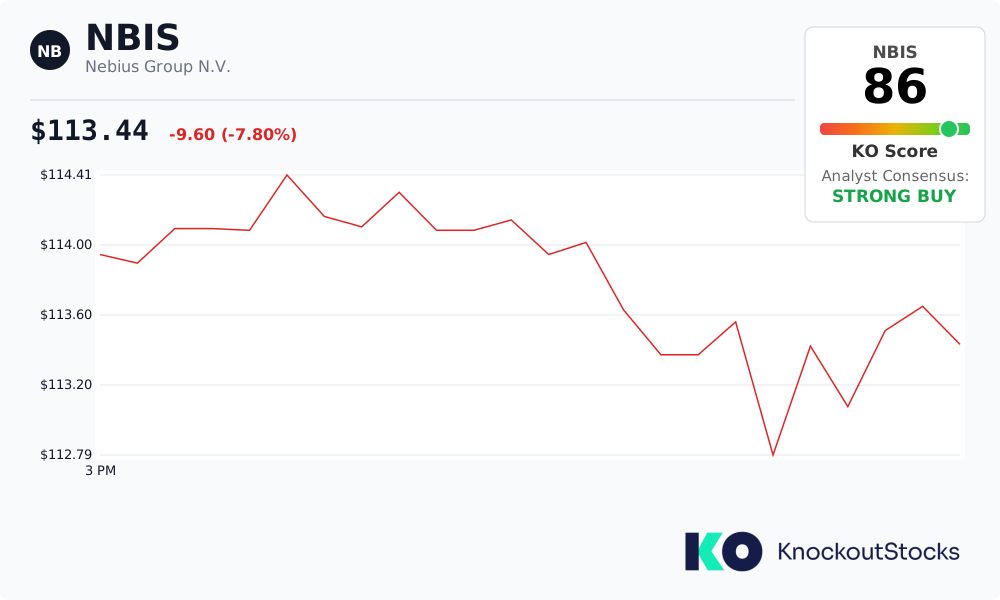 Nebius Group N.V., NBIS
The impressive performance failed to sway Michael Burry’s conviction. The investor behind Scion Asset Management, famous for forecasting the 2008 subprime mortgage crisis, increased his bearish wager the very same day the company announced its results.
Burry initially revealed his short stake on August 6 when the stock was trading around $212 per share. With shares settling near $259 on August 12, his current position sits at a loss.
Nebius, an AI cloud infrastructure company powered by Nvidia technology that was spun off from Russian tech giant Yandex and is now headquartered in Amsterdam, delivered AI cloud revenue of $575 million, surging 514% compared to last year.
During the three-month period, the company secured four major agreements, with each contract averaging over $1 billion in total value. The value of new customer agreements expanded more than ninefold versus the previous quarter.
The company’s cash position stood at $8 billion at the end of June, while operating cash flow reached $2.2 billion. However, capital expenditures totaled $5.7 billion, surpassing analyst projections of $4.7 billion.
In the shareholder letter, CEO Arkady Volozh stated: “We could sell our entire 2027 capacity on these terms today.”
Management also increased its 2026 contracted power capacity goal to 5 gigawatts from the previous target of 4 gigawatts.
The Depreciation Debate at the Heart of Burry’s Thesis
Burry’s bearish position doesn’t question whether AI infrastructure demand is genuine. Instead, his argument revolves around the accounting treatment of depreciation at AI companies.
He maintains that these businesses extend the assumed lifespan of computing hardware that typically becomes obsolete within two to three years, artificially boosting reported profitability.
At the beginning of 2026, Nebius lengthened its server depreciation schedule from four years to five years. Burry has highlighted these types of adjustments as precisely what inflates earnings throughout the industry.
In Q2, depreciation and amortization at Nebius totaled $259.7 million, equivalent to 45% of revenue. Under generally accepted accounting principles, the company recorded a net loss of $190.4 million for the quarter.
On August 12, Burry also expanded short positions in Micron and Oracle. His portfolio of bearish bets includes Nvidia, Palantir, Applied Materials, and Caterpillar.
CoreWeave shares climbed over 19% on August 12 after the company upgraded its full-year guidance, contributing to broader gains across AI infrastructure stocks.
At approximately $259, Nebius shares trade at roughly 20 times the company’s 2026 revenue guidance range of $3.0 billion to $3.4 billion. Through June 30, the company executed an at-the-market offering of 12.7 million shares at an average selling price of $223.60.
The critical question ahead is pricing sustainability. In early Q3, Nebius inked its first short-duration capacity agreement priced between $40 million and $50 million per megawatt.
The post Michael Burry Intensifies Nebius (NBIS) Short Position Despite 34% Stock Rally on Earnings Beat appeared first on Blockonomi.