Strategy reported its largest-ever unrealized Bitcoin loss, approaching $12 billion. The company sold 32 BTC between May 26 and May 31, generating about $2.5 million. Strategy held 843,706 BT
- Strategy reported its largest-ever unrealized Bitcoin loss, approaching $12 billion.
- The company sold 32 BTC between May 26 and May 31, generating about $2.5 million.
- Strategy held 843,706 BTC as of May 31, 2026.
- Michael Saylor highlighted four major Bitcoin ideologies influencing the ecosystem.
- Saylor argued recent Bitcoin weakness reflects capital rotation rather than impairment of the asset.
Strategy Navigates Bitcoin Volatility While Maintaining Long-Term Position
Bitcoin treasury company Strategy continued to attract market attention following reports that it recorded its largest-ever unrealized Bitcoin loss, approaching $12 billion, amid a broader decline in cryptocurrency prices.
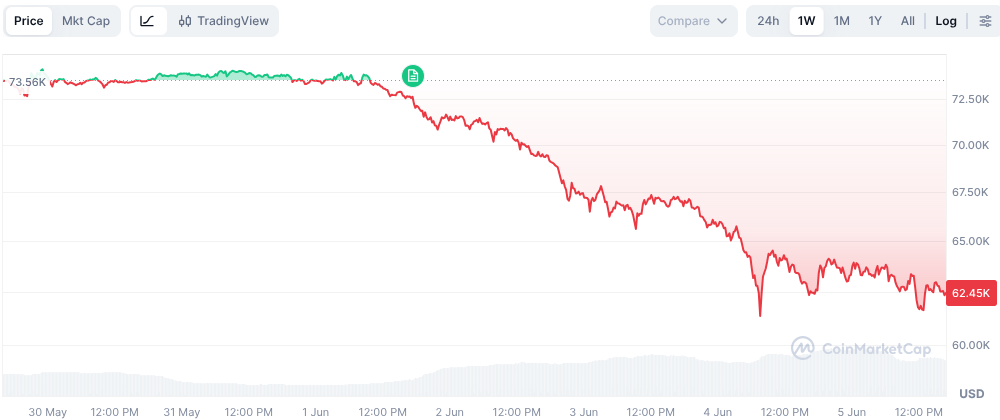 BTC Graph
The development comes after Bitcoin experienced a sharp weekly decline of approximately 15.13%, briefly falling below the $63,000 level. The move reflected increased selling pressure across digital asset markets as investors reacted to broader macroeconomic uncertainty, liquidity shifts, and risk-off sentiment.
Despite the market volatility, Strategy maintained one of the largest corporate Bitcoin positions globally. The company reported total holdings of 843,706 BTC as of May 31, 2026.
Between May 26 and May 31, Strategy sold 32 BTC, generating approximately $2.5 million in proceeds. The transaction represented a small fraction of the company’s overall Bitcoin holdings.
On-chain activity also drew attention on May 29 when Strategy transferred approximately 411.48 BTC, valued at around $30.3 million, to Coinbase Prime. Later the same day, blockchain data showed nearly the same amount-about 411.5 BTC, being withdrawn back from Coinbase Prime, effectively returning the transferred Bitcoin to company-controlled holdings.
The transactions occurred as market participants closely monitored institutional Bitcoin holders during a period of heightened volatility.
Saylor Says Bitcoin Weakness Reflects Capital Rotation, Not Fundamental Damage
As Bitcoin faced short-term selling pressure, Strategy Executive Chairman Michael Saylor said the recent weakness was driven by broader capital allocation trends rather than any deterioration in Bitcoin’s underlying fundamentals.
In a post published on June 4, 2026, Saylor pointed to significant investment flows into artificial intelligence infrastructure, noting that capital markets have directed approximately $400 billion toward AI development over the past six months. He also highlighted that Bitcoin exchange-traded funds have recorded roughly $4 billion in outflows since May 14, contributing to downward pressure on BTC prices.
According to Saylor, the recent decline reflects a temporary rotation of capital toward AI-related opportunities rather than a loss of confidence in Bitcoin. He described the current environment as one in which investors are reallocating funds across sectors as emerging technologies attract increased attention and investment.
The comments came amid heightened volatility in the cryptocurrency market, with Bitcoin experiencing a sharp correction. Despite the short-term weakness, Saylor maintained that market volatility creates opportunities and does not alter Bitcoin’s long-term role as a global digital monetary network.
His remarks also underscore the growing competition for institutional capital between digital assets and the rapidly expanding artificial intelligence sector, which has attracted substantial funding in recent months. Saylor has consistently maintained a long-term bullish stance on Bitcoin despite periods of market weakness.
During a previous market downturn in February 2025, he posted the widely discussed statement: “Sell a kidney if you must, but keep the Bitcoin.”
Notably, Bitcoin has continued to experience significant volatility since Saylor made the comment in February 2025. Despite his call for investors to maintain conviction during market weakness, BTC later faced additional corrections, including its recent drop below the $63,000 level.
Saylor Outlines Four Bitcoin Ideologies Shaping the Network’s Future
Alongside his market commentary, Saylor recently described four major ideological frameworks that influence how participants view Bitcoin’s development and adoption.
According to the framework, Bitcoin Maximalists view Bitcoin as the dominant and only truly decentralized monetary network. This group emphasizes Bitcoin’s role as incorruptible money, a store of value, and protection against inflation and centralized financial control.
Bitcoin Capitalists focus on integrating Bitcoin into the global financial system. They support adoption through banking services, corporate treasury strategies, credit markets, exchange-traded products, and institutional investment vehicles.
Bitcoin Technologists prioritize ongoing improvements to Bitcoin’s infrastructure. Their focus includes scalability, privacy enhancements, security upgrades, and usability improvements designed to support long-term network resilience.
Bitcoin Fundamentalists emphasize protecting Bitcoin’s core principles, including decentralization, self-custody, immutability, and censorship resistance. They typically advocate caution regarding protocol changes and institutional influence.
Saylor characterized the four viewpoints as complementary rather than conflicting forces. In his framework, maximalists contribute conviction, capitalists drive adoption, technologists advance innovation, and fundamentalists safeguard Bitcoin’s foundational principles.
The discussion arrives as Bitcoin continues navigating market volatility while institutional participation, ETF flows, treasury adoption, and technological development remain central themes in the asset’s ongoing evolution.
Conclusion
Michael Saylor’s latest comments come at a time when Bitcoin is facing increased volatility, ETF outflows, and broader shifts in global capital markets. While Strategy reported a nearly $12 billion unrealized Bitcoin loss and the company’s recent transactions attracted market attention, Saylor continues to maintain that Bitcoin’s long-term fundamentals remain intact.
According to Saylor, the recent weakness in Bitcoin reflects a temporary rotation of capital toward artificial intelligence and other high-growth sectors rather than a structural change in Bitcoin’s role as a digital asset. His view aligns with his long-standing conviction that short-term market fluctuations do not diminish Bitcoin’s value proposition as a decentralized monetary network.
As institutional adoption, ETF demand, technological development, and competing investment opportunities continue to shape market dynamics, Bitcoin remains at the center of discussions about the future of digital assets and global capital allocation.