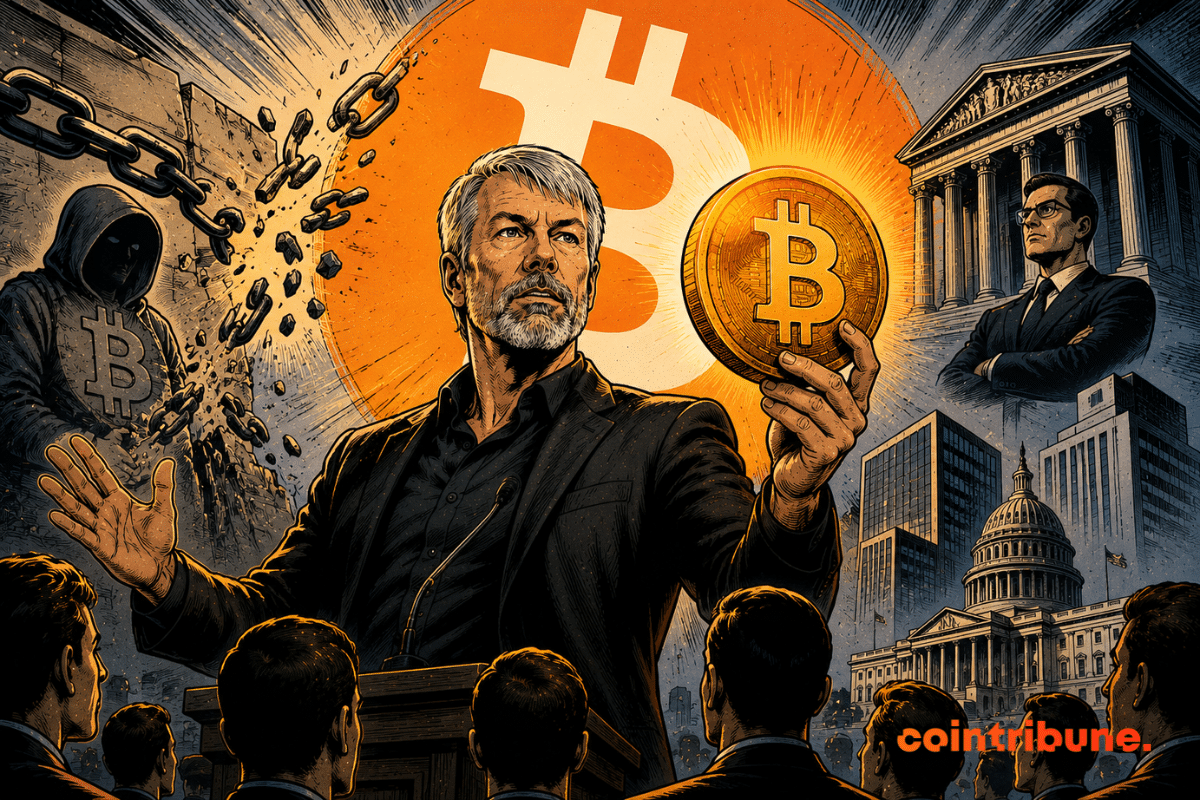
At first glance, it is a bold statement. On August 24, 2026, Michael Saylor published an essay in 14 sections titled “The Bitcoin Reformation”. Bitcoin is currently trading around 80,360 doll
At first glance, it is a bold statement. On August 24, 2026, Michael Saylor published an essay in 14 sections titled “The Bitcoin Reformation”. Bitcoin is currently trading around 80,360 dollars, and now the head of MicroStrategy directly challenges the founding dogmas of the network. Satoshi is no longer presented as an infallible oracle. Self-custody is no longer an absolute duty. Institutions are no longer seen as systematic enemies. Naturally, this has sparked reactions in the crypto community, and quite a few.
In Brief
- On August 24, 2026, Michael Saylor published a 14-section essay titled “The Bitcoin Reformation.”
- He challenges the “oracle” status attributed to Satoshi Nakamoto and the network’s ideological rigidity.
- In the essay, self-custody is presented as a right rather than a duty, drawing on the Coldcard incident.
- The failure of BIP-110, which was closed on August 9, 2026, serves as a key example: conviction does not equal consensus.
- The essay divides the community between supporters of a reform deemed necessary and detractors who denounce a dilution of the founding principles.
S
Satoshi dethroned: Saylor’s essay that has maximalists seething
Questioning the status of Satoshi Nakamoto is something very few dare to do head-on. Saylor, however, risks it without hesitation. Satoshi was a founder, not an oracle, he writes in black and white, in the original English text: “Satoshi was a founder, not an oracle“.
The white paper is not a constitution carved in stone, according to him. This almost religious veneration has ended up freezing the network. Instead of advancing it, precisely. He traces bitcoin’s trajectory from the beginning: “peer-to-peer electronic cash” originally, then “digital gold” for years, and now “digital capital” in his own words, the foundation of a new generation of credit and economic organization, no less.
Honoring Satoshi is not preserving 2008 under glass, he says in essence. Well, not everyone agrees, obviously. Bitcoin purists see it more as dilution than evolution, and the debate is clearly not settled.
Self-custody on Bitcoin is a right, not a sacred duty
Michael Saylor also states that self-custody is a right, not a mandatory ritual. He relies on the Coldcard incident to support his point, where a vulnerability in wallets labeled “Bitcoin-only” cost their users over 100 million dollars.
This calls into question the idea that ideological purity protects from everything. It actually protects from nothing, in this particular case. No ideological pedigree would have prevented these weak keys from leaving Coldcard, he basically sums up. He distinguishes institutional custody, which reduces operational errors, from risks inherent to self-custody: theft, loss of keys, inheritance issues never resolved in time due to lack of anticipation, a classic.
Your 1st cryptos with CoinbaseThis link uses an affiliate program.Rather than a total rejection of institutions, he advocates sorting on a case-by-case basis. Reactions remain mixed on this, as often with Saylor anyway. Some see it as a drift towards traditional finance, the very one bitcoin was supposed to replace initially.
Others simply believe that bitcoin is for everyone, with or without a hardware wallet in a drawer.
BIP-110 failed: proof that strong belief never equals network consensus
Michael Saylor also uses the failure of BIP-110 to illustrate his vision of governance. This proposal aimed to restrict data included in bitcoin transactions. The network simply rejected it, without much public debate, by the way.
It was marked as closed on August 9, 2026. Conviction is not consensus, he writes. This may be the most quoted sentence from the entire essay since its release, on X anyway. According to him, nobody can force the network to follow a particular vision, not even his own.
Anyone can fork Bitcoin. Nobody can force the economy to follow, he adds. Governance relies on consent among actors who clearly do not bear the same costs. And the failure of BIP-110 clearly shows this: orthodoxy is not imposed by conviction, however sincere it may be.
X is on fire after Saylor’s latest bombshell
The essay obviously sparked a debate on X, as always whenever someone touches on bitcoin’s fundamentals. Some praise a position that finally frees the network from the ambient dogmatism. Others accuse Michael Saylor outright of wanting to dilute bitcoin’s essence.
“It’s not up to you to declare a reform, you are a charlatan,” writes one user, rather blunt about the subject. Another adds: the anti-BIP110 crowd slowly realizes they have been fooled, bitcoin as money is dead according to him, no less.
More moderate voices nonetheless speak of a useful reformulation of the network’s issues. Some compare Michael Saylor to a Martin Luther of Bitcoin, excuse the comparison. Others, like Caged Bird, rather mention a mental exercise to justify an institutional shift already well underway at MicroStrategy for several years now.
Saylor himself responded that bitcoin does not abandon its principles, it transcends its prejudices, he says soberly for once. Will this convince skeptics? Nothing is less certain.
- BTC price at publication: 80,360 dollars
- Number of essay sections: 14
- Losses related to the Coldcard incident: over 100 million $
- BIP-110 closing date: August 9, 2026
- Americans considering crypto risky for their retirement: 77%
And to conclude, the path to widespread bitcoin adoption remains long, very long even. Even in the United States, 77% of people still consider crypto too risky for their retirement. The battle of ideas, however, is clearly only just beginning, and it is far from won for Saylor.