TLDR Micron delivered explosive Q4 results with revenue soaring 379% to $54.2 billion, surpassing Wall Street’s $51.5 billion forecast. Adjusted net income multiplied more than ten times to $
TLDR
- Micron delivered explosive Q4 results with revenue soaring 379% to $54.2 billion, surpassing Wall Street’s $51.5 billion forecast.
- Adjusted net income multiplied more than ten times to $38.4 billion, while EPS reached $33.42 compared to $3.03 in the prior year.
- MU shares advanced 3% following the earnings release and have climbed approximately 280% year-to-date.
- The chipmaker has secured 26 long-term customer contracts representing over 35% of projected revenue extending to 2030.
- Executives now anticipate constrained memory supply continuing through fiscal years 2027 and 2028, extending the bullish outlook.
Micron (MU) shares gained 3% after the memory chip manufacturer reported blowout quarterly results. The stock has now surged roughly 280% since the beginning of the year.
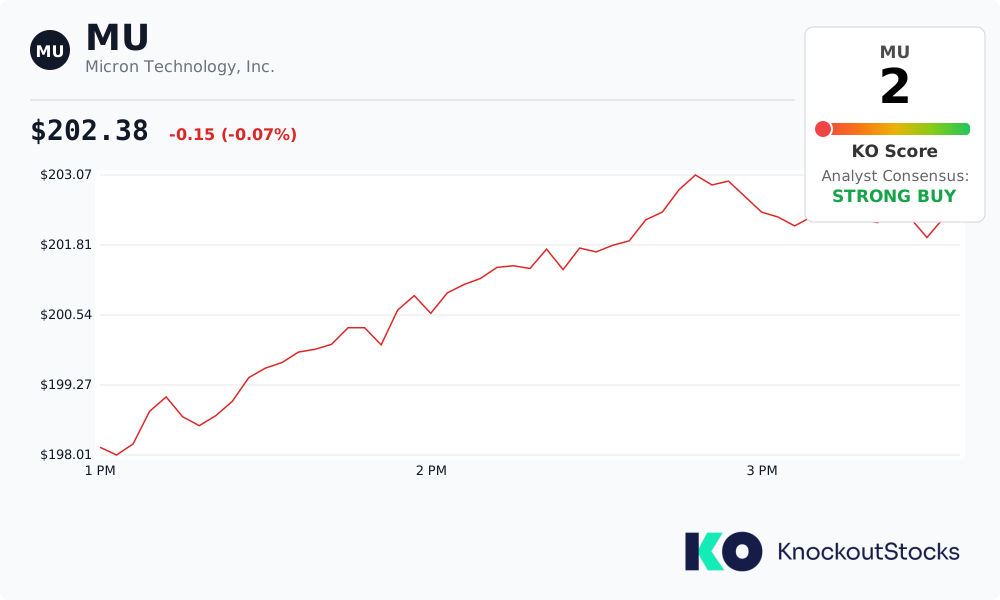 Micron Technology, Inc., MU
The fourth-quarter performance exceeded analyst projections on every metric. Revenue skyrocketed 379% to $54.2 billion, beating the Street’s consensus estimate of $51.5 billion.
Adjusted net income exploded to $38.4 billion, representing more than a tenfold increase. Per-share earnings vaulted from $3.03 in the year-ago period to $33.42, comfortably above the $31.82 consensus.
Despite the strong results, investor enthusiasm remained subdued. The share price has already captured substantial gains, more than doubling over the trailing twelve months.
What’s Driving the Margins
Before the earnings announcement, Wall Street analysts focused on a critical question: could Micron sustain its current gross margin levels? Creative Strategies CEO Ben Bajarin raised concerns about whether pricing adjustments were necessary to avoid the appearance of excessive markups.
CFO Mark Murphy tackled this issue head-on during the conference call. He indicated that first-quarter gross margins would establish a new baseline before resuming their upward trajectory.
The temporary margin compression stems from elevated fiscal 2026 compensation expenses linked to manufacturing operations. Micron absorbed a significant portion of these costs in Q4, shifting the impact into the current quarter.
Murphy assured analysts that margin expansion would resume afterward, powered by gradual price appreciation rather than aggressive increases.
The underlying demand picture remains robust. Hyperscale data center operators are purchasing memory chips at a pace that exceeds the combined production capabilities of Micron, Samsung, and SK Hynix.
Supply Deals Lock In Future Revenue
Micron’s long-term customer partnerships represent a critical element of its growth strategy. These multi-year contracts establish fixed pricing structures and provide insulation from the volatile boom-bust patterns that have historically plagued the memory sector.
CEO Sanjay Mehrotra revealed the company has finalized 26 such agreements to date. Collectively, these contracts are projected to generate more than 35% of total revenue extending through 2030.
This revenue visibility offers significant downside protection if AI-fueled demand eventually moderates. The memory industry has traditionally operated in cycles, with capacity additions periodically alleviating supply constraints.
Micron also revised its supply-demand forecast in this quarterly report. The company now projects tight market conditions persisting through fiscal 2027 and 2028, extending beyond its previous outlook that ended in 2027.
This represents a notable change from prior quarterly guidance, which only addressed calendar year 2027. Management attributed the revision to strengthening industry-wide demand trends observed since the previous earnings update.
Using trailing four-quarter earnings as a baseline, Micron currently trades at 15 times earnings. Analyst projections call for $171.90 in EPS for the upcoming fiscal year and $189.62 for the following period, implying a forward price-to-earnings ratio below 7.
The semiconductor manufacturer is simultaneously making substantial capital investments in future production capacity. Plans include a $100 billion fabrication facility in upstate New York, complemented by two cutting-edge manufacturing locations at its Idaho campus.
These infrastructure projects are designed to triple Micron’s output capability over the coming decade. A substantial portion of the new capacity will focus on high bandwidth memory products, which generate superior pricing compared to conventional DRAM chips.
CHIPS Act-related restrictions are scheduled to lapse on December 9. This expiration could enable Micron to implement more aggressive share repurchase programs given its attractive current valuation multiples.
The post Micron (MU) Posts 379% Revenue Surge as AI Memory Demand Fuels Record Quarter appeared first on Blockonomi.