Key Takeaways MU shares plunged 5.3% Monday amid widespread tech sector weakness driven by concerns over artificial intelligence spending deceleration, before gaining 1.1% in Tuesday’s premar
Key Takeaways
- MU shares plunged 5.3% Monday amid widespread tech sector weakness driven by concerns over artificial intelligence spending deceleration, before gaining 1.1% in Tuesday’s premarket session.
- A labor union representing Micron’s Taiwan employees is threatening industrial action, demanding implementation of a profit-sharing structure that would allocate 15% of operating profits to worker bonuses.
- The company previously disclosed compensation packages for Taiwan-based production staff valued at 35 to 68 months of base pay for the 2026 fiscal year, including a one million New Taiwan dollar cash award.
- Jordan Cvetanovski, Chief Investment Officer at Pella Funds, suggested in a CNBC interview that memory chip manufacturers could experience strong performance over the coming 12-24 months.
- Analyst consensus projects Micron will post earnings of $31.30 per share with revenues reaching $50.78 billion when reporting results on September 30.
Shares of Micron Technology (MU) were changing hands at $923.11 during Tuesday’s premarket trading, down 0.10%, following the prior day’s 5.25% decline. Monday’s selloff was part of a broader technology sector retreat triggered by investor anxiety surrounding potential slowdowns in artificial intelligence infrastructure investments.
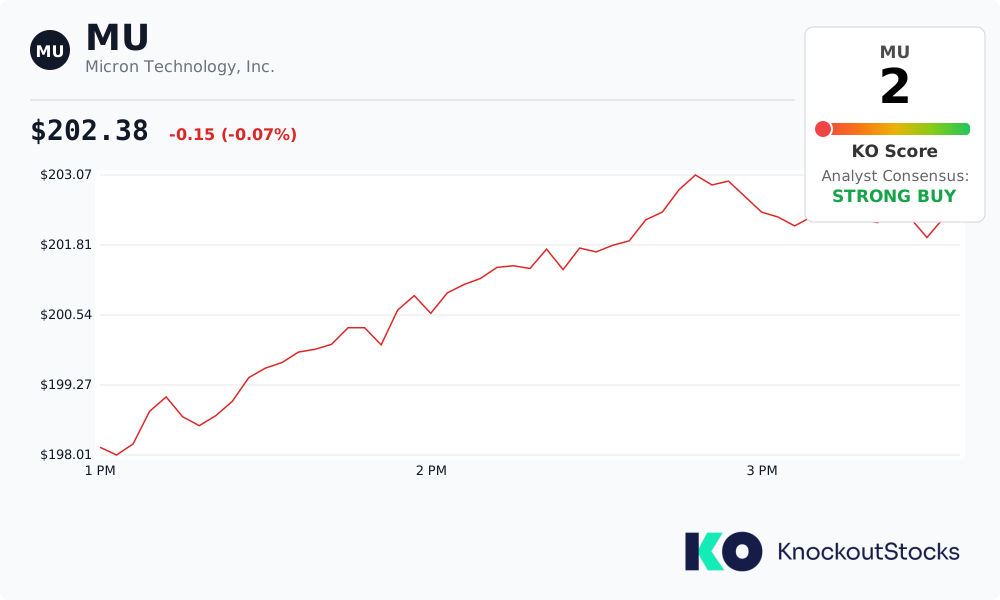 Micron Technology, Inc., MU
As Tuesday’s premarket session progressed, MU recovered 1.1% as concerns about AI investment trajectories appeared to ease. However, attention has now shifted toward a different challenge: potential labor disruption at the company’s Taiwan facilities.
According to reporting from Reuters, the union representing Micron’s Taiwan workforce is calling for the company to abandon its existing incentive structure in favor of a profit-sharing arrangement that would distribute 15% of operating profits as employee bonuses.
These demands surface despite Micron’s recent announcement of compensation arrangements for Taiwan-based manufacturing personnel valued between 35 and 68 months of base salary for the 2026 fiscal period. The compensation package featured a one million New Taiwan dollar bonus—approximately $31,377—designated for each worker who joined the company before August 29, 2025.
The union has indicated dissatisfaction with the current proposal and continues to threaten work stoppage. Taiwan’s labor regulations require mediation procedures to be completed before any strike action can legally commence.
Industry-Wide Worker Demands Intensify
Micron isn’t alone among memory semiconductor manufacturers facing heightened labor demands. Samsung successfully prevented a work stoppage at its South Korean operations in May by committing to a bonus pool representing 10.5% of its semiconductor unit’s operating profit, distributed as equity. Meanwhile, SK Hynix remains in ongoing discussions with its labor representatives after previously committing 10% of annual operating profit toward employee compensation.
This emerging trend across the three major players suggests an industry-wide movement where employees are demanding participation in the recent profitability gains experienced by memory chip producers.
During a Tuesday CNBC appearance, Pella Funds Chief Investment Officer Jordan Cvetanovski noted that despite recent volatility, memory semiconductor stocks could maintain robust performance through the next one to two years, supported by elevated profit margins and solid industry fundamentals. He cautioned, however, that sustained high profitability might eventually incentivize capacity expansion, potentially creating downward pressure on pricing.
Financial Forecasts and Market Positioning
Micron’s quarterly earnings announcement is scheduled for September 30. The analyst community anticipates earnings of $31.30 per share alongside revenues of $50.78 billion, representing substantial growth from the year-ago figures of $3.03 per share and $11.31 billion in revenue.
Wall Street maintains a consensus Buy recommendation on the stock with an average price objective of $1,521.74. Mizuho reaffirmed its Outperform stance in August with a $1,300 price target. New Street Research elevated its rating to Buy with a $1,250 target. Citigroup maintained its Buy recommendation with a $1,150 price objective.
From a technical perspective, MU is currently trading 3.8% beneath its 20-day moving average and marginally below its 50-day simple moving average. Critical support is identified near the $887.50 level, with resistance positioned around $1,012.
The company had not issued a response to media inquiries as of early Tuesday morning.
The post Micron (MU) Stock Faces Labor Unrest as Taiwan Workers Threaten Strike Action appeared first on Blockonomi.