Key Takeaways Micron delivered a historic fourth quarter with adjusted EPS reaching $33.42, a massive jump from $3.03 in the prior year. The chip manufacturer generated $54 billion in revenue
Key Takeaways
- Micron delivered a historic fourth quarter with adjusted EPS reaching $33.42, a massive jump from $3.03 in the prior year.
- The chip manufacturer generated $54 billion in revenue, representing a 379% year-over-year increase and exceeding analyst projections of $51 billion.
- Despite exceptional results, premarket trading saw shares climb only 0.4%, revealing persistent investor skepticism.
- The company secured 26 long-term supply contracts that will account for approximately one-third of revenue through the end of the decade.
- Wall Street analysts, including Cantor Fitzgerald’s C.J. Muse, argue the stock presents compelling value given its modest forward P/E ratio.
Micron Technology turned in a remarkable performance this Wednesday, unveiling one of the strongest quarters in company history. The semiconductor manufacturer reported adjusted earnings per share of $33.42, representing an enormous leap from the $3.03 recorded in the same period last year.
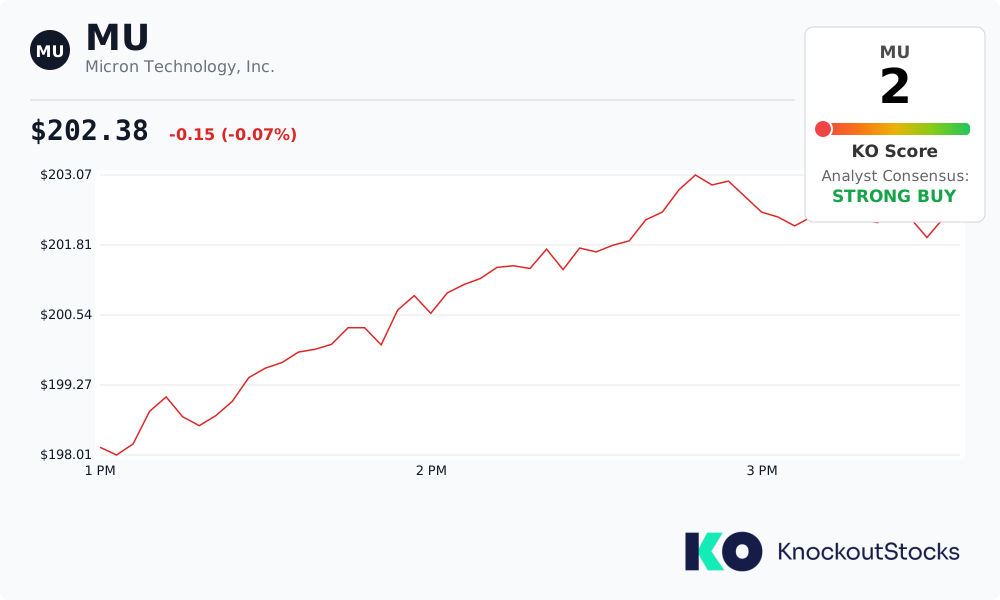 Micron Technology, Inc., MU
Quarterly revenue reached $54 billion, marking a staggering 379% increase compared to the previous year. The figure easily surpassed Wall Street’s consensus projection of $51 billion.
Yet despite these outstanding results, Micron’s stock response was remarkably subdued. Shares advanced a mere 0.4% during Thursday’s premarket session.
This tepid market reaction underscores the deep-seated skepticism investors harbor regarding the memory chip sector’s cyclical nature. Micron currently trades at a forward price-to-earnings multiple of just 6.6, dramatically lower than the S&P 500’s 18.5 valuation.
During the earnings conference call, CEO Sanjay Mehrotra expressed optimism about the road ahead. He indicated that supply and demand dynamics for memory and storage products are likely to grow tighter throughout fiscal years 2027 and 2028.
The quarter saw gross margin reach an unprecedented 87%, setting a new company record. Revenue expansion similarly exceeded all projections.
However, for conservative investors, these figures may signal a cyclical peak. Micron’s own forward guidance suggests modest declines in both revenue growth and gross margin for the upcoming first quarter.
The memory chip industry has historically been characterized by extreme volatility. Pricing and inventory levels experience dramatic fluctuations, and investors have previously suffered losses by entering positions at market peaks.
The current boom is largely fueled by insatiable demand from artificial intelligence data centers. Annual data center expenditures now exceed one trillion dollars, with substantial portions allocated to memory and storage components.
This supply constraint has extended into consumer electronics markets, where price increases became commonplace throughout 2026. Additional manufacturing capacity from Micron and competitors SK Hynix and Samsung won’t come online until the middle of 2027.
Strategic Shift Toward Long-Term Contracts
Micron is actively working to mitigate the traditional volatility inherent in its business model. The company has expanded its portfolio of multi-year supply agreements to 26, up from 16 in the previous quarter.
These contracts will secure roughly one-third of Micron’s total revenue through 2030. Unlike conventional annual agreements, they incorporate minimum price guarantees, maximum price caps, and upfront customer deposits.
Mehrotra emphasized that these arrangements should deliver greater financial predictability in future periods. Portfolio manager Hendi Susanto from Gabelli Funds noted that this cycle appears fundamentally different, as major hyperscale customers are securing supply commitments years in advance.
Nevertheless, Wall Street remains cautious and demands additional evidence before revising its perspective. Following the previous quarterly report, analysts upgraded their forecasts and price targets, triggering a 16% stock rally. Those gains have subsequently evaporated.
Micron’s balance sheet has strengthened considerably. The company generated $59 billion in free cash flow during the fiscal year just concluded.
Management deployed this capital to reduce debt by $10 billion, leaving only $5 billion in outstanding obligations. The company also initiated a share repurchase program.
Wall Street projects free cash flow will surge to $129 billion in the current fiscal year. According to Cantor Fitzgerald’s C.J. Muse, Micron trades at merely 5.6 times his 2027 earnings estimate and 4.5 times his 2028 projection.
Muse characterized the quarterly results as “about as straight down the fairway as one could have hoped.” He anticipates significant share buyback activity commencing in December.
The post Micron (MU) Stock: Should You Buy After Historic Earnings Report? appeared first on Blockonomi.

 Revenue: $54.23B (Est. $51.07B)
  ; +379% YoY