TLDR Shares of Microsoft climbed as high as 4% during Friday’s session, touching $516.39 in afternoon hours. Brian Schwartz from Oppenheimer increased his MSFT price objective to $570, up fro
TLDR
- Shares of Microsoft climbed as high as 4% during Friday’s session, touching $516.39 in afternoon hours.
- Brian Schwartz from Oppenheimer increased his MSFT price objective to $570, up from $515, maintaining an Outperform stance.
- The tech giant consolidated its consumer and business Copilot offerings into a unified enterprise application.
- Three core components power the revamped platform: a central chat interface, a low-code development environment, and an autonomous agent named Autopilot.
- MSFT shares have gained 7% in 2026, trailing the Technology Select Sector SPDR Fund’s 37% year-to-date advance.
Shares of Microsoft experienced a notable rally on Friday, advancing as much as 4% to $516.39 during afternoon market hours. The upward movement followed a price target elevation from Oppenheimer and the company’s announcement of a comprehensive Copilot platform restructuring.
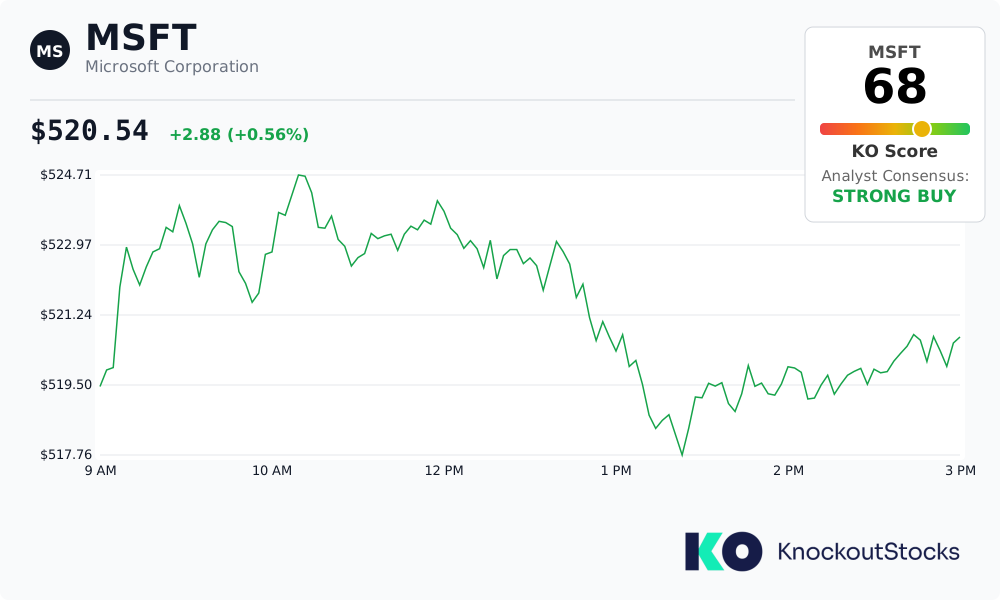 Microsoft Corporation, MSFT
Brian Schwartz, an analyst at Oppenheimer, increased his price objective for Microsoft to $570, marking an increase from his previous $515 target. The analyst maintained his Outperform recommendation, citing growing adoption among corporate clients selecting Microsoft as their primary enterprise AI infrastructure.
Meanwhile, Stifel’s Brad Reback also revised his position upward. He elevated Microsoft from hold to buy status and adjusted his price target to $575 from $530. This new target suggests potential upside of approximately 11% from Friday’s final trading price.
The broader technology sector provided support to markets on Friday. The Technology Select Sector SPDR Fund, which counts Microsoft among its top holdings, advanced 0.8%. The S&P 500 posted a more modest 0.2% increase.
Microsoft Narrows Its Copilot Focus
Microsoft has unified its consumer-facing and enterprise Copilot platforms into one business-oriented application. This strategic consolidation marks the end of the company’s efforts to develop a standalone personal AI assistant for general consumers.
During a preview demonstration, Microsoft’s Charles Lamanna clarified the company’s strategic direction. He emphasized that Microsoft is abandoning the personal companion approach in favor of workplace productivity solutions.
The refreshed application revolves around three primary capabilities. The central hub integrates conversational AI with task automation, enabling users to modify Word, Excel, and PowerPoint documents without leaving the interface.
A second component, leveraging GitHub Copilot infrastructure, empowers business users without technical expertise to create applications and automated processes through natural language commands. This functionality operates within a controlled environment managed by corporate IT departments.
The third element, branded Autopilot, functions as a continuous agent integrated within a company’s cloud infrastructure. It executes complex, multi-stage operations autonomously with minimal human oversight.
A New Way Microsoft Gets Paid
Microsoft has adopted a hybrid pricing structure for its AI services. Standard conversational features remain under a fixed subscription model, while advanced agent-based operations transition to consumption-based billing.
This pricing evolution alters the predictability of Microsoft’s AI-generated revenue streams. The company currently serves over 30 million paid Copilot enterprise subscriptions, establishing a reliable, seat-based income foundation.
Consumption billing links a portion of revenue directly to customer utilization of agent capabilities. This represents a departure from the traditional monthly per-seat accounting model.
The consumer AI market remains contested by other major players. Alphabet continues pursuing individual users through its Gemini platform, while OpenAI does likewise with ChatGPT. Alphabet shares increased 0.68% to $344.70 on Friday.
Microsoft shares have underperformed the technology sector throughout much of 2026. The stock has appreciated 7% year to date, significantly trailing the Technology Select Sector SPDR Fund’s 37% gain during the identical period.
While raising his price target, Schwartz acknowledged several headwinds. He identified potential AI market disruption and the risk of accelerated enterprise technology spending cycles as factors that could constrain Microsoft’s growth trajectory.
Among 55 analysts tracking Microsoft, the stock holds a Buy consensus rating, with 14 assigning it Strong Buy, 38 giving it Buy, and three maintaining Hold recommendations.
Microsoft finished Thursday’s session at $497.93 before Friday’s advance. The stock has traded between $348.54 and $549.20 over the past 52 weeks.
The post Microsoft (MSFT) Stock Surges 4% Following Copilot Enterprise Transformation and Analyst Upgrades appeared first on Blockonomi.
