Key Takeaways MSFT stands as the sole major US hyperscaler maintaining positive free cash flow, ending Q4 FY2026 with $19.6 billion in cash reserves For the first time since going public in 2
Key Takeaways
- MSFT stands as the sole major US hyperscaler maintaining positive free cash flow, ending Q4 FY2026 with $19.6 billion in cash reserves
- For the first time since going public in 2004, Alphabet recorded negative free cash flow, consuming $5.9 billion during Q2 2026
- Amazon’s 12-month trailing free cash flow flipped to negative $7.6 billion, even with AWS generating $42.2 billion in Q2 sales
- Following Azure’s impressive 43% revenue surge and the stock reaching $500, Citi upgraded its MSFT target from $570 to $600
- Bank of America projects total hyperscaler free cash flow will deteriorate from $180 billion positive in 2025 to $64 billion negative in 2026
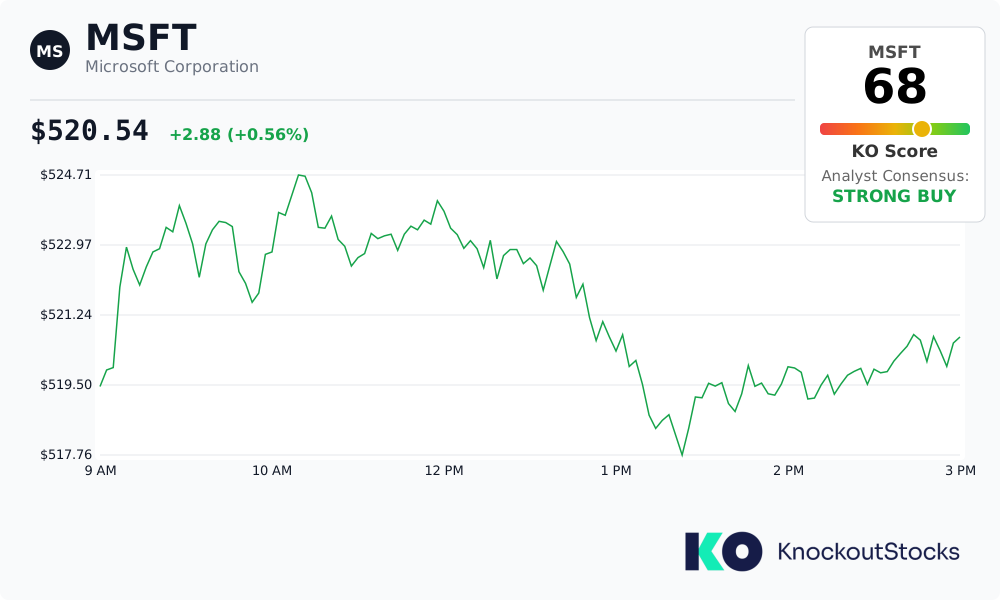
Shares of Microsoft (MSFT) momentarily crossed the $501 threshold on Thursday—marking its 2026 peak—before settling at $499. The milestone prompted Citi analysts to elevate their price objective on MSFT from $570 to $600, accompanied by a strong buy recommendation.
 Microsoft Corporation, MSFT
This remarkable 29% appreciation over 30 days reflects a fundamental narrative that’s creating distance between Microsoft and its cloud computing competitors. As Alphabet, Amazon, and Meta collectively drain cash reserves to finance artificial intelligence infrastructure buildouts, Microsoft stands uniquely positioned as the sole member among the four leading US hyperscalers maintaining positive free cash flow generation.
Alphabet entered negative free cash flow territory during Q2 2026—an unprecedented development since the company’s 2004 public debut. The search giant consumed $5.9 billion during the quarter while capital spending reached $44.9 billion. Management subsequently revised its full-year 2026 capex projection to a range of $195 billion to $205 billion.
Amazon faces comparable challenges. The e-commerce titan’s trailing 12-month free cash flow reversed into negative $7.6 billion territory following three consecutive years of positive cash generation. This deterioration occurred despite AWS delivering $42.2 billion in Q2 revenue, representing a robust 36.7% year-over-year expansion. Amazon has elevated its 2026 capex outlook to $220 billion.
Meta narrowly preserved positive quarterly free cash flow in Q2 2026, though its cash position plummeted 91% year-over-year to merely $784 million. The social media giant also lifted its 2026 capex guidance baseline to between $130 billion and $145 billion.
What Sets Microsoft Apart
Microsoft’s FY2026 capital expenditure stands at approximately $175 billion, revised downward from $190 billion following an accounting adjustment that reclassified datacenter leases from finance to operating leases, reducing reported capex by roughly $15 billion. With Azure annual revenue now exceeding $100 billion, the company possesses greater capacity to absorb infrastructure investments compared to competitors.
CFO Amy Hood highlighted an evolving capex mix as grounds for confidence. She emphasized that the primary spending component has transitioned toward assets with shorter lifespans, including CPUs and GPUs, stating: “If the demand environment changes, you just slow down what is, in fact, the largest component.”
Microsoft’s management has provided guidance indicating expectations for sustained free cash flow positivity throughout FY2027.
Industry-Wide Implications
Bank of America’s sector analysis paints a sobering picture. The financial institution projects that combined free cash flow across the eight largest global hyperscalers will reverse from $180 billion positive in 2025 to $64 billion negative in 2026. BofA anticipates further deterioration to negative $144 billion in 2027 and negative $186 billion by 2028.
Combined hyperscaler capital expenditures are forecasted to surpass $860 billion in 2026 and climb toward $1.2 trillion in 2027. Meaningful returns on these infrastructure investments aren’t anticipated to materialize until approximately 2029.
Amazon CEO Andy Jassy was direct about why the spending continues: “Even at that amount, we will still not have enough capacity to meet all the demand we have in 2026.”
Citi’s $600 price objective for MSFT suggests approximately 20% appreciation potential from current trading levels, with analysts highlighting Azure’s 43% revenue expansion and Wall Street projections indicating growth could surpass 45% in the upcoming quarter.
The post Microsoft (MSFT) Stock Surges Nearly 30% as Cash Position Strengthens Amid Competitor Struggles appeared first on Blockonomi.