MicroStrategy Bitcoin buyback begins a new phase in Strategy Inc’s financial playbook as the company shifts focus from aggressive accumulation toward structured debt reduction while maintaini
MicroStrategy Bitcoin buyback begins a new phase in Strategy Inc’s financial playbook as the company shifts focus from aggressive accumulation toward structured debt reduction while maintaining its massive Bitcoin reserve. The latest move reflects a broader adjustment in how the firm balances leverage with long-term digital asset exposure.
It comes at a time when corporate Bitcoin treasury models are under closer scrutiny from investors and analysts. The strategy signals a more disciplined approach to capital management without stepping away from its core Bitcoin commitment.
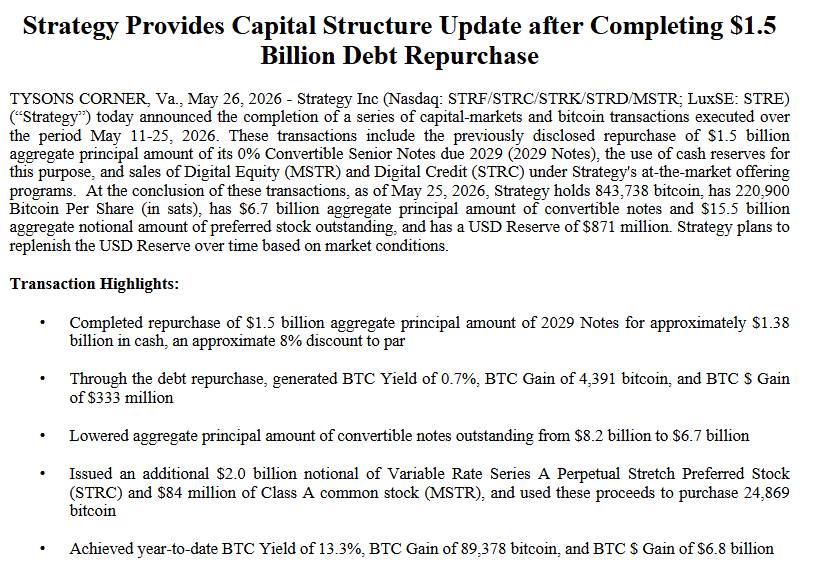
MicroStrategy Bitcoin buyback reflects Strategy Inc’s decision to actively reshape its liability profile while keeping its Bitcoin holdings untouched. Between May 11 and May 25, the company repurchased around $1.5 billion of its 0% Convertible Senior Notes due 2029. The transaction was executed for approximately $1.38 billion in cash, representing an estimated 8% discount to par value.

MicroStrategy Bitcoin Buyback Signals New Phase in Strategy’s BTC Treasury Plan 4
This action reduced total convertible notes from about $8.2 billion to $6.7 billion. The company used cash reserves instead of selling Bitcoin, reinforcing its preference to protect long-term digital holdings while addressing near-term debt obligations. MicroStrategy Bitcoin buyback also contributed to measurable financial outcomes, including a BTC Yield of 0.7%, a BTC Gain of 4,391 Bitcoin, and a BTC $ Gain of roughly $333 million.
How does debt reduction impact financial resilience?
The debt repayment has materially strengthened Strategy’s balance sheet without affecting its core Bitcoin position. The firm continues to hold 843,738 BTC valued at approximately $65 billion. It also maintains a USD Reserve of $871 million to support dividends and interest obligations.
Year-to-date metrics show strong performance, with a BTC Yield of 13.3%, a BTC Gain of 89,378 Bitcoin, and a BTC $ Gain of $6.8 billion. MicroStrategy Bitcoin buyback has played a central role in reducing refinancing pressure while improving capital efficiency. Analysts often view lower convertible debt exposure as a stabilising factor during volatile market cycles.
MicroStrategy Bitcoin Buyback Signals New Phase in Strategy’s BTC Treasury Plan 5
Why is Bitcoin not being sold during financial restructuring?
The decision to avoid Bitcoin liquidation has become a defining feature of Strategy’s approach. Even with internal flexibility to use Bitcoin reserves, the company chose to rely entirely on cash for the buyback. This reinforces the view that Bitcoin is treated as a long-term treasury asset rather than a funding source for liabilities.
During the same period, the firm also expanded its Bitcoin holdings by nearly 25,000 BTC worth over $2 billion, funded through equity-linked instruments. MicroStrategy Bitcoin buyback highlights this dual approach, where debt is reduced while Bitcoin exposure continues to grow rather than shrink.
What role do capital markets play in this strategy?
Capital markets activity remains a key pillar supporting Strategy’s financial framework. The company issued about $2.0 billion in Variable Rate Series A Perpetual Stretch Preferred Stock (STRC) along with $84 million in Class A common stock (MSTR). These proceeds supported both Bitcoin acquisition and liquidity management.
Leadership has described the structure as a flexible system designed to optimise Bitcoin per share across market conditions. This includes using multiple funding instruments depending on market strength and liquidity needs. MicroStrategy Bitcoin buyback is integrated into this framework as a counterbalance mechanism, ensuring that liability reduction does not interrupt broader accumulation goals.
How are executives positioning the long-term outlook?
Company leadership continues to frame the strategy as disciplined capital management rather than short-term repositioning. Executive Chairman Michael Saylor has emphasised that the firm operates with multiple capital levers including cash reserves, equity instruments, and digital credit tools. The goal is to maintain flexibility while growing Bitcoin exposure per share over time.

MicroStrategy Bitcoin Buyback Signals New Phase in Strategy’s BTC Treasury Plan 6
CEO Phong Le has also highlighted active management of convertible debt alongside structured capital allocation. This approach aims to maintain financial stability while supporting long-term digital asset growth. MicroStrategy Bitcoin buyback underlines a dual approach of liability management alongside sustained Bitcoin holdings.
Conclusion
MicroStrategy Bitcoin buyback marks a clear shift in Strategy Inc’s capital approach pairing debt reduction with steady Bitcoin exposure. Convertible notes are down to $6.7 billion from $8.2 billion. Bitcoin holdings remain unchanged at 843,738 BTC valued near $65 billion. At the same time continued capital market activity and additional Bitcoin purchases show that accumulation remains central to its long-term vision.
No Bitcoin was sold during the buyback process reinforcing its role as a strategic reserve asset. MicroStrategy Bitcoin buyback ultimately represents a dual-track financial model where liability management and Bitcoin accumulation move in parallel shaping a more resilient corporate crypto structure.
Glossary
Convertible Notes: Company debt that can be repaid or refinanced later.
Debt Reduction: Decreasing total company debt to strengthen finances.
BTC Yield: Measure of Bitcoin value growth from company actions.
Bitcoin Treasury Strategy: Using Bitcoin as a long-term reserve asset.
Cash Reserves: Money kept by a company for payments and debt needs.
Frequently Asked Questions About MicroStrategy Bitcoin Buyback
What is MicroStrategy Bitcoin Buyback?
MicroStrategy Bitcoin Buyback is when the company reduces its debt without selling its Bitcoin.
What type of debt did MicroStrategy buy back?
MicroStrategy bought back convertible notes that are due in 2029.
Why is MicroStrategy not selling Bitcoin?
MicroStrategy does not sell Bitcoin because it treats Bitcoin as a long-term asset.
How does this strategy affect the company?
This strategy helps the company reduce debt and stay financially strong while keeping its Bitcoin holdings.
What is the goal of the Bitcoin buyback strategy?
The goal of the Bitcoin buyback strategy is to reduce debt while still keeping full exposure to Bitcoin.
Sources:
Cryptobriefing
Strategy