On November 24, 2026 the one-year lock-up on team tokens ends at Monad. The figure behind it comes from the Monad Foundation's own tokenomics paper: at the first anniversary of the mainnet la
On November 24, 2026 the one-year lock-up on team tokens ends at Monad. The figure behind it comes from the Monad Foundation's own tokenomics paper: at the first anniversary of the mainnet launch, the released team tokens correspond to roughly 10.7 percent of the initial supply. With an initial supply of 100 billion MON, that is about 10.7 billion tokens. In circulation today are 11.83 billion MON. The team tranche alone therefore reaches around 90 percent of the amount currently in the market.
This is not a price forecast, and this article does not give one either. It answers a narrower question: what is scheduled for this date, how large is it relative to the circulating supply, and how much of that can be evidenced from the primary source. Anyone holding, staking or planning an entry into MON therefore has two months to review their own position size and their staking lock-up before the date.
In German nothing has been written on this date so far. That is the actual reason for this article, because the data situation is confusing: various aggregators name widely differing totals for November 24, and at least one carries a circulating supply that contradicts its own market capitalisation. Which figure holds and which does not is set out below.
What Is Scheduled for Release at Monad on November 24, 2026
The Monad Public Mainnet launched on November 24, 2025. All lock-up periods for the team and investors run from that day, which is why the first large cliff falls on the anniversary. The Monad Foundation writes in its tokenomics overview, verbatim: “All team tokens are locked for the first year following the launch of Monad Public Mainnet. Team tokens are released at the 1-year anniversary of the launch and over the three years that follow.” And further: “At the 1-year anniversary of the launch, released team tokens will represent ~10.7% of initial token supply.”
A cliff is, in tokenomics, the point at which a lock-up period ends and a first, usually large tranche becomes available all at once. Ongoing monthly instalments then generally follow. That is exactly how it is structured here, and for three groups at the same time.
- Team: around 27 billion MON in total, so roughly 27 percent of the initial supply, spread across employees, founders and contractors of the Monad Foundation and Category Labs. Release begins at the anniversary and is spread over the three following years. At the anniversary itself it is the roughly 10.7 percent named above.
- Investors: about 19.7 billion MON, roughly 19.7 percent. For this the primary source names “a four-year lock-up schedule starting from the launch of Monad Public Mainnet, with a one-year cliff and equal (1/48) monthly unlocks thereafter”.
- Category Labs treasury: about 3.95 billion MON, roughly 3.95 percent, earmarked for future employee compensation.
For the team the source names a percentage at the anniversary. For the investor tranche it names the mechanics, but no sum for this one day. That is the point at which model calculations diverge.
Why Aggregators Name Widely Differing Sums for the Same Day
For November 24, 2026 data services carry total sums of roughly 16.6 to 17.1 billion MON. The difference arises from a single question of interpretation: how is the “one-year cliff” for investors to be read? One reading assumes that with the cliff twelve of the 48 monthly instalments fall due in one go, that is a quarter of the investor tranche and thus about 4.9 billion MON. Another reading has only the first monthly instalment fall due at the cliff.
The primary source spells out neither reading. Anyone naming a total sum for this day is therefore naming a model assumption and not an evidenced figure. That is why this article puts the lower bound in the foreground, the one that holds without any interpretation: the team tranche of roughly 10.7 billion MON. This figure is evidenced by the wording of the primary source and on its own already reaches around 90 percent of today's circulating supply.
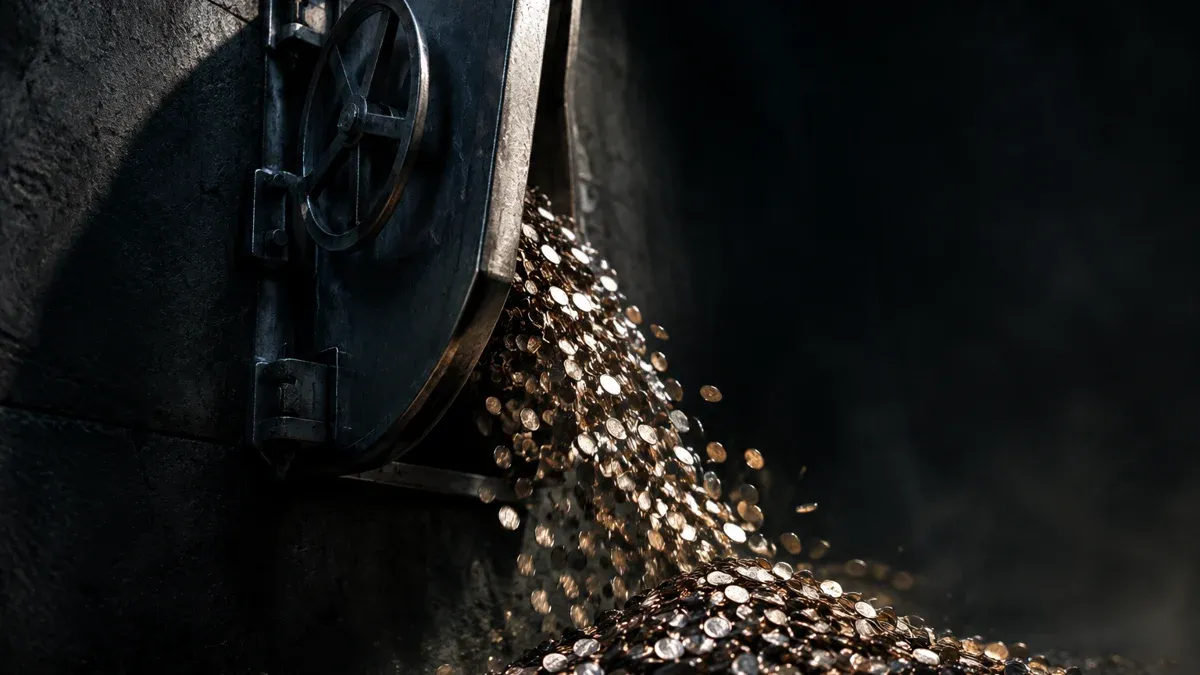
A release changes how many tokens are available. Whether they are also sold is on no schedule.
The Numbers Trap: Which Circulating Supply for MON Is Reliable
On the circulating supply the data sources diverge by more than a factor of four. One widely used data set reports a circulating supply of roughly 51 billion tokens for MON. That figure contradicts the market capitalisation in the same file, and it contradicts CoinGecko.
The cross-check is simple arithmetic, and it works with any token. Divide the market capitalisation by the price; out comes the circulating supply the provider actually used for its calculation. For MON, CoinGecko shows a price of $0.0263 on September 26, 2026 at a market capitalisation of roughly $311 million. The calculation yields about 11.8 billion tokens, and that is precisely the circulating supply CoinGecko reports as well: 11,825,165,000 MON.
Why the difference is so large has a substantive reason, and it matters for understanding the date. Unlocked and in circulation are two different things. According to the primary source, roughly 49.4 billion MON were not locked on the mainnet's first day, of which about 38.5 billion alone were for ecosystem development, managed by the Monad Foundation. These tokens are technically free but do not sit in the market. Anyone confusing “unlocked” with “circulating” ends up with figures that are off by a factor of four. Calculated with 51 billion, the team tranche would appear as 21 percent of the circulating supply instead of around 90 percent.
How Large 10.7 Billion MON Really Are Relative to the Market
Two comparisons place the size in context without making any statement about the price. First the quantity comparison: 10.7 billion against 11.83 billion circulating tokens, so about 90 percent. Second the value comparison at today's price: at $0.0263 the team tranche corresponds to a nominal value of roughly $280 million, against a market capitalisation of around $311 million.
Both figures are snapshots and expressly not a statement about what will be sold. Released means available, not disposed of. According to the primary source, team tokens are additionally subject to vesting over typically three to four years, tied to the date on which the respective person joined; a token is only released once it is both unlocked and vested. How much actually reaches the individual on November 24 therefore depends on individual schedules that have not been published.
What the Cliff Means for Your Position - and What It Does Not
An unlock is a supply event on the time axis, not a signal. What can be said reliably: from the date onwards, more volume can be sold than before. What cannot be said: whether, when and at what price that happens. Anyone deriving a direction from an unlock date is supplementing the data with an assumption.
In practice this means three things for you. First, the date is known and has been in the schedule since November 2025; it is therefore not a surprise but information the market can know. Second, your own position size is the variable that lies in your hands. Third, tradability decides whether you could react at all on the date. Where MON is listed and on what terms is something you check before the date and not on it; for a general comparison of the venues we maintain an overview of crypto exchanges.
This pattern is not confined to Monad. We have worked through the same mechanism twice in recent weeks: at the end of the one-year lock-up at Falcon Finance and at the DoubleZero unlock. In both cases the reliable statement was the same: the volume relative to the circulating supply, the exact date, and an express refusal of any statement about the price.
Why Staking Turns the Cliff Into a Scheduling Problem for You
With staking you tie up tokens in order to secure a network and receive a reward for it. The lock-up is the point that is often overlooked in connection with an unlock date: anyone staking cannot as a rule sell immediately. Between terminating a delegation and free availability there is, on many networks, a waiting period of days.
If you stake MON, that waiting period therefore belongs in your calendar before November 24 and not after it. What needs clarifying is how long unbonding actually takes at your provider or validator, whether a minimum term has been agreed, and whether an early termination costs rewards. A side aspect from the primary source: locked tokens cannot be staked. The team and investor tranches therefore do not contribute to the staked amount until the cliff, which can change after the date.

Around 10.7 billion team tokens coming free against 11.83 billion circulating MON: the size comparison is the core of this date.
What the Rest of the Lock-Up Schedule Looks Like Through 2029
November 24, 2026 is the first and largest juncture, but not the last. After the cliff the release of team tokens continues, according to the primary source, over the three following years, and the investor tranche is paid out in equal monthly instalments of one forty-eighth each. The foundation expects all initially locked tokens to be fully unlocked by the fourth anniversary of the mainnet launch in the fourth quarter of 2029.
For completeness of the initial distribution, all from the same source: roughly 38.5 percent was earmarked for ecosystem development, about 27 percent for the team, roughly 19.7 percent for investors, 7.5 percent for the public sale via the Coinbase platform at $0.025 per token, about 3.95 percent for the Category Labs treasury and roughly 3.3 percent for the airdrop. Locked at launch were 50.6 billion MON, that is 50.6 percent.
Anyone wanting to keep an eye on the schedule needs no daily monitoring for it. A calendar entry two weeks before the date is enough, plus a second one for the day itself. What can be observed afterwards is whether the actual circulating supply changes in the weeks after the cliff, and that can be traced with the arithmetic already described, from market capitalisation and price.
Which Numbers You Should Always Recalculate Yourself at an Unlock
The Monad case serves as an exercise because here a primary source and several contradictory aggregators sit side by side. Four checking steps are enough, and they take a few minutes.
- Cross-check the circulating supply. Market capitalisation divided by price gives the circulating supply used. If it deviates strongly from the reported figure, the field is unreliable.
- Put the release in proportion. Released amount divided by circulating supply. Only this quotient says something about the order of magnitude; an absolute token figure on its own says nothing.
- Check the source of the tranche. Does the figure appear in the project's paper, or is it modelled from a lock-up clause? With modelled figures the assumption belongs alongside.
- Note down the date and the time. Cliffs fall on a point in time, not on a day. For your own arrangements the time zone counts.
What Remains Open About This Date
What remains open first is the total sum for November 24, because the interpretation of the investor lock-up clause has not been published. What remains open second is how much of the team tranche is actually vested, and thus released, at the anniversary, since the individual schedules depend on joining dates. What remains open third is whether the foundation will make the schedule more precise by then; the tokenomics overview dates from November 10, 2025 and describes expectations, not commitments.
What is established, by contrast: the date, the mechanics of a cliff and subsequent instalments, the team tranche of roughly 10.7 percent of the initial supply at the anniversary, and today's circulating supply of 11.83 billion MON. On this basis a position can be placed in context without needing a forecast.
Part of placing the market situation in context is that MON has been trading well below its highest price since launch: CoinGecko reports an all-time high of $0.0488 from November 26, 2025, so from the days immediately after the mainnet launch. The current price stands at about $0.0263. Both are historical values and no indication of further developments.
Monad Unlock: What to Take Away
- Enter November 24, 2026 in your calendar and count the lock-up backwards from it. If you stake MON, your provider's unbonding period is the figure that decides your ability to act on the date. Which platforms apply which lock-ups and rewards is shown by our comparison of staking platforms.
- Never take the circulating supply unchecked from a data field. Market capitalisation divided by price costs ten seconds and would have prevented an error by a factor of four in the case of MON. Tools that carry such metrics consistently can be found in our overview of analytics platforms.
- Record your acquisition dates before you change anything. Anyone reshuffling because of a date may trigger a taxable event in Germany; what matters is the acquisition date and the holding period. For ongoing record-keeping our comparison of crypto tax software is a help.
Sources for this article: the MON Tokenomics Overview of the Monad Foundation for all details on lock-up periods, tranches and initial distribution, as well as the market data on MON at CoinGecko for price, market capitalisation and circulating supply, retrieved on September 26, 2026.
(As of September 26, 2026. This article is not investment advice. Prices and fee structures change; check the terms with the provider before you buy.)
