Mono Protocol Presale and the Strategy Behind Unified Blockchain Balances The Mono Protocol Presale is live at stage 44 of 197, and its numbers keep drawing questions. The project behind it w
Mono Protocol Presale and the Strategy Behind Unified Blockchain Balances
The Mono Protocol Presale is live at stage 44 of 197, and its numbers keep drawing questions. The project behind it wants DeFi users to hold one balance and move across blockchains without handling bridges or gas by hand.
That pitch sounds simple, yet the details need a closer look. Prices rise stage by stage, tokens unlock in phases, and several roadmap items remain plans rather than live features.
What Does the Mono Protocol Presale Actually Mean?
Mono Protocol is a chain-abstraction project. Chain abstraction means users act across many blockchains without manually switching networks, wallets, or gas tokens. The project sums it up as one account, one balance, and one click.
A Mono Protocol Presale is the early token sale for MONO, the protocol's native token. Buyers connect a wallet, choose a payment asset, and confirm the purchase. They can claim MONO after the token generation event (TGE), following the published schedule.
The minimum purchase is $10, and the page says payment works with more than 200 tokens. A separate Mono Protocol presale overview tracks the sale's listing details.
How Does the Cross-Chain DeFi Model Work?
Moving assets between chains usually means bridging by hand. That often involves waiting for source-chain finality, the point where a transaction can no longer be reversed. Mono aims to remove that wait.
The Mono Protocol tokenomics outlines a total supply of 1 billion MONO-tokens, with 50% allocated to the presale and 10% reserved for liquidity.
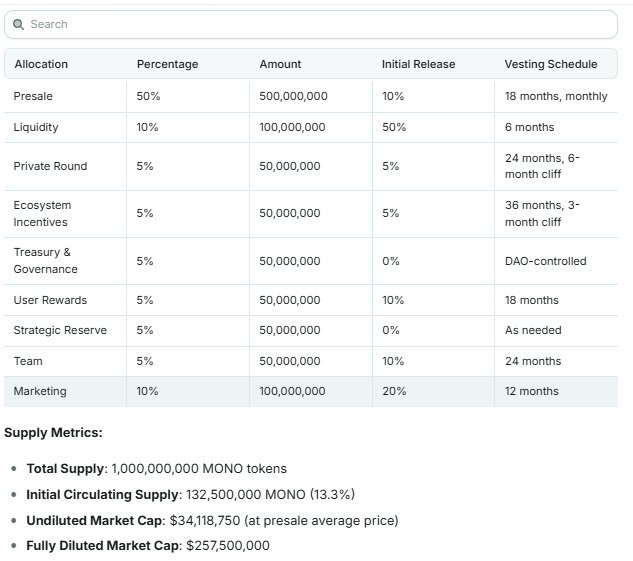
The remaining supply is distributed across marketing, private sale, ecosystem incentives, treasury, user rewards, strategic reserves, and team allocation, with different vesting schedules shaping token circulation over time.
How Do Liquidity Locks Speed Things Up?
The project says Liquidity Locks let a transaction run at the speed of the destination chain, whatever the source chain's finality time. They come in two forms. An account-based form handles one-click actions, while a vault-based form uses a smart contract to pool deposits from several chains.
What Do Mono Balances Add?
Mono-Balances turn a high-level intent into a ready-to-sign transaction. Smart routing decides which chain to spend from, whether a bridge is needed, and which solver should execute the job. Gas abstraction means users never touch gas directly.
The project also claims up to 40% faster execution than traditional cross-chain routes, plus lower costs than bridges. No independent test is cited for these figures, so they remain claims for now.
What Is the Current Mono Protocol Presale Stage?
As of October 9, 2026, the official page shows stage 44 live at $0.1175 per-MONO. The table separates the figures it displays.
Detail
Official figure
Starting price (stage 1)
$0.01
Current price (stage 44)
$0.1175
Last stage price (stage 197)
$0.4975
Stated launch price
$0.50
Raised so far
$11.55M
Fundraising goal
$22.8M
Investors
4,458
Private round
$2M, closed
The project frames the climb from $0.1175 to $0.50 as roughly 326% potential profit. That is a stated target, not a market price. A launch price becomes real only when an exchange lists the token, and thestage 44 funding update captured an earlier snapshot of the same sale.
Analyst note: if all 70.6 million presale tokens sell, the $22.8M goal implies an average near $0.32 per token. That is a rough calculation, not a published figure. At the $0.50 launch price, the fully diluted valuation (FDV) would be about $70.6 million. FDV counts every token as if it already circulates, so the market cap at launch would sit lower.
The page also shows two counters: $11.55M of $11.60M and $11.55M of $22.8M. The first appears to track the current stage threshold, though the project does not say so.
How Is the MONO Token Supply Split?
The initial supply is 141,252,439-MONO. The official page lists the allocation below.
Allocation
Share
Approx. tokens
Presale
50%
70.63M
Liquidity
10%
14.13M
Marketing
10%
14.13M
Team
5%
7.06M
Treasury and Governance
5%
7.06M
Strategic Reserve
5%
7.06M
Ecosystem Incentives
5%
7.06M
User Rewards
5%
7.06M
Private Round
5%
7.06M
Token counts are rounded calculations from the stated percentages.
Half the supply goes to presale buyers. That spreads ownership widely, but it can also add selling pressure once claims open. The team holds only 5%, which is a modest share.
The project says allocations are released in phases. The pages reviewed show no detailed vesting calendar, which is the schedule that controls when tokens become available.
What Does the MONO Token Do?
The official page lists three uses for-MONO:
Universal gas and protocol fees: MONO pays paymaster fees, meaning fees for a service that covers gas on a user's behalf, plus quoting, routing, and Resource Lock fees.
Security and governance: network operators such as bundlers, observability nodes, and the orchestrator stake-MONO as economic security and earn a share of protocol fees.
Execution bonds: solvers and routers lock-MONO as performance bonds to guarantee instant execution under the Resource Locks model.
Utility depends on usage. Staking and execution bonds sit in the Q3 2026 roadmap, so some roles are not live yet. A token with fee, staking, and bond roles can tie demand to network activity, but only if the protocol attracts real volume.
What Does the Roadmap Say About the Token Launch?
Thepublished roadmap splits 2026 into four phases:
Q1: throughput upgrade, parallel routing, Bug Bounty v2, and a unified SDK.
Q2: full Solana support, two or three more chains, and Unified Balance v2 for non-EVM networks.
Q3: token launch with CEX and DEX listings, staking, execution bonds, and the Universal Gas Module.
Q4: Mono Protocol v1.0, an enterprise layer, MEV-Shield v2, and cross-chain payments.
MEV, short for maximal extractable value, means profit made by reordering transactions. Mono-describes its design as MEV-resilient, which is another claim awaiting live proof.
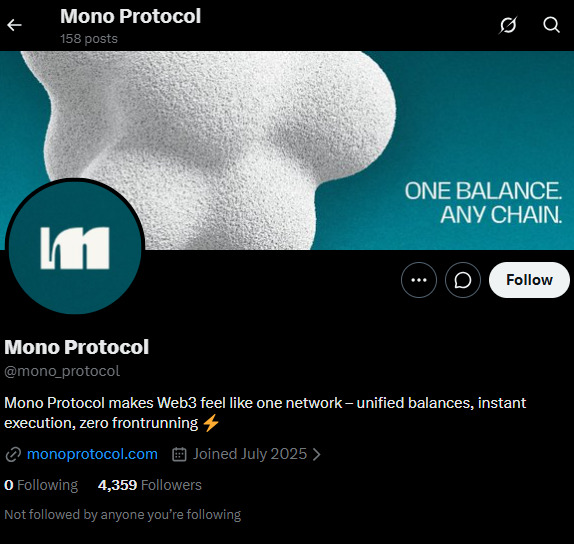
FollowMono Protocol on X for the latest updates on MONO-tokenomics, presale developments, ecosystem announcements, and upcoming project milestones.
The roadmap still labels every 2026 phase as coming soon, although Q3 has ended. The presale page says the listing will be announced after all stages finish, and stage 44 of 197 is far from that point.
A "New Roadmap Release" event dated 25 December may bring updated dates, and confirmed listings will show up inexchange listing updates.
What Are the Main Risks to Consider?
Timeline risk: the Q3 2026 launch target has passed without a confirmed listing date.
Selling pressure: half the supply sits with presale buyers, and vesting details remain unclear.
Unverified claims: the 40% speed gain, lower costs, and 326% potential profit come from the project, not independent testing.
Audit limits: the page marks an audit as completed, but an audit is not a guarantee of safety, and its scope deserves a full read.
Price gap: the $0.50 launch price is a target, and a real listing price may differ.
Delivery risk: Solana support, v1.0, and other items are future plans.
Phishing: fake presale pages are common, so only links from the official domain count.
Conclusion
Mono Protocol is a chain-abstraction project built around unified balances, liquidity locks, and a token with fee, staking, and bond roles. The Mono Protocol Presale sits at stage 44 of 197 at $0.1175, against a stated $0.50 launch price.
The 50% presale allocation and the detailed product design stand out. Vesting, listing timing, and whether the speed and cost claims hold up in live use remain uncertain. The updated roadmap, the full audit report, the contract address, and the claim schedule are the next items to check.
Disclaimer:
This article is for information only and is not financial advice. Crypto presales carry a high risk of loss, and project claims may change or prove inaccurate. Buyers should research independently and consult a qualified adviser before taking any decision.