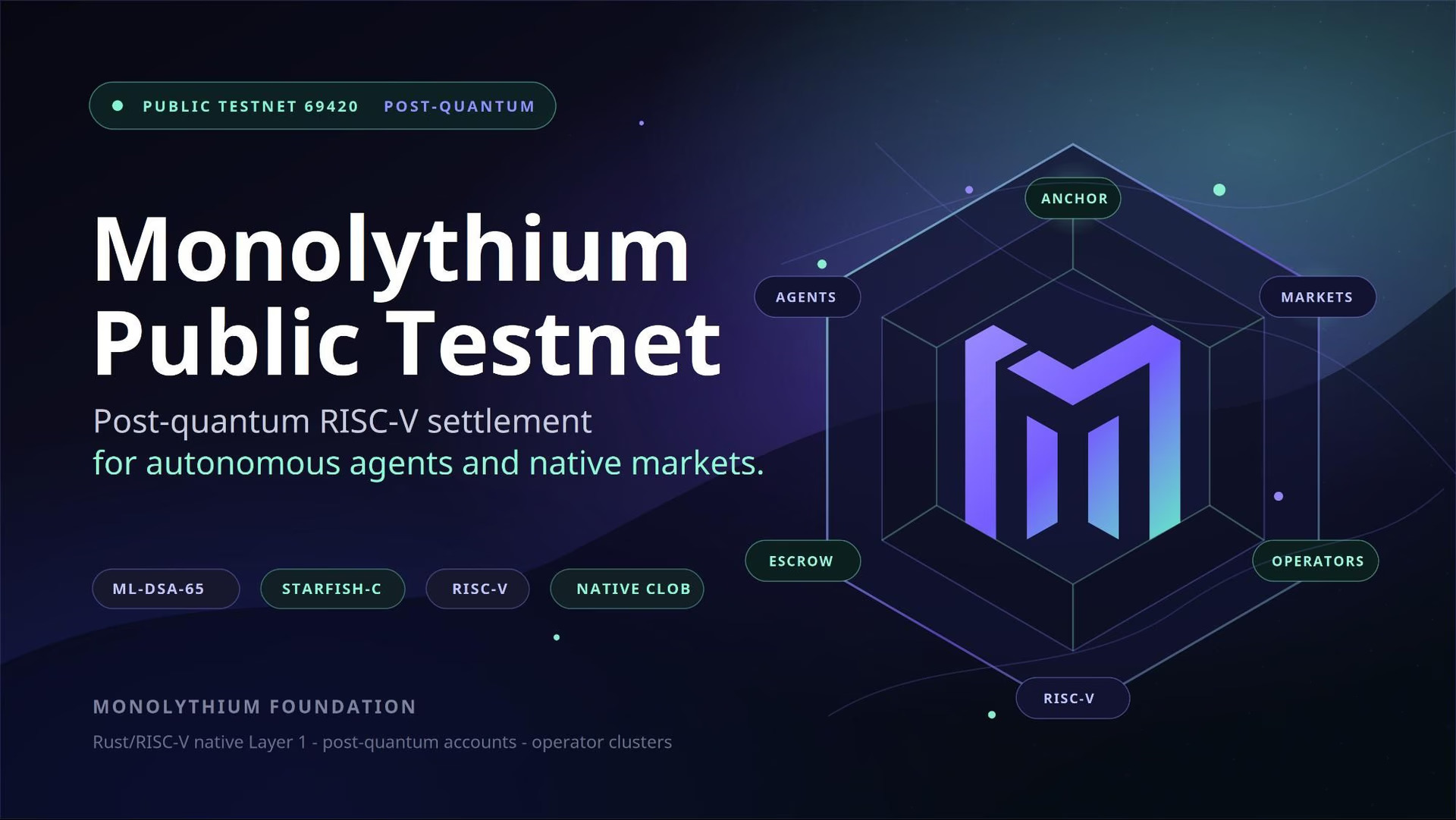
Monolythium Foundation Introduces Public Testnet for Post-Quantum Rust/RISC-V Layer 1 Monolythium Foundation today introduced the public testnet for Monolythium, a rebuilt Layer 1 blockchain
Monolythium Foundation Introduces Public Testnet for Post-Quantum Rust/RISC-V Layer 1
Monolythium Foundation today introduced the public testnet for Monolythium, a rebuilt Layer 1 blockchain designed as settlement infrastructure for autonomous agents, post-quantum accounts, native markets, and operator-cluster infrastructure.
The launch follows a full protocol reset. On April 28, 2026, Monolythium decommissioned its predecessor Cosmos-based app-chain, including its earlier EVM-bridged surface, legacy test network, operator software, launchpad, and explorer. The project chose to rebuild the protocol around autonomous economic activity carried out by humans, companies, software agents, and online services on open settlement rails.
Monolythium's position is that the next phase of blockchain infrastructure will not be defined only by wallets sending tokens. Software agents are beginning to request services, pay for APIs, buy compute, open escrow, negotiate terms, and act under delegated authority. That requires more than generic smart contracts. It requires identity, consent, spending policy, reputation, service discovery, native markets, and dispute resolution enforced below the application layer.
“Monolythium was not rebuilt to become a slightly faster version of an existing EVM chain,” said Nayiem Willems, founder of Monolythium. “The reset was about removing assumptions that would have limited the protocol later. If autonomous agents are going to hold identities, spend funds, pay service providers, open escrow, and build reputation across platforms, the settlement layer underneath them needs different primitives from day one.”
The rebuilt protocol is not EVM-compatible at execution. Existing Solidity contracts and EVM bytecode do not run natively on Monolythium. The execution layer is Rust-first and compiled to deterministic RISC-V artifacts, while common settlement functions are handled through native protocol modules instead of repeatedly redeployed application contracts.
Those native modules include asset standards, name registration, account policy, issuer attestations, service discovery, availability, reputation, escrow, bridge policy, spending limits, and a protocol-level spot central limit order book, or CLOB. The native CLOB is intended to provide shared spot-market infrastructure for token pairs, stablecoin pairs, compute, data, agent services, real-world assets, and other marketable resources without requiring every market to depend on a separate bespoke contract.
Monolythium deliberately excludes perpetual futures and margin trading from the base protocol. The market layer is designed around spot settlement rather than leveraged derivatives. The project's view is that agents paying for services, buying compute, routing liquidity, or managing treasury balances need predictable markets and final settlement at the protocol layer.
Post-quantum cryptography is built into the protocol from the start. Monolythium uses ML-DSA-65 for account and consensus signatures. User accounts, operator identities, and consensus certificates are based on post-quantum signatures rather than classical elliptic-curve signatures. The reason is structural: if an account or autonomous agent accumulates reputation, consent history, commercial activity, and attestations over years, its key material becomes part of its economic identity. Monolythium is designed so that identity does not begin with a future migration problem.
At the consensus layer, Monolythium uses Starfish-C, a DAG-BFT design organized around vertices, waves, and anchors. Anchors serve as the user-facing finality unit for payments, orders, escrow updates, bridge routes, and agent actions.
Monolythium also uses operator clusters instead of treating a network operator as a single key controlled by one party. Operators join clusters, clusters admit operators, and infrastructure quality becomes visible through network tooling. The model is intended to make region, reliability, hardware profile, archive capability, oracle support, and other service tiers part of the operator market.
The public testnet also includes LythiumSeal, Monolythium's encrypted mempool research track. LythiumSeal is designed to keep sealed transaction bodies opaque until ordering is locked, reducing the visibility that can enable front-running and transaction-order manipulation. It is live on testnet, open source, opt-in, and research-stage.
Monolythium mainnet has not launched. The current release is a public testnet intended for developers, operators, and researchers.
About Monolythium
Monolythium is a Rust/RISC-V-native Layer 1 blockchain designed as settlement infrastructure for the autonomous economy. The protocol combines post-quantum account and consensus signing, Starfish-C DAG-BFT consensus, native asset standards, a native spot CLOB, agent-commerce primitives, operator clusters, and hardened node infrastructure.