Morgan Stanley expects the market for tokenized real-world assets (RWAs) to reach as much as $10 trillion by 2030. The American multinational investment bank's latest outlook adds to a growin
Morgan Stanley expects the market for tokenized real-world assets (RWAs) to reach as much as $10 trillion by 2030.
The American multinational investment bank's latest outlook adds to a growing list of Wall Street forecasts that see blockchain technology reshaping how financial assets are issued, traded and settled.
Amy Oldenburg, Morgan Stanley’s head of digital asset strategy, told The Block at Token2049 that the market would reach between $3 trillion and $10 trillion by the end of the decade.
What is Tokenization? (0:57)
The bank is also preparing to support tokenized equities on its alternative trading system (ATS) in the first quarter of 2027, later than its previous target of the second half of 2026.
The shift reflects growing institutional interest in putting traditional financial products on blockchain networks.
But while the forecasts point to a potentially massive market, the industry still faces questions over regulation, liquidity and how different platforms will work together.
Related: Americans could get more than $4,000 back from the IRS
Wall Street sees a multitrillion-dollar opportunity
Citi Institute’s June 2026 Tokenization 2030 report estimates that the global tokenized asset market could grow from approximately $17 billion to $5.5 trillion by 2030 in its base-case scenario.
Its forecast ranges from $2.7 trillion in a bear case to $8.2 trillion in a bull case.
Citi expects public market securities, particularly U.S. equities and Treasury securities, to drive much of the early growth.
It also estimates that if 10% of U.S. retail investors use on-chain solutions by 2030, demand for tokenized public equities could reach about $2.6 trillion.
The bank points to growing involvement from major market infrastructure providers, including the Depository Trust & Clearing Corporation, the New York Stock Exchange, and Nasdaq, as a potential catalyst for adoption.
Meanwhile, Pantera Capital’s State of Tokenization report for the first quarter of 2026 offers another view of the market’s development.
Pantera Capital is a U.S. investment firm specializing in cryptocurrency, digital assets and blockchain companies. It is one of the earlier institutional investors in the crypto industry, having launched a Bitcoin fund in 2013.
The company's researchers tracked 593 tokenized assets across 11 asset classes, representing approximately $321 billion in market value.
The report found that 77.6% of tracked assets remained wrappers, while only 2.7% qualified as native on-chain instruments.
The figures use different market definitions from Citi’s estimate, but highlight an important distinction: representing an existing asset on a blockchain is not the same as rebuilding the financial infrastructure around it.
Popular on TheStreet Roundtable:
Growth depends on more than blockchain adoption
The International Monetary Fund’s Oct. 8 analysis of tokenization points to the gap between the technology’s potential and its current scale.
The IMF estimates that repurchase agreements account for most tokenized activity, with daily transaction volumes averaging $300 billion to $350 billion.
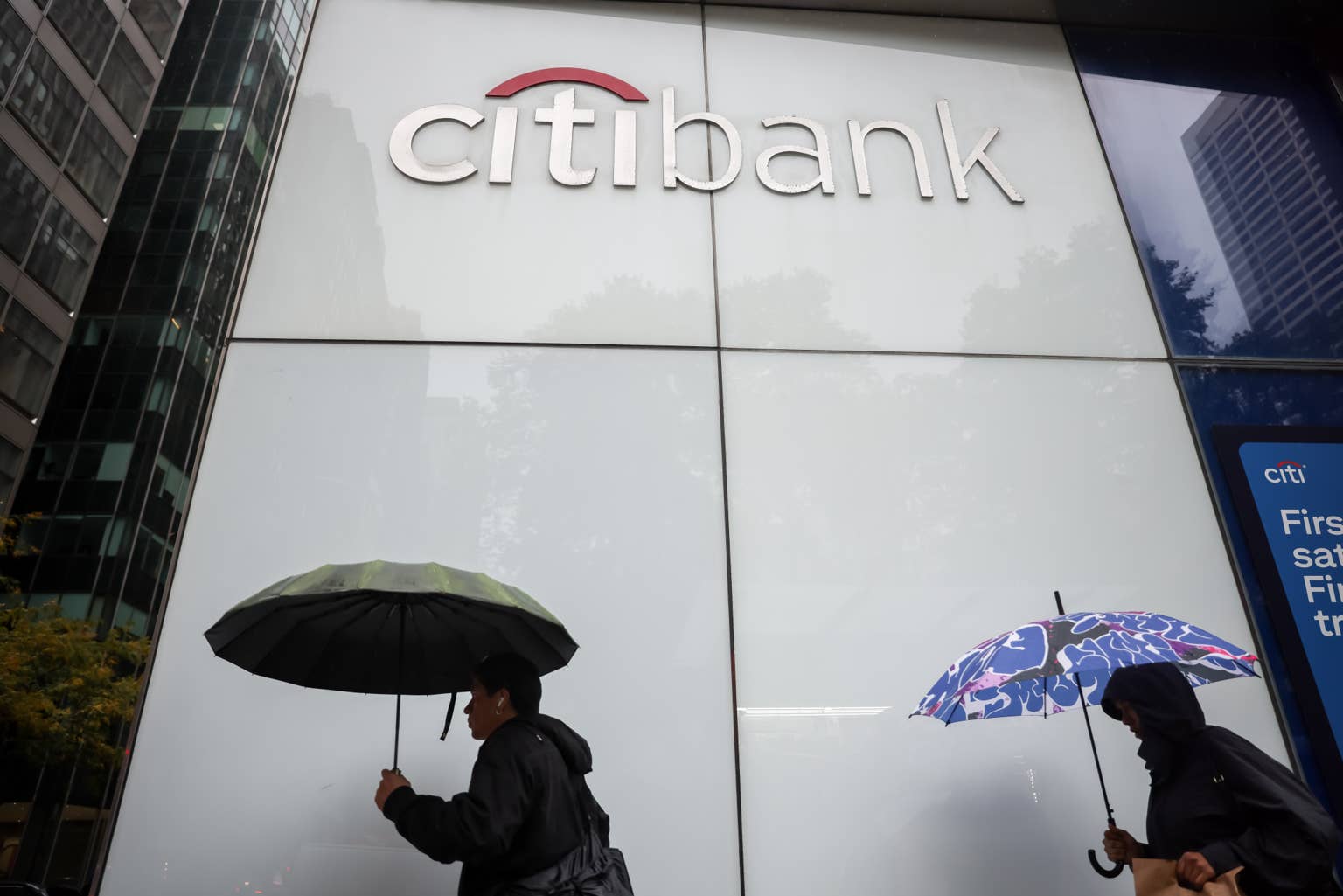
A Citibank branch in New York, US, on Sunday, Oct. 11, 2026.
Bloomberg via Getty Images
Trading in tokenized assets such as credit, money market funds and equities adds another $65 billion a day. By comparison, the U.S. repo market handles around $13 trillion in daily volume.
The IMF says tokenization could make transactions faster, lower costs and combine functions such as issuance, trading and settlement.
However, it warns that fragmented platforms, uncertain legal rights and limited interoperability could restrict growth.
Tokenized markets also remain relatively illiquid and can experience higher volatility than their traditional counterparts.
Citi likewise expects tokenized and traditional systems to operate alongside each other for some time. The bank identifies regulated digital money, including stablecoins and tokenized deposits, as an important part of enabling on-chain settlement.
For Morgan Stanley’s $10 trillion outlook to become reality, the industry will need more than new products and institutional announcements.
Related: Cathie Wood sells Meta shares after Zuckerberg's big AI launch