A funded trader can clear every stage of a challenge, close a position in the green, and still have the account terminated, not for losing money, but for a clause they never noticed when they
A funded trader can clear every stage of a challenge, close a position in the green, and still have the account terminated, not for losing money, but for a clause they never noticed when they paid. It reads like a rare misfire. New data suggests it is much closer to standard: across more than 300,000 funded accounts, only around 7% of traders ever drew a payout, and the reason typically had nothing to do with trading ability.
That is where Velotrade’s 2026 Prop Firm Transparency Report begins. The report worked through the published rulebooks of six firms, Topstep, FTMO, FundingPips, Blue Guardian, HyroTrader and Velotrade, isolating the terms that actually determine whether a funded trader keeps what they make. Its case is direct: traders fixate on profit splits, while the rules tucked inside evaluation guides and help-center pages are what quietly close most accounts.
Most funded accounts are lost to rules, not bad trades
The figures behind that claim come from two separate industry datasets:
- In a 2024 study by FPFX Tech covering more than 300,000 accounts (reported via Finance Magnates), just 7% of traders ever reached a payout, and only about 14% cleared a challenge in the first place.
- A separate 500,000-trader analysis by hoc-trade found that roughly 70% of failures came from hitting loss limits, not from missing profit targets.
- Consistency rules can erase 33% to 50% of the profit made on a single strong day. Four of the six firms reviewed apply one.
The pattern is consistent: the trade is seldom the issue. The rulebook is.
“Could a trader read our rules once, in one sitting, and know every way their account could end? If the answer is no, the rulebook is not finished. Most of this industry has treated that as a marketing problem. We think it is the entire product,” said Gianluca Pizzituti, Chief Executive Officer of Velotrade.
A market booming and breaking at once
Appetite for funded accounts has surged even as the number of firms was thinned out. Monthly searches for “prop firm” climbed from roughly 880 in early 2020 to about 49,500 by 2025, a 56-fold jump, drawing waves of first-time buyers into an industry whose decisive terms sit off the sales page.
The other half of the story is harsh. After MetaQuotes pulled MT4 and MT5 licenses from prop firms serving US clients in February 2024, several prominent names collapsed. The Funded Trader halted operations and later admitted to more than $2 million in denied payouts. True Forex Funds shut down citing insolvency, leaving roughly 300 traders owed $1.2 million. SurgeTrader closed within days, its CEO conceding that about 10% of payout obligations went unpaid.
The same trade, two firms, two outcomes
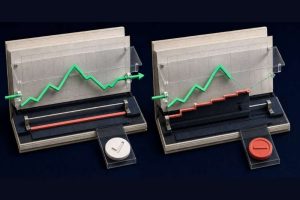
Every prop account has a maximum-loss line, but firms draw it in fundamentally different ways, and the difference can decide the identical trade twice. A fixed drawdown is set from the starting balance and never shifts: on a $100,000 account with a 10% limit, you fail at $90,000, no exceptions. A trailing drawdown climbs with your equity and never falls back.
The report runs one account through both models. An ordinary day-seven pullback bottoms out about $10,000 above a fixed $90,000 floor, so the account is never at risk and goes on to finish up roughly $6,500. Under a trailing floor that has ratcheted up near the peak, the very same dip breaches the line and closes the account outright. FTMO anchors its maximum loss at 10% of the starting balance; Topstep’s trailing limit rises with the end-of-day balance and locks at the start. Neither firm conceals its model, but fixed versus trailing is no footnote. It decides the trade.
The penalty for a good day
A consistency rule limits how much of your total profit can come from any one session. Trade too well, too quickly, and you fail anyway. Under a 40% single-day cap with a $1,000 target, a strong $450 session is 45% of profit, over the line, so the evaluation fails even though the target was met.
Topstep, FundingPips, Blue Guardian and HyroTrader each apply a version, during evaluation or on a payout tier. FTMO applies a 50% Best Day Rule on its 1-Step product, documented in its help center rather than the headline rules. And the tightest single-day caps tend to sit on the most attractive payout options. Velotrade says it applies no consistency rule at any stage. For readers weighing the crypto-focused end of the market, Velotrade’s rundown of the top crypto prop firms sets these terms out side by side.
The rule that can punish a winning trade
Loss limits close the most accounts. But the report singles out a quieter rule as the hardest to see coming, because it can shut an account on a trade that never closes at a loss.
A max-risk-per-trade rule caps how much any single position or trade idea may lose at any moment, measured on unrealized, floating, profit and loss, not on closed trades. It sits beneath the advertised daily loss limit. If an open trade’s paper loss so much as touches the cap intraday, even for a second, the rule can trigger and the account is finished, even if that trade would have gone on to close in profit.
Three things make it easy to miss at checkout:
- It measures unrealized loss. Your trade never has to close red.
- It can switch on only after funding. You can pass the entire evaluation without ever meeting the rule that then governs your funded account.
- It can aggregate re-entries. Close a losing trade and reopen in the same direction, and the losses are combined toward the cap.
Firms name it differently. Blue Guardian’s “Guardian Shield” force-closes trades near 1-2% unrealized (depending on account type); a first breach cuts your split to 50%, a second closes the account. FundingPips applies a “Risk Per Trade Idea” rule at the funded stage that aggregates re-entries. HyroTrader requires a stop-loss within five minutes of every trade, monitored live. Velotrade says it publishes no secondary per-trade or per-idea cap beneath its daily limit.
None of these is illegitimate as risk management. The report’s point is about placement: a rule that can end a funded account arguably belongs next to the price, not several pages into a help center.
What the rulebooks say, side by side
The full rulebook comparison sets all six firms against the terms that most often decide a payout. Because Velotrade both published the report and appears in the final column, that column reflects a market participant’s own position rather than a neutral grade, and traders are advised to verify current terms directly with each firm.
FirmDrawdown ModelFloating P&L CountedConsistency RulePosition Risk RuleNews TradingWeekend HoldingRules ChangeWhere the Detail LivesFTMOFixed, from initial balance (10%)Yes, loss line includes unrealized P&LBest day threshold on some account typesNo secondary per-trade cap on standard accountsUnrestricted in evaluation; short window around targeted releases once fundedAllowed in evaluation; funded Standard must close before the weekend; Swing exemptYes, news and weekend rules tighten at the funded Standard stageTrading objectives pages, FAQTopstepTrailing, end of day, locks at starting balanceYes, realized and unrealized P&LBest day threshold in evaluation; separate threshold on payoutNo formal per-trade cap; full size into major news is a listed riskNo fixed blackout window; maximum size into major news flaggedNot permitted at any stage; day-trading program with a fixed daily lossConsistency requirement and payout path differ once fundedHelp center articlesFundingPipsVaries by product; most models fixed, one product trails 5% from peak equityYes, on the daily loss limit across modelsConsistency score gates the higher on-demand payout tier“Risk Per Trade Idea” cap, funded stage only, aggregates re-entriesUnrestricted in evaluation; funded accounts restricted near high-impact newsAllowed in evaluation; funded accounts under a temporary restrictionYes; per-trade cap and news and weekend rules activate once fundedRules pages and payout termsBlue GuardianDaily loss limit plus trailing mechanics, varies by productYes, uses balance or equity, whichever is higherApplies during evaluation; varies by product“Guardian Shield” near 2% unrealized; first trigger cuts split, second closesBroadly permitted in evaluation; short restricted windowGenerally permitted, subject to plan rulesYes; the floating loss shield and news restriction are documentedBlog and rules documentationHyroTraderVaries by plan; optional upgrade converts trailing dailyYes, daily drawdown monitored in real timeApplies during evaluation only; drops away once fundedMandatory stop-loss within 5 minutes of every trade, monitored liveHolding through news permitted; news-only strategies restrictedPermitted at every stage, reflecting 24/7 crypto marketsYes; the consistency requirement applies only during evaluationTerms and FAQVelotradeFixed, disclosed from initial balanceNo secondary floating loss cap publishedNone at any stage, per published rulesNone published beneath the daily limitPermitted at every stage, per published rulesPermitted at every stage, per published rulesNo; rules stated as consistent from purchaseSingle published rules page
Source: each firm’s own published rules pages, help-center articles and FAQs, captured July 2026. “Varies by product” means the answer differs across a firm’s account types. Terms change frequently, so confirm current conditions before purchasing.
Where the established firms still lead
The report is candid about the other side of the ledger. As a prop firm, Velotrade is new, it launched its challenges in 2026, while FTMO (2015) and Topstep (2012) have run trader evaluations for far longer. Paying out funded traders at scale is something only time proves, and on that specific record the incumbents have years of history while Velotrade is early. Several firms also scale funded accounts well beyond Velotrade’s $200,000 ceiling and support more platforms. A clean rulebook can be designed from day one; a paid-out track record cannot, and the report advises weighing both.
The ten-minute checklist before you buy a challenge
The report’s practical takeaway: ten minutes reading the terms may matter more than any comparison of profit splits. Drawing on its review of six prop firm rulebooks, it tells traders to check:
- Drawdown mechanics: fixed from the initial balance or trailing your equity? If trailing, end-of-day or tick-by-tick, and when does it lock?
- Consistency rules: eval, funded, or both? Tied to a payout tier? What is the exact single-day cap?
- Per-trade caps: is there a secondary cap beneath the daily limit, does it measure unrealized losses, and does it aggregate re-entries?
- Funded-stage changes: do rules activate, tighten or disappear once funded, and does the account start at a reduced balance?
- Payout conditions: minimum trading days, withdrawal frequency, first-payout waiting periods, and whether a payout can be declined at the firm’s discretion.
- Where it’s written: are all account-ending rules on a single page, and can support point to each one in writing?
Regulators are asking the same question
Scrutiny is mounting. The US Commodity Futures Trading Commission is expected to open a public consultation on 1 August 2026 (comments close 30 November 2026) on whether challenge fees amount to “commodity-pool participation interests”, a designation that could pull evaluation-based US futures prop firms under CFTC and NFA registration. In Europe, the FCA and ESMA have reiterated that prop marketing to retail must carry prominent risk warnings and drop misleading performance claims, and regulators in Europe, Australia and North America are examining whether charging a fee without delivering funding resembles a pay-to-play model.
Nothing here is settled law, some bodies, including CySEC and, for now, ESMA, have signalled prop trading is not an immediate priority. But the direction of travel is toward standardised, upfront disclosure, the same shift most other consumer financial products already made.
The bottom line
The report’s conclusion is that the prop model itself is sound, backing skilled traders with firm capital is a reasonable idea. What lags is disclosure at the point of sale. Comparing rulebooks, it argues, deserves at least the same weight traders give to comparing profit splits, because the rulebook, in the end, decides whether the split is ever paid.
About Velotrade
Velotrade is a proprietary trading firm offering funded trading challenges across crypto, forex, stocks, indices and commodities, built around a single, fully published rulebook and a fixed drawdown model. The firm puts transparency at the center of its offering, aiming to ensure that every rule capable of ending an account is disclosed in one place before a trader buys. Velotrade Re Limited is incorporated and registered in Hong Kong, where its founding team has operated a licensed invoice-finance business since 2016, with founders drawn from JP Morgan, Bank of America and Dresdner Kleinwort. All trading services are provided in a simulated environment using demo accounts with simulated funds. For more information, visit velotrade.com.
Disclaimer: This content is meant to inform and should not be considered financial advice. The views expressed in this article may include the author’s personal opinions and do not represent Times Tabloid’s opinion. Readers are advised to conduct thorough research before making any investment decisions. Any action taken by the reader is strictly at their own risk. Times Tabloid is not responsible for any financial losses.
The post Most Funded Prop Traders Never Get Paid. New Research Points to the Rules, Not Bad Trading appeared first on Times Tabloid.