MTN Nigeria Communications PLC has recorded ₦4.7 trillion in total revenue during the nine months ended September 2026, reflecting its continued market leadership. According to the company’s
MTN Nigeria Communications PLC has recorded ₦4.7 trillion in total revenue during the nine months ended September 2026, reflecting its continued market leadership.
According to the company’s corporate filing via the Nigerian Stock Exchange on Friday, the operator’s latest earnings represent a 23.7% growth compared to the same reporting period in 2025. On a quarter-on-quarter basis, MTN Nigeria’s Q3 earnings reflect strong growth compared to the slowdown experienced in Q2.
Also Read: NCC CEO, Maida, urges telcos to boost network quality with increased investment.
Following the payment of ₦630.5 million to the Nigerian tax collector during the period, MTN Nigeria delivered a profit after tax (PAT) of ₦1.17 trillion, which was up by 55.3%. Also, PAT margin, the percentage of total revenue that remains as pure net profit after all expenses, interest, depreciation, and taxes have been subtracted, expanded by 5.1 percentage points to 25.3%.
Breaking down the earnings report, the company’s CEO, Karl Toriola, noted that the growth was driven by more users, deeper data adoption, higher usage and rising demand for home broadband, supported by continued investment in network coverage, capacity and quality.

Karl Toriola
The growth was not without bottlenecks. Toriola pointed to market forces and how the operator continued to battle with the increasing cost of powering its telecom towers. That cost is expected to cause a 9.6% jump in operational expenses to ₦2 trillion in 2026 from ₦1.8 trillion in 2025.
“We continue to deliver on our efficiency programme, expanding margins and strengthening cash generation despite energy cost pressures, and these gains are increasingly structural,” he added.
Expressing some positivity about the company’s low financial risk and how it only borrowed in naira, the MTN Chief said: “Our balance sheet is strong, with borrowings fully naira-denominated and at fixed rates, eliminating foreign currency and floating-rate exposure on our debt.”
EBITDA increased by 36.8% and the EBITDA margin expanded by 5.5pp to 56.9%. Depreciation and amortisation rose by 32.6%, reflecting higher network investment, while net finance costs fell by 25.3% to ₦277.0 billion as borrowings were reduced.
MTN Nigeria experienced a relatively balanced foreign exchange rate (₦1,329/US$ at the end of September 2026 against ₦1,475/US$ in September 2025), with the stronger naira producing a net foreign exchange gain of ₦80.1 billion, compared to ₦55.6 billion in the first 9 months of 2025.
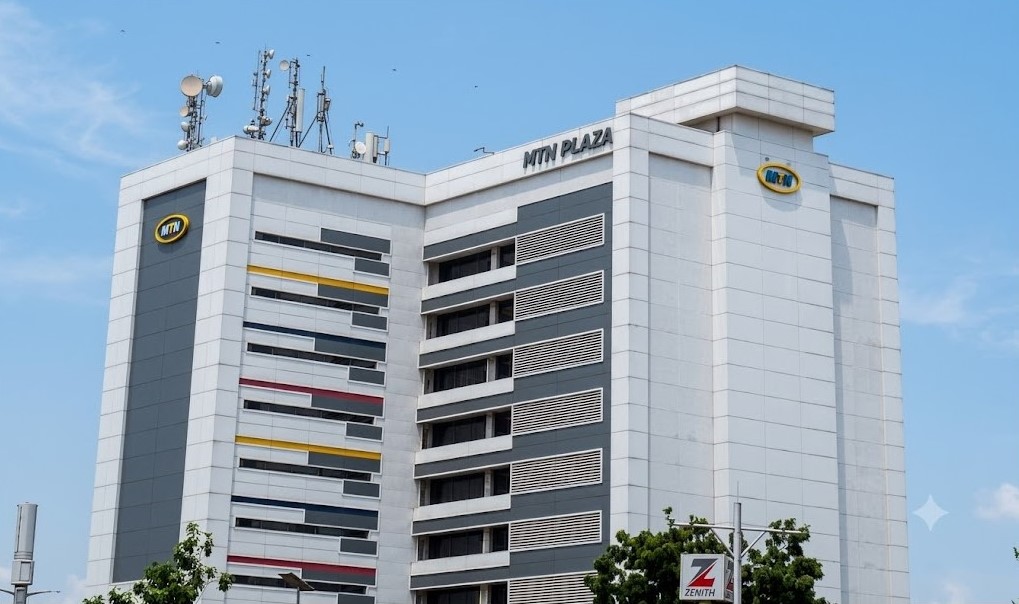
MTN Nigeria building, Ikoyi, Lagos. Image taken on July 6, 2026
Data revenue soars as expected
Internet penetration and the new world of work are major drivers of how Nigerians now spend most of their productive day online. MTN is at the receiving end of that trend.
In the nine months ended September 2025, the operator’s data revenue jumped 35.8% to ₦2.68 trillion, driven by broad-based digital adoption. As a share, data revenue contributed just over 50% of the operator’s earnings during the period.
The growth was attributed to active data users increasing by 12.0% to 57.2 million, and average monthly usage per active data user grew by 16.2% to 15.3GB for the nine months.
Another major driver is the data traffic on MTN’s network, which rose by 30.1%. This means that a higher volume of internet data, video streaming, app usage, and digital communication is flowing through the provider’s infrastructure than before. It shows more users are streaming 4K video, high-definition live streams, and heavy audio files.

An internet user
Speaking of drivers, smartphones connected to the operator’s network rose 12.4% as customers upgraded to 4G- and 5G-capable devices, bringing smartphone penetration to 66.0%.
Another major driver is home broadband, which is becoming an increasingly important contributor to MTN Nigeria’s growth. FibreX, its flagship Fibre to the Home (FTTH) product, now carries approximately 13% of its total data traffic. This means that more data traffic on FTTH is freeing up capacity on the mobile network.
FTTH supports high-speed internet service and has been a pick for households, remote workers, gamers, and businesses that require ultra-fast, reliable, and high-bandwidth internet connectivity. FTTX, another broadband network architecture, is a driver of data traffic. Industry data shows that MTN leads FTTX with 176,468 subscriptions as of Q2 2026, a number that tripled the 56,468 of Fibre One, which is placed second.
Revenue from calls
MTN Nigeria’s voice revenue grew by 11.1% to ₦1.5 trillion, fueled by a 10.9% increase in mobile subscribers to 94.7 million. Voice revenue made up a 32% share of the operator’s earnings during the period, showing that while it’s a secondary contributor, it maintains its relevance to financial growth.
Capex (excluding leases) rose 14.2% to ₦864.8 billion, showing continued push in infrastructural deployment. Specifically, MTN said its investment accelerated in Q3, up 69.1%, as it stepped up its 2026 network rollout, expanding coverage and capacity, improving network quality and supporting home broadband growth.

In the first six months of 2026, MTN Nigeria’s profit after tax hit ₦707.54 billion, a 70.6% jump from ₦414.86 billion a year earlier.
Total revenue grew 25.9% year-on-year to N2.99 trillion, with service revenue, the core measure of the company’s operational performance, rising by the same margin to N2.97 trillion. Profit before tax came in at N1.09 trillion, a 75.4% increase from N622.26 billion in H1 2025.
Also Read: MTN accounts for 52% of 23,396 data depletion complaints against Nigerian telcos in H1’26.