Crypto users have never had a shortage of ways to move money. They have the opposite problem. There are multiple blockchains, stablecoins, wallets, bridges, exchanges, and payment rails. For
Crypto users have never had a shortage of ways to move money.
They have the opposite problem.
There are multiple blockchains, stablecoins, wallets, bridges, exchanges, and payment rails. For experienced users, this flexibility can be powerful. For everyday spending, however, it can introduce unnecessary complexity.
A crypto payment card shouldn't require users to completely rethink how they move funds every time they want to make a purchase.
The problem with single-network funding
USDT is available across multiple blockchain networks.
That flexibility is useful because different networks can offer different characteristics around fees, speed, liquidity, and ecosystem support.
But it creates a practical problem for payment products.
Imagine a user already holds USDT on one supported network. If a payment card accepts deposits only through another network, the user may need to:
- Move the USDT to another network.
- Pay network or transaction fees.
- Wait for the transfer.
- Deposit the funds.
- Finally use the card.
None of these steps actually improve the purchasing experience.
They're simply infrastructure overhead.
Multiple networks can reduce unnecessary friction
A better approach is to let users fund their spending balance through multiple supported networks.
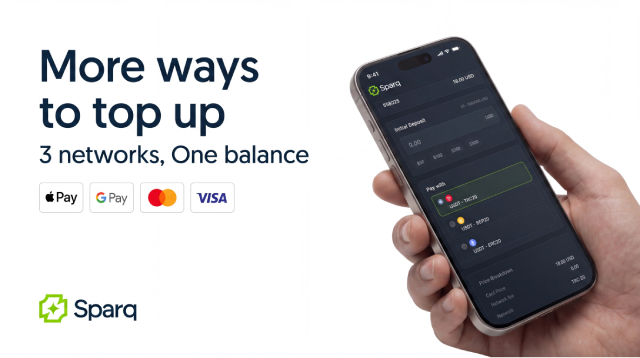
That's the idea behind Sparq's multi-network top-up experience.
Instead of forcing every user into one specific network, Sparq gives users more flexibility when funding their card.
The important part is what happens afterward.
Regardless of the supported network used for the top-up, the user gets a straightforward spending experience through their balance.
Multiple funding paths. One spending experience.
Why this matters for stablecoin payments
Stablecoins are increasingly interesting as a payment medium because they combine blockchain-based settlement with a value designed to remain relatively stable against fiat currencies.
But adoption isn't only about the underlying asset.
It's also about UX.
A payment system can have excellent infrastructure and still feel difficult if users have to understand blockchain networks every time they want to spend.
The winning products will increasingly abstract away unnecessary complexity while preserving the benefits of crypto underneath.
Crypto cards are becoming payment interfaces
The long-term opportunity for crypto cards isn't simply putting a Visa or Mastercard interface on top of crypto.
It's creating a bridge between two very different financial experiences.
On one side:
Wallets, networks, stablecoins and blockchain infrastructure.
On the other:
Restaurants, subscriptions, travel, shopping and everyday payments.
The best payment experience should make the first side almost invisible when the user is interacting with the second.
That's where multi-network funding becomes important.
One balance is a better mental model
Most people don't want to think about which blockchain their money is currently sitting on when they're buying something.
They want to know:
How much can I spend?
A single spending balance provides a much simpler mental model.
Users can think in terms of available spending rather than constantly tracking different networks.
That doesn't eliminate the underlying blockchain infrastructure.
It simply puts the complexity where it belongs — underneath the user experience.
The future of crypto payments is less visible crypto
This may sound counterintuitive.
The more successful crypto payment products become, the less users may need to think about blockchain mechanics during everyday transactions.
Users shouldn't need to understand network infrastructure to buy groceries.
They shouldn't need to understand token standards to pay for dinner.
And they shouldn't have to manually manage multiple payment balances just because their stablecoins exist on different networks.
The infrastructure can remain sophisticated.
The experience should remain simple.
Final thought
Crypto payments don't necessarily need more complexity.
They need better abstraction.
Supporting multiple USDT networks while maintaining a simple spending balance is one example of how payment products can reduce friction between blockchain infrastructure and everyday commerce.
More ways to top up. One balance to spend.
That's the kind of UX that can make crypto feel less like a technology you operate — and more like money you use.