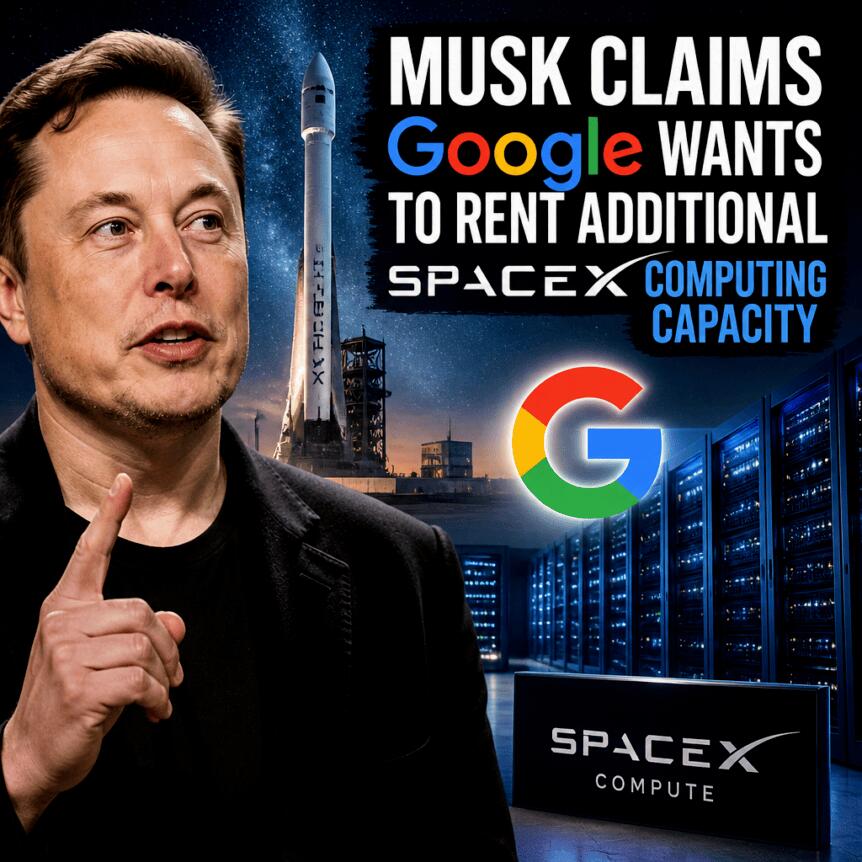
Elon Musk has said Google is interested in renting additional computing capacity from SpaceX, pointing to a fast-growing market for AI infrastructure that is increasingly stretching beyond tr
Elon Musk has said Google is interested in renting additional computing capacity from SpaceX, pointing to a fast-growing market for AI infrastructure that is increasingly stretching beyond traditional data centers. In an X post on Saturday, Musk said the technology giant has “expressed interest” in such a move, without offering further specifics.
The comment comes as SpaceX already has a major cloud-related deal with Google. As Reuters reported, SpaceX has an agreement signed in June under which Google will pay the company $920 million per month from October through June 2029 for cloud services. That contract—and Musk’s latest remarks—highlights how demand for compute is colliding with constraints around where and how quickly new capacity can be built.
Key takeaways
- Musk said Google has “expressed interest” in renting more computing capacity from SpaceX, though no details were provided.
- Reuters reports SpaceX’s June agreement already sets Google payments at $920 million monthly for cloud services through June 2029.
- AI-driven compute growth is pushing companies to seek new ways to deliver processing power, including infrastructure beyond Earth.
- The US FCC authorized SpaceX to deploy up to 1 million satellites for an orbital computing network called “Starmind,” aimed at meeting rising AI data needs.
Google compute demand meets SpaceX’s infrastructure push
While Musk did not outline what “more” computing capacity could mean, his statement fits into a broader pattern: the AI boom has driven rapid expansion in compute demand, leading companies to pour money into data centers and power-intensive infrastructure. Reuters linked this heightened demand to “massive investment in data centers,” and the report notes that a June SpaceX regulatory filing described agreements with Google and Anthropic for computing capacity totaling more than $70 billion.
If Google’s interest goes beyond existing arrangements, it could signal that major AI and cloud customers are looking for additional supply channels as they plan for long-term training and inference needs. For investors and operators, the main question is whether SpaceX’s role is confined to cloud services on the ground—or expands into higher-margin, infrastructure-like services tied to satellites and orbital systems.
What SpaceX’s existing Google deal already covers
Reuters’ reporting adds important context to Musk’s comments. According to the news agency, SpaceX has an agreement signed in June in which Google will pay $920 million each month from October to June 2029 for cloud services. That payment structure underscores that the relationship is not speculative; it is tied to a long runway and substantial recurring revenue.
In this light, Musk’s claim may be best read as an incremental update rather than a brand-new commercial agreement. Still, the market implication is clear: compute capacity is becoming scarce enough, and expensive enough, that large buyers are discussing additional arrangements even while existing commitments are already underway.
From data centers to “orbital computing”
The idea of moving compute beyond Earth’s surface is gaining regulatory traction. Cointelegraph previously reported that the US Federal Communications Commission (FCC) authorized SpaceX to deploy up to 1 million satellites as part of a planned network of orbital data centers. The FCC described the move as historic.
Per an FCC announcement, the satellite constellation—referred to as “Starmind”—is intended to provide orbital computing infrastructure to meet growing demand for AI. The agency said it would be used to process large volumes of data for applications on Earth.
FCC Chairman Brendan Carr characterized the authorization as opening a “new frontier” for computing infrastructure, as SpaceX and other companies pursue methods of relocating data processing capacity away from Earth’s surface. For businesses building AI systems, that matters because latency, bandwidth, and power constraints can all affect total cost and performance. Orbital infrastructure—if scaled and operational—could become another layer in how compute is delivered, potentially complementing rather than fully replacing terrestrial data centers.
Why the timing matters for AI infrastructure planning
Several developments are converging: AI demand is rising quickly, major cloud customers are signing large capacity commitments, and regulators are approving new satellite-based infrastructure concepts. Musk’s statement about Google interest arrives in the middle of that sequence, while Reuters notes that the June SpaceX regulatory filing included agreements involving Google and Anthropic for computing capacity worth more than $70 billion.
What remains uncertain is how quickly any additional rented capacity—beyond current deals—could be delivered and what form it would take. Space-based computing requires not only satellite deployment but also integration with ground systems, network scheduling, and continuous operational reliability. The FCC authorization confirms regulatory permission to proceed at a large scale, but it does not, by itself, guarantee timelines for full commercial capacity.
Even so, the direction of travel is difficult to ignore. The AI sector’s appetite for compute is reshaping infrastructure strategy, and SpaceX’s orbital approach is being framed by regulators as a response to that pressure. If Google’s interest translates into expanding commitments, it could further validate orbital computing as a meaningful part of the future compute supply chain.
Readers should watch for clearer disclosures on what “more computing capacity” would entail—whether it is tied to satellite-based processing, specific throughput commitments, or new phases of existing contracts—and for follow-up regulatory or commercial filings as SpaceX’s orbital network moves from authorization toward operational delivery.
This article was originally published as Musk Claims Google Wants to Rent Additional SpaceX Computing Capacity on Crypto Breaking News – your trusted source for crypto news, Bitcoin news, and blockchain updates.